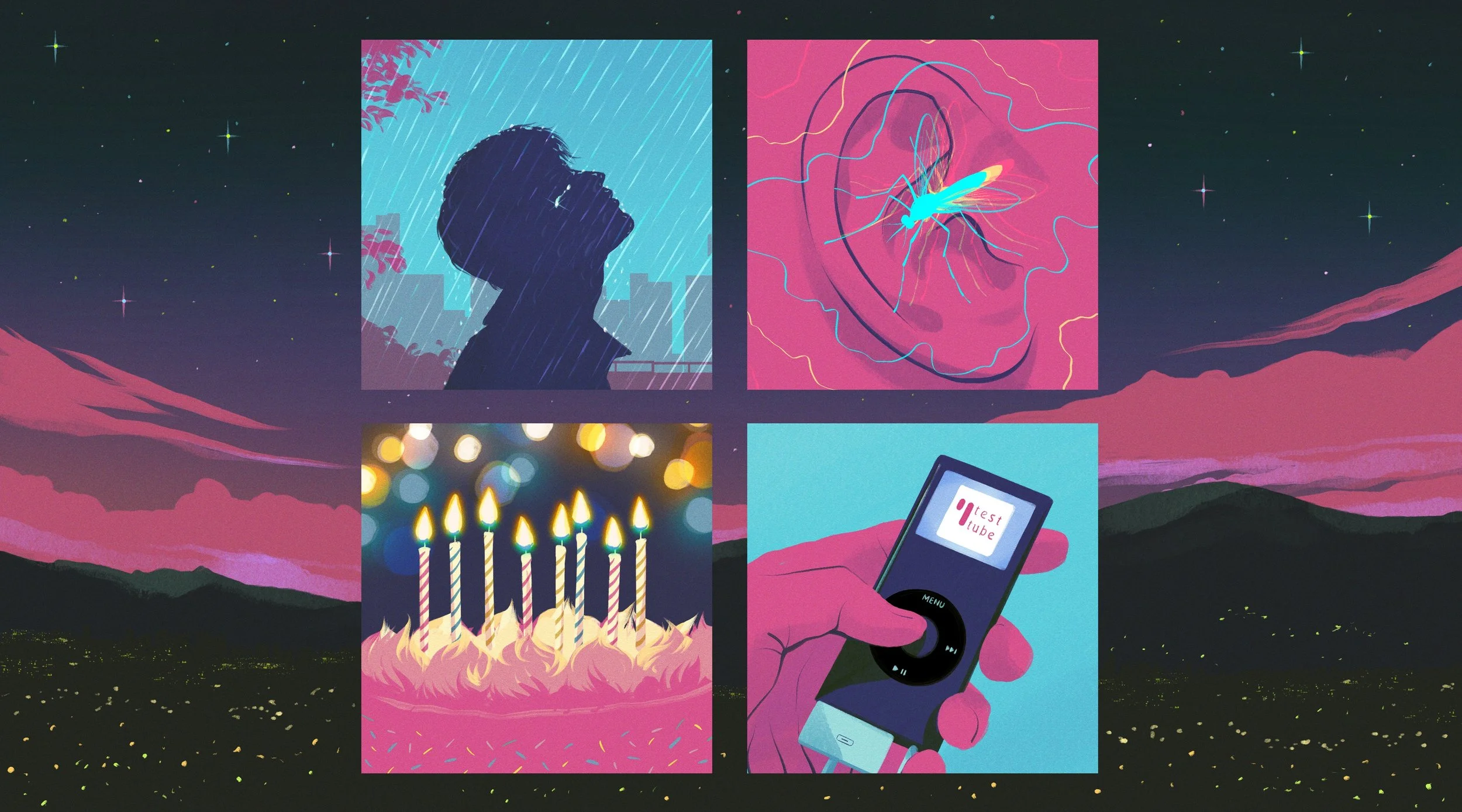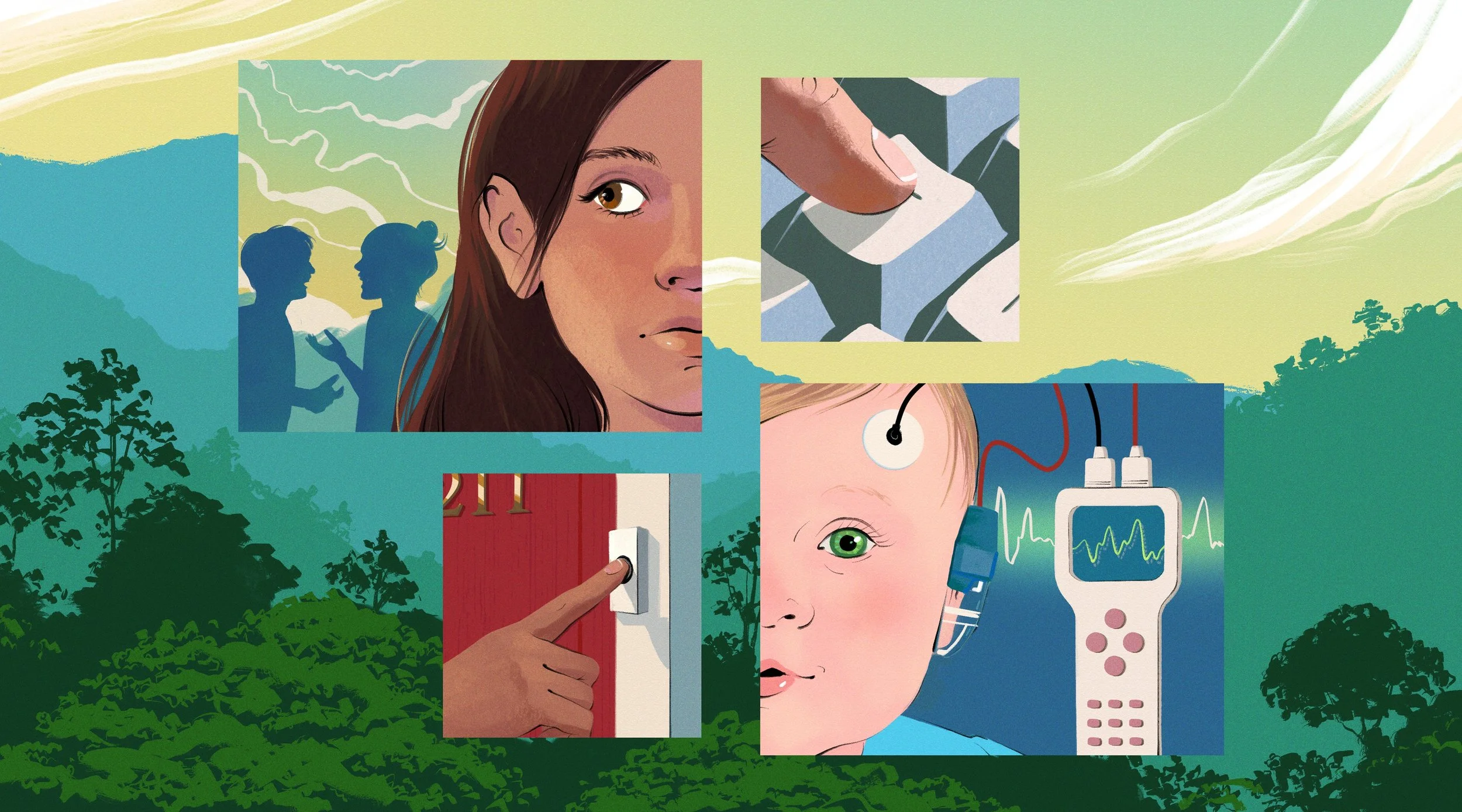
Art by Jon McCormack.
This episode was written and produced by the listeners of Twenty Thousand Hertz.
Our 2026 Listener Story competition continues with five more incredible listener-made pieces. In this Silver collection, you’ll hear the surprising craft behind mechanical keyboards, the natural sounds hidden in Indian ragas, and how learning a new language can transform noise into belonging.
MUSIC FEATURED IN THIS EPISODE
Still Sleeping by Wesley Slover
Just Facts 06 by Wesley Slover
Sandra Robot by Wesley Slover
Twenty Thousand Hertz is produced by Defacto Sound.
Subscribe on YouTube to see our video series.
Follow Dallas on Instagram, TikTok, Facebook, and LinkedIn.
If you know what this week's mystery sound is, tell us at mystery.20k.org.
Support the show and get ad-free episodes at 20k.org/plus.
Listener Links:
Hear Leonardo Barrios’ music under the name Bardø on Spotify.
Learn about Ross Maddox’s work testing the hearing of babies at maddoxlab.org.
Explore Nathaniel Harrison’s work with Shore 3 Studios.
Hear Vicki Hansen’s music under the name Indiajiva on Youtube and Spotify.
Try NetSuite Next for free at netsuite.ai/20k.
Shopify: Own your customer relationships. Own your revenue. Start with a free trial at shopify.com/20k
View Transcript ▶︎
[20K sonic logo]
[music in: Wesley Slover - Morning Arrival]
Okay, I wanna let you in on a secret. I also don't love the sound of my voice, and after ten years of making this show, I get so tired of hearing me all the time. One of my favorite things about Twenty Thousand Hertz is when I hear what other people share what sound means to them.
So with that in mind, last year, we started a Listener Story competition, where we play short, fully produced sound stories made by you, our listeners. In other words, they're mini Twenty Thousand Hertz episodes.
Last year was so successful that we just decided, "We're gonna do this every year." So this year, we received 34 incredible stories, and collected the finalists into three episodes. This episode is from the second group, which is what we're calling the Silver Collection. The Gold Collection will follow in a few weeks.
Enjoy.
[music out]
Story 1, by Leonardo
Leonardo: When you start making music as a teenager, you're not thinking about contracts. You're thinking about who's bringing the speaker, who's staying up all night finishing the song. That's what La 211, our band, was for us. Not a company, not a brand, just home.
Leonardo: Most people never even knew why we were called La 211. It was just Saul's house number. But somehow, that house became the center of our lives. You'd pull up at, like, 6:00 PM, and suddenly it was 4:00 in the morning and nobody had gone home. Half of the room would be trying to make songs. The other half would be playing FIFA, ordering Uber Eats, arguing over dumb stuff.
Leonardo: But somewhere in the middle of all of that chaos, a movement started happening. At first, it was just friends supporting friends. Then random people started recognizing us, not just online either, like strangers at parties walking up to us saying, "Yo, you guys are Lelo Sonse, right?"
Leonardo: And the crazy part is people connected with us because we didn't feel polished. We felt reachable. Like, if someone came up to us at a show, they weren't meeting artists, they were just meeting us. Then we met 40, and suddenly everything started to feel bigger. Better visuals, studio sessions every week, actual opportunities.
Leonardo: I remember one of our first sold out shows, 10 minutes before doors opened, power died. And outside, it was absolutely pouring rain. I remember running through the back of the venue trying to connect a generator in the middle of the storm, and the generator didn't even work. But somehow people still came back the next day. That was probably the first moment where we all looked at each other like, "Okay, this might actually become something real."
Leonardo: Looking back, that's also around the time things started changing. Not dramatically at first, just little moments, conversations turning into decisions before everyone even talked about them, questions getting answered with, "Oh, we'll see later."
Leonardo: I remember this one moment super clearly. We had this song called "Passos." And Marco, one of our closest friends, had a verse in it. He'd been practicing that verse for weeks. One day, we get to the studio, 40 plays the updated version, and Marco's part is just gone. No conversation, no warning, nothing. And I think that was one of the first times where the room felt weird.
Leonardo: Eventually, the group started splitting up. Some people wanted to keep chasing the opportunity. Others started feeling like the opportunity was chasing us. And honestly, what scared me wasn't losing the project. It was realizing our friendships were starting to feel transactional. The last day we left the studio, nobody fought, but the energy in the room felt heavy, like everybody already knew things were never going back to normal.
Leonardo: Not long after that, my cousin Omar told me a well known music label wanted to hear my music, so I sent everything over. A few days later, I walked into their studio in my hometown, Guadalajara, Jalisco, and my Spotify page was already pulled up on the screens waiting for me. And I'm not gonna lie, after everything we had gone through, that moment felt surreal.
Leonardo: But more than anything, it felt transparent. Nobody dodged conversations. Nobody made vague promises. Nobody treated me like I was replaceable. And after living through the opposite, that meant everything to me. I'm grateful things worked out the way they did, but sometimes I still miss that house. I miss making songs until sunrise. I miss all of us being in the same room. I miss when none of this felt like business yet.
Leonardo: So if you're chasing music, protect your work, protect your name, but most importantly, try to not lose the people that made you fall in love with it in the first place.
Leonardo: This podcast was written, narrated, and sound designed by Leonardo Barrios. You can find my music under Bardø, that's Bardø with a crossed O, on all streaming platforms. Thank you for listening.
Story 2, by Ross
Ross: This is the story of a sound, your response to it, and how that response, or lack thereof, can have a major impact on your life. The sound is usually referred to as a one hundred microsecond click. The click part of that name is fairly obvious. The one hundred microsecond part means it is really short, one tenth of one thousandth of one second.
Ross: You may not have noticed, or may have thought it was an audio glitch, but the sound has actually been played several times already in this story. Here it is one more time in all its glory.
Ross: Why do we care about this sound? Well, if you're below a certain age, you've likely heard it before today, several thousand times in fact, when you were only a few days old. We use this sound to screen newborn babies' hearing.
Ross: You've probably had a hearing test at some point in your life. Low and high frequency tones are played, and you have to tell the tester you've heard them by pressing a button, or maybe raising your hand as the tones get softer and softer. But newborns are not that cooperative, so we have to take a different approach. We ask their brain directly if it heard the sound by measuring what's called the auditory brainstem response.
Ross: The auditory brainstem response, or ABR, is what it sounds like. It is a test of how your auditory system responds after hearing a sound, like our 100-microsecond click. The ABR is a super fast series of voltage waves, much like what a microphone sends down a cable when its diaphragm vibrates.
Ross: We measure these waves with special electrode stickers that we put on the baby's head. Each wave comes from a different part of the brain with arcane Latin names like "inferior colliculus" and "lateral lemniscus." More important than what the waves look like or where they come from, though, is simply whether or not we see them at all.
Ross: But even that is tricky, because the ABR is tiny and the measurements are noisy. The biggest source of noise when measuring the brain is the brain itself. Think of it as a party. There's all kinds of stuff going on in a newborn's brain, wondering who all these new people are, realizing it's time for some milk, and even just regulating breathing, a newfound responsibility.
Ross: Everything the brain does produces voltages like the ABR, and they all show up on top of each other in the measurements. So much like at a noisy party, we have to ask the brain to repeat itself. We click, it responds, we say, "What was that?" by clicking again, etc. Luckily, we can click around 20 to 40 times per second, which sounds like this.
Ross: So the test only takes a few minutes. After a few thousand repetitions, we have a nice picture of the ABR. Or we don't.
Ross: If we don't see anything, the baby does not pass the screening and is referred for further testing. In some cases, their hearing turns out to be fine. In others, we might find some degree of hearing loss and get them hearing aids. When there's no hearing detected at the follow-up, parents may decide to get cochlear implants, or plan to use sign language, or both.
Ross: Getting the right kind of intervention when needed can have a huge impact on how a child learns and develops later in life. It's why, since the early 1990s, there have been efforts in the US to make newborn infant hearing screening universal. These efforts have been hugely successful, with 98% of infants now having their hearing screened before one month of age.
Ross: And that's how our click, at a mere 100 microseconds long, can have effects that last a lifetime.
Ross: This audio story was written and recorded by me, Ross Maddox. I'm a scientist at the Kresge Hearing Research Institute at the University of Michigan, Ann Arbor. Among other things, my lab is working on faster and more accurate ways to test babies' hearing. If you would like to learn more, please visit our website at maddoxlab.org.
Story 3, by Vivian
Vivian: My experience with sound. Have you ever felt like everyone around you was talking, but none of it was meant for you? When you grow up in a family where no one your age speaks your language, it can feel isolating.
Vivian: As a kid, I lived in Baja while my cousins lived all over California. Whenever they visited, we would play together, and the truth is, kids always find a way to communicate. With dolls, with games, with gestures. Words aren't always necessary.
Vivian: But I remember very clearly how it felt when they started talking to each other in English. Suddenly, I was outside the conversation. I didn't understand what they were saying. I remember hearing what I can only describe now as a cocktail party effect. All the voices blending together, overwhelming, almost slowing everything down.
Vivian: I felt frustrated, small. I just wanted to go home and talk to someone who understood me. I don't remember the exact moment when I began understanding English. It wasn't instant. It happened slowly. Every visit, every conversation, every song. Little by little, the noise became words. The words became meaningful, and then something shifted.
Vivian: Fast-forward a few years, and I was ahead of almost everyone in my class in English. I even joined a music academy, and I was assigned the English songs because I had the best pronunciation.
Vivian: For the first time, something that once made me feel excluded became my strength. My family would talk about how impressed they were with my speaking skills, especially compared to my cousins who could barely speak Spanish. It felt good. It felt like an ego boost, like I had turned confusion into power.
Vivian: That confidence lasted until middle school. I started dating someone who had grown up in San Diego. Whenever I spoke English, he would stop me mid-sentence to correct my pronunciation. Sometimes he would laugh, sometimes he would make fun of me, and slowly I began to doubt myself.
Vivian: The language that once felt like a bridge started to feel fragile again. I avoided speaking unless it was necessary. I became hyper-aware of every sound that left my mouth. Every word felt like a test. Sounds stopped feeling empowering, and started feeling risky.
Vivian: But here's the surprising part. Even during that time, I realized something. I could remember exact sounds from my childhood, the tone of certain voices, the rhythm of English before I even understood it. I didn't just hear language, I felt it, just like music. The sound of that language and all the exclusion, excitement, insecurity, and identity that came with it became part of that music too, and somehow that made it beautiful.
Vivian: I realized my relationship with English was never really about being perfect. It was about emotion, about memory, about belonging. Today, when I think about sound, I don't just think about audio. I think about that little kid hearing noise she couldn't understand, and I think about how she eventually turned that noise into music.
Vivian: I would like to say a quick thank you to everyone that made this episode happen. My teachers at Tech de Monterrey Guadalajara, Jesse Herrera, and my cousins Michelle and Gigi, who recorded background voices to help with the authenticity of the sounds.
[music in: Wesley Slover - Just Facts 06]
After the break, sculpting a sound that many of us hear thousands of times a day... And, learning the ancient music of the forest.
[music out]
***MIDROLL***
Story 4, by Nathaniel
Nathaniel: Every job has a sound, or maybe more accurately, a soundscape. Some are loud, some are urgent, and others just fade into the background. In an office, the sound of work is a constant quiet rhythm, repeating itself thousands of times a day. Computer startups, hard drives spinning, mouse clicks, but often the most repeated sound is this.
Nathaniel: Like a lot of people, it was a sound I used to ignore until one small thing changed.
Adam: I'm a software engineer. I tell people I type for a living.
Nathaniel: That's my friend Adam. He's the one who got me into mechanical keyboards.
Adam: When I lived in Dallas, one of my coworkers always had a mechanical keyboard. As soon as I tried one of his, I was like, "I gotta get one."
Nathaniel: One day, Adam let me try a few of his own keyboards, different switches, different builds, all of them better than what I was used to. But then he handed me one more. It felt different. It sounded different. There was something about it, the weight, the tone, the way each key press landed. It felt intentional.
Samara: Most of our users are either programmers, or creators, or people who just spend hours just typing every day.
Nathaniel: Samara works at NuPhy, a keyboard design company.
Samara: For NuPhy, sounds is never just an accessory to the keyboard. If a tool is something you interact with tens of thousands of time every day, it shouldn't just feel good, it should sound good, too.
Nathaniel: Sometimes their team draws inspiration from the sounds of everyday life, like rainfall, animal noises, or different subtle textures of the world around them.
Samara: Working in the keyboard industry has really made me think more deeply about everyday sounds. I simultaneously analyze the frequency of the sounds around me all the time. Whenever I'm hearing things outside of the office, it will trigger some thought that probably we can make these sounds.
Nathaniel: Samara says that their development team basically gets to work in a playground for keyboard enthusiasts. They engineer their own switches, gasket mounts, and experiment with different materials to get the sound that they're after.
Samara: Switches are always the most important because they're the sound producing unit.
Nathaniel: And there are a lot of switches out there, and that's probably the part of a mechanical keyboard that most people are familiar with. There are tactile switches, which add an audible click sound when they're pressed. There are linear switches that don't add any sound.
Nathaniel: And there are silent switches, which are engineered for people who want a very quiet typing experience. But it's not just good enough to have a good sounding switch. You have to shape that sound, too.
Samara: Materials are kind of like the wood used in a musical instrument. They shape the character of the sounds.
Nathaniel: You can kind of think of a switch as the string on a guitar or the tine on a kalimba. It produces the sound, but the construction and the materials are what shape it. There are special types of foam that are built into the keyboard that filter out high, harsher frequencies and denser plastics and metals that emphasize deeper and warmer tones.
Nathaniel: When you combine all of those elements together, you get something that sounds intentional. It wasn't an afterthought. It was crafted from the beginning. When you look at it closely, a keyboard can be a pretty complex thing. Switches, materials, construction, all carefully designed, but what all of that really shapes is a sound, a sound people like me hear thousands of times a day.
Adam: I would say if you have a chance to try a mechanical keyboard, you should try it. Because you can, you can say all of this, but when you pick one up and type on it, it's a whole thing.
Nathaniel: Sound shapes our daily experience, and for a long time, the sound of my keyboard was just a background noise, something I tuned out. But when that sound is designed, when it's given care, attention, and intention, it changes something. And whether it's an office, a workshop, a kitchen, every place we work has its own soundscape. Sometimes paying attention to those sounds can reveal simple ways to transform even the smallest parts of our day.
Nathaniel: What used to feel routine, a little uninspiring, became something I actually enjoy. A little detail, a different keyboard, but it turned something I ignored into something I look forward to.
Nathaniel: This episode was created at Shore 3 Studios. Editing, music, and mixing by Nathaniel Harrison, with special thanks to my friend Adam and Samara at NuPhy. Thanks for listening.
Story 5, by Vicki
Vicki: The Forest that sang: the ancient origins of the Indian raga. Thousands of years ago, a group of forest-dwelling sages in ancient India called rishis spent a lot of time listening, not to each other, to the world around them, the animals, the wind, the rain. And what they heard became the foundation of one of the most sophisticated musical systems ever developed.
Vicki: This is the story of how a peacock's cry became a musical note, and how that idea eventually gave rise to the Indian raga. The ancient Indian musical scale is called the saptak. It has seven notes: sa, re, ga, ma, pa, dha, ni, which map roughly to the do, re, mi scale most of us grew up with.
Vicki: But according to ancient tradition, these notes weren't invented. They were heard first in the sounds of specific animals.
Vicki: Sa, the tonic, the note everything else revolves around, came from the cry of the peacock.
Vicki: Re from the bull, whose strength reflects how close it sits to the root note.
Vicki: But also from the skylark, whose plaintive song carries a quality of longing.
Vicki: Ga, the third note, from the humble bleat of a goat, earthy and warm.
Vicki: Ma, the fourth, from the heron, a mournful searching call.
Vicki: Pa, the fifth and the most naturally harmonious note after Sa from the bright, clear song of the Indian cuckoo.
Vicki: Da from the horse, or depending on the tradition, the chorus of monsoon frogs.
Vicki: And ni, the seventh, from the elephant: low, resonant, and unresolved, always pulling back towards home.
Vicki: From these seven notes, Indian classical musicians built something called a raga. The word comes from the Sanskrit root meaning "to color" or "to tinge."
Vicki: A raga isn't quite a melody, and it isn't quite a scale. It's more like a set of rules governing how a musician moves through certain notes, which ones to emphasize, which to approach only from above, never from below, and how long to linger on each one. There are hundreds of ragas, and each one is traditionally assigned to a specific time of the day, and even a season.
Vicki: Raag Bhairav is played at dawn.
Vicki: Raag Yaman in the early evening.
Vicki: The idea is that different emotional qualities belong to different times, and the music should reflect that. What is important about this story, the peacock's cry becoming sa, the cuckoo call becoming pa, is what it assumes about sound. It assumes the world is already musical, that nature didn't just inspire human music. Nature is the music. We've just been learning to hear it.
Vicki: The rishis didn't sit down and design a scale. They sat still and listened for years until the forest taught them. Maybe that's the oldest definition of a musician. Not someone who makes sound, but someone who finally, carefully, pays attention to the sound that was already there.
Vicki: My name is Vicki Hansen, and our music is recorded under the name Indiajiva, which you can find on Spotify and Youtube.
[music in: Wesley Slover - Sandra Robot]
Twenty Thousand Hertz is produced out of my sound agency, Defacto Sound. Hear more by following Defacto Sound on Instagram, or by visiting Defacto Sound dot com.
Vicki: This episode was written and produced by the wonderful listeners of Twenty Thousand Hertz.
Other Voices: It was story edited by Casey Emmerling, with help from Grace East. It was sound designed and mixed by Jade Dickey, with original music by Wesley Slover.
Thanks to everyone who submitted a story for this year's Listener Story competition. I get so much joy out of hearing your stories.
Finally, take a moment to subscribe to my Youtube channel Dallas Taylor dot mp3, where I go behind the scenes at amazing audio locations around the world. You can also find me on Instagram and TikTok under that same name, Dallas Taylor dot mp3.
Thanks for listening.
[music out]