Art by Michael Zhang.
This episode was written & produced by Casey Emmerling.
In Part 2 of our deep dive into needle drops, Dallas, Casey and Grace uncover more surprising stories behind some of cinema’s most unforgettable song choices. From a fiercely contested track that became a ‘90s comedy staple, to Quentin Tarantino’s habit of raiding old movie soundtracks, these pairings often took strange and unexpected paths to the screen. Along the way, they explore the hidden world of Music Supervision, impossible price tags, and the controversy around musical “soundalikes.”
MUSIC FEATURED IN THIS EPISODE
James Carr - Sweet Midnight
Gerhard Feng - Let's Do It This Way
Wesley Slover - Not Quite Summer
OTE - Your World On My Shoulders
Ryan James Carr - When I'm Gone
Twenty Thousand Hertz is produced by Defacto Sound.
Subscribe on YouTube to see our video series.
Follow Dallas on Instagram, TikTok, Facebook, and LinkedIn.
If you know what this week's mystery sound is, tell us at mystery.20k.org.
Automate your expenses with Ramp and get $250 off at ramp.com/20k.
Get three months of free payroll with Gusto at gusto.com/20k.
Get NetSuite's free business guide, "Aligning for the Agentic Era: How AI Is Changing Everyday Work," at netsuite.com/20k.
View Transcript ▶︎
[20k sonic logo]
[music in: Ryan James Carr - Sweet Midnight]
Casey: Alright. So are we ready to roll?
Dallas: I'm already rolling.
Grace: Let’s do it.
Dallas: I've been rolling.
Grace: I'm rolling, too.
Our last episode was a discussion between me, our Supervising Producer Casey, and Defacto Sounds producer, Grace. In it, Casey walked Grace and I through the early history of needle drops, which are popular songs used in movies or TV shows.
Casey: So in part one, we left off at the end of the 1980s, and that was right around the time that the job of Music Supervisor was starting to become more common in Hollywood.
[music out]
Casey: So Dallas, do you wanna describe what a Music Supervisor is?
Dallas: Okay, so Music Supervisor is the person responsible for... kind of the business and the operations of getting music into some sort of media. Whether it be movies, TV, video games, they're the ones that are executing the plan.
Dallas: Many of them also work heavily on actually curating that music, too. And so it's this hybrid role sits between creative and operations, and uh, working directly with the artist to either create music, or acquire music.
Casey: Yeah, that's a great definition. So here's a clip of Music Supervisor Mary Ramos. Mary has been Quentin Tarantino's Music Supervisor for many years, among others. And here she is on Deadline's Crew Call podcast describing what people with that job do.
[music in: Gerhard Feng - Let's Do It This Way]
Mary Ramos: We are responsible for all musical aspects of a film or a television show. And every project is different, and every director or showrunner is different. And so some of them have come to the project with full-on ideas about what they want. Some, you can come on and really help shape the story and help shape the world, and the style, and everything with suggestions about songs, and about overall concept, and about composers.
Casey: So once the edit of a film or TV episode is decently far along, the Music Supervisor and director and composer will do something called spotting, where they go through the rough cut and they say, "There should be score here. There should be a song here. Let's try both a song and score music here and see what works better."
Casey: It's also important to decide where there should be no music, because sometimes music can be a crutch or feel overly directive of how the audience is supposed to feel at any given time.
[music out]
Casey: Dallas, I know you have strong feelings about this. Do you wanna comment on that?
Dallas: Yeah. I've worked on projects where music sometimes does more harm than good. Imagine that you're doing a documentary that has a global appeal. We all have our unconscious bias of what types of music make us feel a certain way. And so as filmmakers, you may want to put what you think the vibe should feel like, because that's how you would be affected by that music.
Dallas: But music is so unbelievably subjective that it might not come across that way at all to someone in India or Japan, and it might actually get in the way of them processing the feelings that you're trying to emote through your story.
Dallas: So some of the best documentaries I've ever worked on, we've pulled music in the final mix. Because when you don't have music, it forces you to experience what's happening in real time without any foreshadowing, without any telling you of how you're supposed to feel. 'Cause that constant emotional pull in telling you how to feel can also have its own subtle exhaustion.
Grace: I feel like that's so true in like, written work, too, like the canonical “Show, don't tell," and I feel like that's like the editorial version of that.
Casey: Right. But when filmmakers do decide to use a needle drop, sometimes there will already be a song suggested in the script or the director will already know what song they intend to use.
Casey: For instance, in the early '90s, there was a very famous needle drop that I'm sure you'll know as soon as I play it, so go ahead and shout it out as soon as you do.
[clip in: Wayne’s World]
Dallas: It’s Queen, and it's from the… Wayne's World.
Grace: [Singing]
Casey: You got it.
Dallas: Yeah.
Grace: [Singing]
[clip out]
Casey: So that was "Bohemian Rhapsody" by Queen as featured in Wayne's World. Grace, do you wanna describe what's going on in that scene?
Grace: Okay. I have never seen Wayne's World.
Casey: Whaaat? [sfx: alert sound]
Dallas: We need a reaction video now.
Grace: I know! It's shocking. You now all know my dark secret. I've never seen Wayne's World.
Casey: Okay, Dallas, do you want to describe what's going on in that scene?
Dallas: Okay, so Wayne's World came from an SNL skit that then got expanded into a movie.
Casey: Yeah.
Dallas: Wayne and Garth are just kind of your everyman late teen/early 20s, normal, I think Midwestern dudes. And they're super into, like, hard rock.
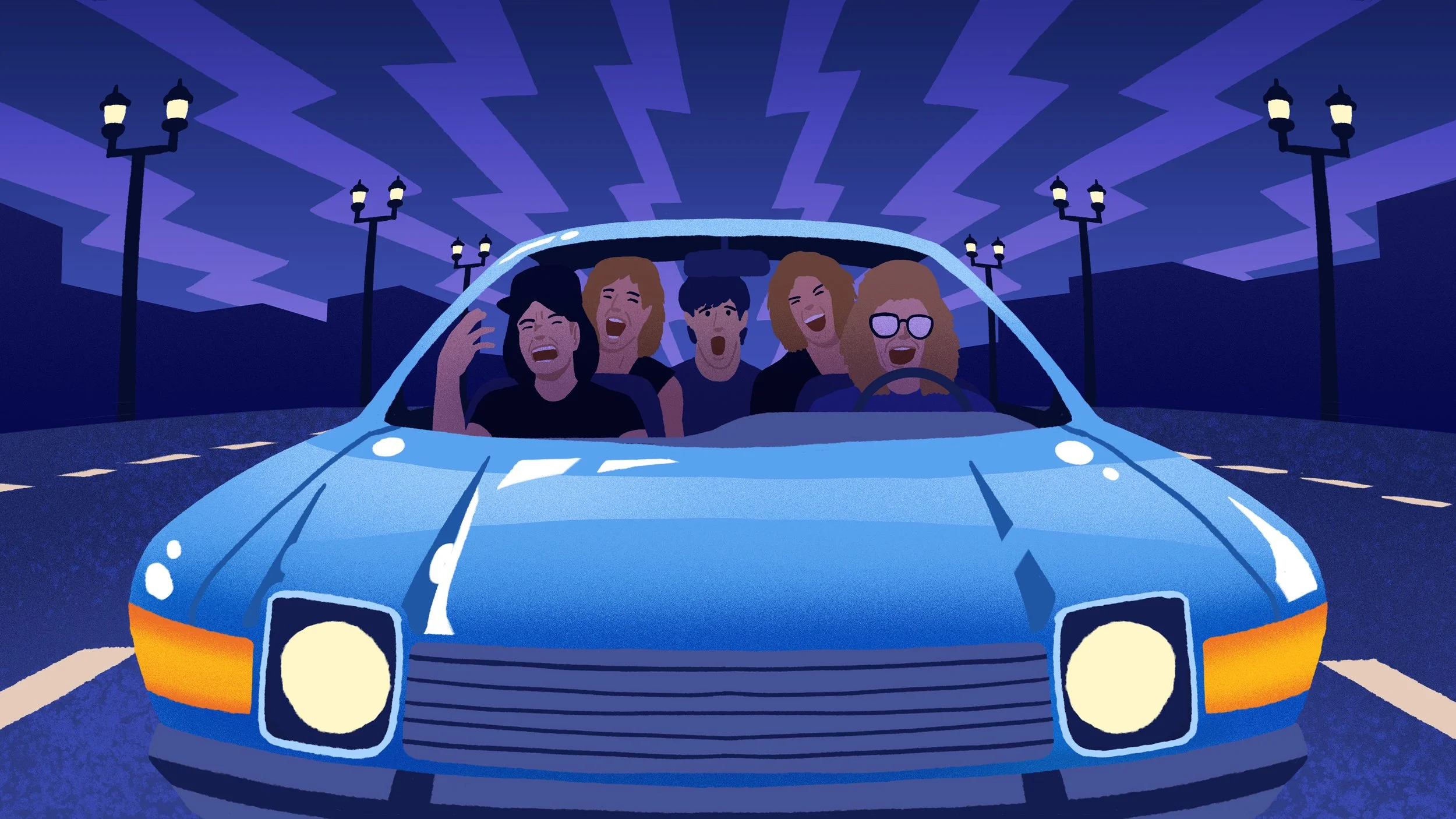
Dallas: And in this scene in particular, it's Wayne, Garth, and I think there's, like, two of their buddies in the back. And I don't know, they're just, like, nerding out on how great this track of music is, and they're all lip syncing it, and then eventually they just, like, all start head banging together. Incredibly iconic scene in movie history.
Grace: I have to go watch this immediately.
Casey: You definitely need to watch Wayne's World.
Casey: So Mike Myers, who co-wrote Wayne's World, knew that was the song he wanted for that scene, and he wrote it into the script. As he told Rolling Stone, quote,
Casey: "I grew up in Scarborough, Ontario, of British parents. I'd gone to England in '75 with my family and heard “Bohemian Rhapsody” on the radio. We were obsessed with it. Me and my brother, our friend's car was a powder blue Dodge Dart Swinger that had a vomit stain on the side of it where someone chiseled it into the shape of Elvis Presley.
Casey: We’d drive down the Don Valley Parkway listening to Bohemian Rhapsody. We would time it to enter the Toronto city limits when the rocking part would kick in. I was “Galileo” three of five. If I took somebody else's “Galileo,” or somebody took mine, a fight would ensue.
Casey: It's just something that I always back-pocketed. Wayne's World was my childhood. I only knew to write what I knew."
Dallas: Aww.
Grace: Oh, that's amazing.
Casey: But at that time in the early '90s, Queen was not a super hot, you know, popular radio artist. So the producers of Wayne's World, including Lorne Michaels, wanted to use a Guns N' Roses song instead.
[music sneaks in: Guns N' Roses - Paradise City]
Grace: Ohh.
Casey: Mike Myers says he doesn't remember which song, but you could sort of imagine it being something like “Paradise City.”
[music up, then under]
Dallas: It-it could have worked, but it wouldn't have been as classic.
Casey: Exactly.
Grace: Totally.
Casey: And Mike liked Guns N' Roses, but it wasn't what he knew from growing up. So here he is telling the story to Stephen Colbert.
Mike Meyers: So I f–really fought hard for that to be the song, “Bohemian Rhapsody,” to the point, uh, 'cause I, you know, I'm not very bright sometimes, I went, "I don't wanna be in the movie if that's it." And Lorne Michaels was like, "Let me get this straight. You've never been in a movie, you're not likely to be in a movie, and now you're not gonna be in a movie."
Casey: I like how Mike Meyers' impression of Lorne Michaels is just Dr. Evil.
[clip: Austin Powers]
Dr. Evil: I’m going to place him in an easily-escapable situation involving an overly-elaborate and exotic death.
Grace: I was literally just about to say, “that sounds very familiar.” Lorne laying down the hammer.
Casey: Yeah.
Casey: But apparently Lorne eventually gave in and said, "If you feel that strongly about it, we can use Bohemian Rhapsody," and they did. And it was a hilarious scene, and it also sent Bohemian Rhapsody up to number two on the Billboard charts, which was actually higher than it charted in the '70s.
Grace: Wow.
Dallas: Well, not only that, but I remember that time when it came out, and Guns N' Roses was, like, very pop famous at this point, so it would have made sense. But Queen was obscure enough that part of that story was like, "These are really nerdy rock dudes." So it almost felt dated, but in a "I-know-my-rock-history" type of way.
Dallas: So that's why Guns N' Roses would not have worked, but Queen worked perfectly, and I think that's exactly what, like, Mike Myers was getting at.
Casey: Totally. And I think the, you know… the operatic flamboyance of that song adds a whole extra fun layer to these like rocker heavy metal dudes.
Grace: Yeah.
Casey: But going back to Music Supervisors, for a period movie, they might immerse themselves in what was popular during that time period. For example, Music Supervisor Randall Poster had a really cool approach for the show Boardwalk Empire. Have you seen that?
Dallas: I have not. I've always wanted to, though.
Grace: I have not. Same. It's on my list.
Casey: Yeah, super good show. But yeah, it's a crime drama set during Prohibition starring Steve Buscemi. But recorded music from the 1920s is all pretty scratchy and lo-fi, of course. So here's a 1921 song called "Make Believe."
[clip: Nora Bayes - Make Believe]
Grace: Such a vibe.
Dallas: It is. I love that.
Grace: I love when you can hear the artifact of the technology on the recording. It's just so cool.
Casey: Totally. And there definitely are some songs like that in Boardwalk Empire, but you can understand why they wouldn't necessarily wanna score every scene with music of that kind of fidelity.
Grace: Yeah.
Casey: And so the Music Supervisor, Randall Poster, connected with this guy, Vince Giordano. He's a band leader of a group called The Nighthawks that specialize in 1920s and '30s jazz.
Dallas: I have seen him live.
Casey: Oh really? Cool.
Dallas: Yeah.
Grace: What? That’s so cool.
Casey: How was it?
Dallas: Incredible.
Casey: Do you want to describe how you would describe Vince Giordano and The Night Hawks?
Dallas: Uh, I think it's a Big Band, one. If you could just see that picture you know, kind of classic Big Band. And then I really feel like “Vince Giordano and The Nighthawks” really describe it better than any words that I could describe. I think you get it.
Casey: Sure. Yeah.
Grace: I was gonna say, I've never seen a picture of them, but I already kind of what they probably look like.
Dallas: It–that's exactly, yeah.
Grace: That’s amazing.
Casey: Yeah. So for the show, the Nighthawks re-recorded a bunch of songs from the '20s, and they had famous singers like Elvis Costello and St. Vincent and Neko Case record the vocals. And that was how they crafted the soundtrack of that show.
Grace: No way!
Casey: So here's St. Vincent singing that same song that we just heard, "Make Believe."
[clip: St. Vincent - Make Believe]
Dallas: Oh I love that.
Grace: That’s so cool.
Casey: Yeah, a really cool approach.
Casey: So some filmmakers are known for having really strong “music design,” quote unquote, where the needle drops are really at the forefront and given a lot of attention, like the background sound cuts out and the song comes in at full volume. Maybe the characters are in slow motion while the music plays.
Casey: So I'm gonna play you a little montage of songs that have appeared in movies by one specific director, and see if you can name that director,
Grace: Ooh, okay.
[montage of needle drops]
Dallas: Oh, Ca- um, yeah, Cameron, um, James, no. Um… Yeah, it's the guy who did Almost Famous.
Casey: Nope.
Dallas: Oh, okay. I was so convinced on that that I didn't really pay much attention after that. I'm sorry.
Casey: That's all right. Can you name another famous director with a very particular visual style?
Grace: Is it–is it Wes Anderson?
Casey: You got it.
Dallas: Ah, wow.
Grace: Okay, I was second-guessing myself 'cause that, the second French song, I was like, "Oh, that sounds just like a Wes Anderson movie." But then I was like, "No, it couldn't be."
Dallas: Oh, that makes sense.
Casey: So those songs were all in Wes Anderson movies. In order, the songs were in Rushmore, Moonrise Kingdom, The Darjeeling Limited, and The Royal Tenenbaums.
Grace: Yes! Okay, got it. Yep.
Casey: But Wes Anderson's go-to Music Supervisor is Randall Poster, who we just heard about for Boardwalk Empire.
Casey: So here's a good interaction between him and podcaster Justin Jay. Justin is asking Randall about his song selection process.
Justin Jay: Do you still have a back pocket full of these gems, or do you find it harder and harder to kind of mine music from the past that people aren't familiar with?
Randall Poster: You know, I've talked about that Wes and I keep a safe of songs under lock and key waiting for the right moment. So I certainly have songs that I've been itching to use in movies, mostly for Wes.
Dallas: Hmm.
Casey: I wanna hear that playlist.
Dallas: Yeah.
Grace: Me too!
Casey: Another thing to consider is if you use a popular song, people will know it and already have opinions about it, which could be good and you can borrow off of those positive feelings, but it could also be bad, like they're sick of hearing that song, and so when they hear it in a movie, they get annoyed.
Grace: Hmm.
Casey: For example, here's Randall Poster again talking about using The Beatles in a soundtrack.
Randall Poster: To me, like The Beatles are kryptonite, right? It's like too many associations, too overpowering, just too meaningful in different ways to people.
Dallas: I agree.
Casey: Now having said that, Wes Anderson and Randall Poster did use "Hey Jude" for the opening scene of The Royal Tenenbaums. In early screenings, they used the original Beatles recording, but then George Harrison passed away, and it made licensing the song difficult.
Casey: So they eventually swapped it out for an instrumental cover by composer Mark Mothersbaugh, which arguably worked even better since it feels more unique to the movie.
[clip: The Royal Tenenbaums]
Narrator: Royal Tenenbaum bought the house on Archer Avenue in the winter of his thirty fifth year. Over the next decade, he and his wife had three children, and then they separated.
Casey: So using a famous song can be kind of a double-edged sword. On the other hand, if you pick something obscure, then people can experience both the song and the scene for the first time together.
Casey: But Randall Poster also points out how your own personal opinion of a song shouldn't necessarily cloud your judgment as a filmmaker.
Randall Poster: And often too, sometimes it's like, it's funny it’s with, you know, people have assoc- like directors or editors or producers that you're working with, they have, you know, it's like, "Oh, I hate that song. I hate that song. I always hated that song." And I have to sometimes say, "You can put a song you hate into a movie. It's okay to hate it, you know? But it's… it's working."
Casey: So those are some of the creative things that Music Supervisors think about. But of course, the other huge part of the job is licensing. So when you license a song, there are two things you have to pay for, the sync rights and the master rights. Are you familiar with those terms?
Grace: One of them is, like, the music itself, like, not performed. And then the other is, like, the actual, like, recorded version, I think, I could be wrong.
Casey: Totally. Yeah, that's, that's really close. So the sync is the melody and the words to the song. In other words, it's the composition. And the rights to that are held by the music publisher. But the master is the specific recording of that song. So you're paying the record label of whatever artist put out the version of that song that you wanna use.
Grace: Totally.
Casey: So you might remember that there was a trailer for a gritty superhero movie that used a pretty famous cover song. I'll play a clip of the trailer. It should be pretty obvious what the movie is if you listen to the dialogue, but you can also tell me if you recognize the song.
Dallas: There better be a booj in here or I'm out.
[sfx: booj]
Casey: I think there's actually not. It's, it's more understated.
Dallas: Ooh.
[clip: Logan trailer]
Dallas: Oh yeah. Okay.
Professor X: Logan, what did you do?
Dallas: Okay. I know the song. It's, um, the Johnny Cash, “Hurt…”
Logan: Charles, the world is not the same as it was.
Dallas: Nine Inch Nails…
Casey: Yeah, you got it.
Dallas: But I don't know what the movie was.
Grace: Is it Logan?
Casey: You got it!
Dallas: Okay.
Casey: Yes.
Grace: Yay! A great movie.
Casey: Yeah, so that's the trailer for Logan, the Wolverine movie. It used Johnny Cash's cover of "Hurt," which was originally by Nine Inch Nails. So in that example, they'd be paying for the sync rights of the Nine Inch Nails song, and the master rights of the Johnny Cash recording.
Grace: Oh!
Casey: But the bigger point is that most of the time, Music Supervisors are not negotiating with the artists directly. They're talking to people at big corporations whose job it is to maximize the profit from that music. And finalizing which songs are gonna be in a movie usually happens late in the editing process, often when there's not much budget left.
Dallas: What?
Grace: Cla- classic.
Casey: Yep, just like post sound, exactly.
Dallas: And then post sound comes after that.
Casey: Does it? Does it usually?
Dallas: Yes!
Casey: It's all making sense.
Grace: I just–I just described us to a prospective client as “the cherry on top.”
Dallas: Yes.
Grace: 'Cause we're still special, but we're always, like, the final, sometimes afterthought touch.
Casey: Exactly. So here's Randall Poster again on the Plug podcast.
Randall Poster: It's always a challenge to pay for the music in a movie, because, you know, generally, it's the last money that goes out, everything is… generally costs more than they anticipated. You know, in the last twenty years, visual effects has just been an explosive budgetary item, right? They–they always wanna do more with visual effects. And so it's always a struggle, whether it's a million dollar movie, or it's a $100 million movie.
Casey: And of course, the more famous an artist is, the more expensive their music tends to be, even if you're just trying to use a fraction of a song. So actually going back to Wayne's World, there is a scene where Wayne and his girlfriend are in a music store, and there's a guitar in a glass case that Wayne really wants, so the employee takes it out so Wayne can play it.
Casey: So I'm gonna send you both a link on Slack and then let's just all push play. And Dallas, you can kind of audio describe what happens next.
Grace: Okay.
Dallas: All right, I'm clicking it now.
[clip in: Wayne’s World - Home Release]
Music Store Guy: Careful.
Dallas: Wayne picks up the white guitar. Immediately plays "Stairway to Heaven." The music store guy with the long hair and looks exactly like what you'd expect immediately points to a sign that says, "No Stairway to Heaven."
Dallas: And then Wayne says…
Wayne: No Stairway. Denied!
Dallas: Denied!
Grace: Denied!
Casey: Yeah.
Grace: I gotta watch this movie.
Casey: You do.
Grace: This looks so fun.
Casey: Yeah, it's a great little scene. But is there anything a little strange or off that you notice about that?
Dallas: It doesn't sound like "Stairway to Heaven!"
Casey: Exactly. It sounds nothing like “Stairway to Heaven,” which I always thought was weird growing up. So as a reminder, here's what the beginning of “Stairway to Heaven” actually sounds like.
[clip: Led Zeppelin - Stairway to Heaven]
Dallas: Uh-oh. Oh, stop it. Stop it. Stop it before we get sued by the record companies.
Grace: Denied.
Casey: Yeah.
Dallas: Forgive us, record companies. Please don't take our podcast off of all platforms because we played one second of "Stairway" in a perfectly fair use, situation
Casey: Exactly. So what I found out very recently is if you saw Wayne's World in-theater in the US back in 1992, here is what that scene sounded like.
[clip in: Wayne’s World - Theatrical]
Music Store Guy: Hey!
Dallas: Sounds right.
Wayne: No Stairway. Denied!
Casey: Exactly. So you can tell that it's “Stairway to Heaven,” and the joke actually makes sense. And you can hear that Wayne just plays the first four notes of the song. And director Penelope Spheeris said, quote:
Casey: "With 'Stairway to Heaven,' we were told that we could only use two notes before we'd have to pay $100,000.”
Dallas: Wow.
Casey: “So to sell that he's gonna play Stairway to Heaven in two notes is pretty difficult. I don't know this to be absolutely true, but someone told me that in the first version of the movie, we play too many notes, so they had to go back in and edit a note or two out."
Casey: So apparently Paramount didn't wanna pay a hundred grand to keep those four recognizable notes…
Grace: Fair.
Casey: So they changed it to those four random notes that don't really sound like anything that I played originally.
Dallas: Wouldn't that be parody or something? I don't know. It's–I guess it's not technically parody.
Grace: Oh, right. ‘Cause it's like truly the song.
Casey: Yeah, it does feel like a weird gray area. Because Mike Myers is playing it, they wouldn't be paying for the master rights, but they would be paying for the sync rights, which is like the composition.
Grace: Sync rights, mmm.
Casey: But anyway, so they changed it to those four random notes and that altered version is what they used for the international release, the VHS, DVD, Blu-ray… So basically anyone who watched Wayne's World at home like I did would've seen that altered version.
Casey: But this story actually has a happy ending because for the 4K release in 2022, Paramount cleared the rights and restored the original audio. So 30 years later, the joke finally made sense again.
Dallas: There we go.
Grace: No way. So it's back to its former glory?
Casey: It's back. On the 4K, yes.
Grace: Interesting. Okay, good to know.
Casey: But of course, the overall cost of music for a movie also depends on how many songs you're trying to license, and that can vary wildly. So here's Mary Ramos again, who we heard from earlier, talking about how Tarantino's approach to soundtracks really drives up the cost of his movies.
Mary Ramos: You know, talking about Quentin, yes, his movies are huge and he has huge budgets. He doesn't have a composer, usually. So he uses individual songs, needle drops, we call them “needle drops.” So he uses, you know, hundreds of needle drops in his films because he doesn't use score. So you pay for every single one of those things, and that's– that's how it kind of drives up.
Grace: I don't think I realized that Tarantino doesn't use score. That's really interesting.
Dallas: I never thought of it as that binary until I heard that.
Grace: Right.
Casey: Yeah, there are a couple of exceptions, like The Hateful Eight has an original score by Ennio Morricone. But the vast majority of the time he does not have a composer and just uses a whole bunch of needle drops.
Grace: That's so interesting.
Casey: But in addition to using pop music, one unique thing that Tarantino does is repurpose score music from older movies. So he has such an encyclopedic knowledge of movies and even movie soundtracks that he basically scores his movies in his head with old soundtracks.
Casey: So I'm gonna play a little montage of music from a Tarantino movie, and I want you to guess which of his films it comes from.
Grace: Okay.
[montage: Tarantino music]
Dallas: Uhh…
Grace: Is it, it's Kill, Kill Bill?
Dallas: Oh, I love Kill Bill.
Casey: You got it.
Dallas: Yeah.
Dallas: Oh I would've got in on that one
Grace: Yeah. Wow.
Dallas: What a classic.
Grace: I forgot this was in there.
Casey: Yeah, so those are all–
Grace: Wow, so those are... Sorry, go ahead. I'm just, like, in awe of this process.
[music sneaks in: Ennio Morricone - L'Arena]
Casey: Yeah, so those are all part of the Kill Bill soundtrack. The first track comes from a 1960s spaghetti Western called The Mercenary. That track plays when Uma Thurman punches her way out of a coffin in Part Two.
Grace: Yes! Iconic scene.
[music transition to: Meiko Kaji - Flower of Carnage]
Casey: The second track comes from an awesome Japanese movie called Lady Snowblood, which was a big influence on Kill Bill. And it plays when Uma Thurman duels Lucy Liu in Japan.
Grace: Yes. Oh my gosh.
[music transition to: Bernard Herman - Twisted Nerve]
Casey: The third track is from a '60s horror movie called Twisted Nerve. That's the tune that Daryl Hannah's character whistles in the hospital scene of Kill Bill.
Dallas: Aww, so eerie.
[music transition to: The 5678's - Woo Hoo]
Casey: And then the fourth one is not from a movie score. It's a pop song by the Japanese band The 5.6.7.8's.
Casey: The band itself is in the movie.
Dallas: That’s right.
Casey: They're on stage playing the song right before that huge fight scene with Lucy Liu's gang.
Grace: The Crazy 88, I think.
Casey: The Crazy 88. Yeah, exactly.
Grace: Yeah.
Casey: So in an interview with Rolling Stone, Tarantino explained how he came across that song. And for this, I'm going to attempt a Quentin Tarantino impression.
Grace: Oh my God, heck yeah.
Casey: Quote, "I was in Japan and getting ready to leave for Australia with, like, two hours before I had to head to the airport, all right? So I took a walk and passed this clothing store. I went in, and there's this cool group of girls singing on the sound system. I asked the counter lady who it was and she goes, 'That's The 5.6.7.8.'s,' and shows me the CD.
Casey: I said, 'Can I buy this?' And she goes, 'No, it's our CD. This is a clothing store, not a music store.' So I asked her to call the store manager. Being insistent in Japan is considered very rude, okay? But I was thinking it could be good for that crane shot I use in the movie. The manager agreed to sell it to me for six yen." End quote.
Casey: So Tarantino bought the CD, and once he got a closer look at it, he thought the band looked awesome and decided to put them in that scene.
Grace: Okay, new show idea is that we all do celebrity impressions and we have to guess what everyone is doing.
Dallas: [Sneeze] I’m clearly allergic to this idea.
Grace: Bless you.
Dallas: Did we just get a sneeze in Twenty Thousand Hertz?
[music in: Wesley Slover - Not Quite Summer]
After the break, why a famous TV show had to replace most of its needle drops for streaming. Plus, a chip company gets sued for imitating a musician.
[music out]
MIDROLL
[Microhertz Bumper]
Casey: So we talked about “Stairway to Heaven” in Wayne’s World. But that’s not the only licensing kerfuffle that’s happened with a Led Zeppelin song. So I'm gonna play you another montage of needle drops that appeared in a particular '90s movie, and you can guess what film that is.
Grace: Okay.
[needle drop montage]
Casey: Any guesses?
Grace: Okay, all bangers, but I have no idea what the movie is.
Dallas: I have no idea. Have I seen it?
Casey: It is an early '90s movie about a bunch of kids on the last day of school in 1976. Does that ring any bells?
Dallas: Negative.
Casey: Your hint for the film is, “Disoriented and Befuddled.”
Dallas: Dazed and Confused.
Grace: Oh, Dazed and Confused! Okay.
Casey: You got it.
Grace: I forgot about the clues.
Dallas: I have not seen it, but good, good, uh…
Casey: Oh, really? Yeah, it’s a great movie. Have you seen it, Grace?
Grace: It's been a long time, but yes.
Casey: Okay, nice.
Casey: Yeah, so those songs were all in Dazed and Confused, Richard Linklater's coming-of-age dramedy. As you can hear, it featured lots of classic rock bands like Aerosmith, Alice Cooper, Lynyrd Skynyrd, ZZ Top, Foghat… The cost for all of that music was over a million dollars, which is about a sixth of the total budget for the film.
Dallas: Whoa.
Grace: Oh my God, for the total film?
Casey: Yes, it was pretty enormous.
Grace: Wowee.
Casey: And Linklater really wanted Led Zeppelin to be on the soundtrack, even though they were notoriously protective of their catalog at that time. Can you guess which Led Zeppelin song he wanted to use?
Grace: I mean, "Immigrant Song"?
Casey: Uh, that's a very good guess. I thought you were gonna say “Dazed and Confused,” which w-
Grace: Oh. I was like, “It's too on the nose.”
Casey: …would've been a very reasonable and logical guess, But it was actually a different song that he wanted, which is “Rock and Roll.”
[clip: Led Zeppelin - Rock and Roll]
Grace: Oh, yeah. Oh, dude, Led Zeppelin's so good.
Casey: So after months of dead ends, Linklater and his music supervisor managed to send a videotape to Jimmy Page, the guitarist of Led Zeppelin. It included a clip of the movie where they wanted to use that song, and then Linklater recorded a personal plea explaining how important it was to his movie, and basically begging Jimmy Page to let him use it.
Grace: Wow.
Casey: And Jimmy Page agreed. He said in a letter that he “understood the artist's intent,” and Linklater was thrilled that Jimmy Page called him an artist.
Grace: Wow.
Casey: Umm… But then they had to get singer Robert Plant to sign off, so Linklater sent him a similar video. But Plant's representatives just would not agree to it. So at the last minute, they had to swap out that song for something else.
Grace: No way.
Casey: And Richard Linklater's production journal for Dazed and Confused was later published by the Austin Chronicle. And here's what he wrote after getting that final “no” back from Robert Plant's team.
Grace: Oh no.
Casey: Quote, “I've never worked so hard for something like this and not gotten it. I'll boycott Plant for life. The official reason is that ‘it is in direct competition with his solo career.’ Plant doing lame covers of old songs and uninspired new garbage is not much of a solo career. But hey, by not having a Zeppelin tune in this movie, everyone will naturally forget that Zeppelin and Mr. Plant's only viable blip on the music history scene ever existed. Then they will all run out and purchase this pathetically aging rock star, who still wants to look and act like he did 20 years ago's, illustrious solo album. Yeah, right. It's always the lesser talents who have the major attitudes. Everyone knows who the major architect behind Zeppelin was. One's a musical genius, one's a construction worker with a good voice. Lifetime boycott."
Grace: Oh my–
Dallas: You know, those are inside thoughts.
Grace: Wow. Those are inside thoughts.
Casey: Yes.
Grace: Oh my God.
Casey: And, exactly.
Grace: In his defense, he did write them in his, like, journal.
Casey: Exactly. So keep in mind, at the time, he's a young filmmaker. He's very upset in this moment, and this basically is his diary that we're hearing.
Grace: Oh, man.
Casey: Whereas in interviews, he always seems like a really friendly guy.
Dallas: Aww, you know, gotta give him a pass here. If those were his inside thoughts and he was processing them by putting them down, then it was never supposed to be played back, and now I feel a moral dilemma of how hilarious that was, though.
Casey: Yeah. Well, but then he did, apparently, like, so the Austin Chronicle, after the movie came out, they wrote to him and said like, "Can we interview you about the process of making this movie?" And he just sent them this journal like, "Here you go! Here's a bunch of material.”
Grace: Funny.
Casey: So that's how that got published.
Dallas: Okay, so we're good.
Casey: So he still did agree to let it be published.
Dallas: Okay.
Casey: But I do think his feelings have changed because ten years later, he was working on School of Rock.
Grace: Oh yeah!
Casey: And once again he hoped to use a Zeppelin song in it, "The Immigrant Song.” And during production they filmed Jack Black onstage with a thousand extras behind him…
Grace: I remember this!
Casey: …recording a plea to Led Zeppelin.
Casey: So here is that.
Jack Black: Hey, Robert Plant, Jimmy Page, John Paul Jones, the gods of rock. We need your song, man.
Crowd: We love you!
Jack Black: This is a movie about rock. But dude, your song would be the hard rocking cherry on the top of the mountain. Please.
Jack Black: I just want you one time to repeat after me. Lords of rock, Led Zeppelin!
Crowd: Lords of rock, Led Zeppelin!
Jack Black: Grace us with your mighty love!
Crowd: Grace us with your mighty love!
Jack Black: [Singing]
Grace: Jack Black is the best. Oh my god.
Casey: He really is.
Grace: Oh man.
Casey: So they sent that over and apparently Led Zeppelin was charmed by it, and this time they all agreed. And Robert Plant said, quote, “I think it was exactly the right thing to do with School of Rock, to blow our myth up into the sky for a while. Because it's all myth. It doesn't matter. I've watched the film and I find it funny."
Dallas: Aww.
Casey: And so that's how they were able to include the scene where Jack Black is driving around in his van singing "The Immigrant Song.”
Grace: Ugh, so iconic. Yeah.
[clip: School of Rock]
Grace: It's so good.
Dallas: And his solo career was fine.
Casey: Yeah. Robert Plant's solo career was actually fine.
Grace: That's so… that is, like, just, like, the saltiest thing I've ever heard. Oh, man.
Casey: But even when you do secure the rights to a song, things can still get complicated, especially when it comes to re-releases of TV shows. And that's exactly what happened with this show. So tell me if you recognize the theme song.
Grace: Okay.
[clip: Scrubs theme]
Grace: Oh, Scrubs!
Casey: You got it
Grace: [singing]
Casey: Yeah. Scrubs has lots of music in it. Almost every episode has a needle drop, if not several. But the show started in 2001, which was before streaming. So at that time, some of those licensing deals for those music tracks didn't cover future formats of the show.
Grace: Ohhh.
Casey: So when the show came out on DVD, they had to renegotiate some of those deals, and in some cases they couldn't. So on the DVD release, there are about 15 songs that have been swapped out from the broadcast versions.
Casey: But then when the show came to streaming, they had to do it all again, and rather than pay millions more dollars, they ended up just swapping out a whole bunch more songs. So if you watched Scrubs back in the day, and then stream it now, there's a good chance you'll hear different songs than what you might remember.
Grace: Oh, that's so interesting.
Casey: For instance, there's a episode in the first season where JD says some kinda demeaning things to Carla, who's a nurse, that make her feel insecure about being a nurse and not being a doctor like he is. And toward the end of the episode, he feels guilty, and they're talking in the rain. She's about to get on a bus and basically telling him off.
Casey: So here's the original version.
[clip: Scrubs - Broadcast Version]
Carla: Nine years, I never once felt bad about what I do, not for one second. And then I met you.
JD: Please wait.
Carla: Don’t!
Casey: So that song is by a band called Sebadoh. But if you watch it on Hulu today, it sounds like this.
[clip: Scrubs - Hulu version]
Carla: And then I met you.
JD: Please wait.
Carla: Don’t!
Dallas: Mmmkay.
Casey: Yeah, so that second one is an artist called Jeremy K. I feel like it's kind of "In the style of Sublime."
[clip: Sublime - Lovin']
Casey: Personally, I just don't think the second one works as well. What do you guys think?
Grace: Yeah. It's like the emotional tenor is, like, completely different. Like, the first one feels more like melancholy or, like, regretful.
Casey: Yeah.
Grace: And the second one feels like… I don't know, a little maybe too much, like, levity or something?
Casey: Yeah it has, I don't know, that kind of like, alternative rock chill dude-ness to it, the second one.
Grace: Y–right.
Grace: Yeah.
Casey: Where it’s like “Well, things aren't so good anymore, but I'm still gonna be okay."
Dallas: It felt like even more... It even felt like more on the nose than the original.
Casey: Yeah, totally. You mean the lyrics?
Dallas: Yeah.
Grace: Yeah.
Casey: So Scrubs stars Zach Braff and Donald Faison have a podcast where they go through the show episode by episode. And at one point, they had Bill Lawrence, the creator of Scrubs, on to talk about that episode that we just heard. And here's the three of them starting with Bill.
Bill Lawrence: The song that Christa picked at the end of this episode was so good and so poignant, and it was–It's not... You know, the original music is not on these episodes in streaming, and it bums me out when we hit those.
Zach Braff: I heard you. I–We keep telling the audience that. Not that we don't love Hulu,but they, um-
Donald Faison: We love you, Hulu.
Zach Braff: We love you, Hulu. But because of streaming rights and contracts and such, you're not gonna get all of the original songs that Bill and Christa and others placed in these shows.
Bill Lawrence: And Zach and Neil and–and–
Zach Braff: And Zach Braff and Neil Goldman…
Dallas: I feel like one day we're gonna have to do this with the entire podcast, and it's gonna make no sense, where we have to sw–we have to, like, swap out, like, everything we talked about. You know, this whole episode here is gonna be like, "Why are they…
Casey: Yeah, all the music clips.
Dallas: Why does every... Wha–Nothing makes sense." And we're, we're, it's gonna be a podcast 10 years in the future and be like, "If you're noticing back 10 years ago, some episodes that make no sense, like we're talking about a certain song that you all know and love, but it's a totally different song, you know, made by AI…”
Casey: Yep.
Grace: Oh no.
Dallas: Um, that's because of the rights of wherever we are now."
Casey: Yeah, we're gonna be forced to prompt Suno to make songs in the style of every song we've ever talked about on the show.
Casey: But yeah, in that last clip they were talking about all the songs that Christa picked for Scrubs, and the Christa that they're referring to is, Dallas I'm guessing you may know since you brought her up recently.
Dallas: No way!
Casey: Do you wanna say her name?
Dallas: Oh, um, her name in… Oh gosh, uh, sorry. You're putting me on the spot. Her name, uh, next door is, hold on.
Grace: It's Liz, right?
Dallas: Liz from Shrinking!
Grace: From Shrinking?
Casey: You got it.
Grace: Yeah.
Casey: Yes. Her name is Christa Miller. She played Jordan in Scrubs.
[clip: Scrubs - Jordan]
Jordan: And Bob, when are you gonna tell Perry that that promotion you’re making him jump through hoops for was filled months ago? It just seems wrong.
Grace: Ohhh!
Casey: You might also know her as Liz, the neighbor on Shrinking.
[clip: Shrinking - Liz]
Liz: Look, I wiped their butts, I looked over their homework, I went to all their long boring baseball games.
Paul: I love baseball.
Liz: Baseball’s awful.
Grace: Yes. the pieces are coming together.
Casey: Yeah, and she's married to Bill Lawrence, the creator of Scrubs and Shrinking and Ted Lasso.
Dallas: Ohhh!
Casey: So on the Today Show, Christa explained that she was always a huge music kid growing up and made a lot of mixtapes. And she goes on to say…
Christa Miller: And then when Bill did the pilot of Scrubs, he wasn't happy with the music. So I said, "Let me give it a pass." And he… I mean, like he had no notes, and he goes, "Now you're their Music Supervisor."
Interviewer: So you listened and you were like, "Ooh, this song would go here," or…
Christa Miller: Yeah, I just feel it. It's like if music is like a different language to me. And I know what gives me goosebumps and what works. And so then I was the uncredited Music Supervisor on Scrubs, and now Bill doesn't wanna do a show without me being-
Interviewer: Wow.
Christa Miller: ...the Music Supervisor.
Grace: Wow!
Casey: So ever since then, Bill and Christa have worked together on multiple shows where he is an Executive Producer or a showrunner, and she is a Music Supervisor as well as sometimes an actress…
Grace: How cool.
Casey: …including Cougar Town and Ted Lasso and Shrinking.
Dallas: That is such an X factor because she's such a good actress and I think I would be so intimidated if I was an artist and Liz from Shrinking calls me wanting to use my thing.
Grace: I know!
Dallas: I would just be so enamored by the whole call, and so fandom, that I'd be like, "You can have anything you want! You want me to pay you to do it?"
Casey: Maybe that helps get those deals.
Dallas: Yeah.
Grace: Yeah exactly, they’re like “Bring her in.”
Casey: Yeah, when it's time to bust out the big guns, bring in Christa Miller. It's Miller Time.
Grace: It’s Miller Time! Can we include like a [imitates can open] sound effect?
[sfx: beer can open]
Casey: But beyond Ted Lasso and Shrinking, there have been tons of memorable needle drops in the prestige TV era. For example, in 2022, there was a show that made this song a plot point. I'm guessing you'll probably know it.
[clip: Stranger Things]
Grace: Oh man. I became rapidly obsessed with this song. It is from one of the later Stranger Things seasons. It's called "Running Up That Hill" by Kate Bush.
Dallas: Ooh! There you go.
Casey: You got it.
[clip: Kate Bush - Running Up That Hill]
Grace: It's so good.
Casey: Exactly. So that's Stranger Things season four featuring “Running Up That Hill” by Kate Bush. It's the thing that pulls Max out of Vecna's trance so that she can escape from him.
Grace: Yes! It’s such a good scene.
Casey: So when that song originally came out in 1985, it charted at number 30 on the US Billboard chart. But after it was on Stranger Things 37 years later, it shot back up the charts and peaked at number three in the US and number one on the UK Singles Chart, making Kate Bush the oldest female artist to ever top the UK Singles Chart.
Grace: That's so awesome. Good for her.
Casey: And music supervision is now such a big part of television that in 2017, the Emmys introduced an award for Outstanding Music Supervision. And actually the music supervisor of Stranger Things, Nora Felder, won in 2022 for her work on that episode with the Kate Bush song.
[clip: Emmys Stranger Things win]
Emmy Presenter: And the Emmy goes to… Stranger Things, Nora Felder.
Casey: But neither the Oscars nor the Golden Globes have an award for music supervision, so unfortunately…
Grace: Wow!
Casey: …music supervisors in film can't get that same type of official recognition.
Grace: That, like, really surprises me.
Casey: So the last category I wanna talk about is commercials, because obviously there are lots of commercials with needle drops. It's a powerful way to advertise and connect your brand or product with a well-loved song, and it can make a lot of money for artists and record labels.
Casey: Funny enough, right around the time that Led Zeppelin licensed “Rock and Roll” for School of Rock, they also licensed it for a Cadillac campaign.
Dallas: Because money.
Casey: Yep.
[clip: Cadillac commercial]
Cadillac Commercial: Never yield to convention. Cadillac CTS. Break Through.
Grace: [Singing]
Dallas: I don’t know if that's Ca–I didn't know if that was Casey or Grace in that moment.
Casey: That was Grace.
Grace: That was me. That was me.
Casey: But you may have noticed the tagline at the end of that commercial was "Break Through," because the campaign was designed around “Break On Through to the Other Side” by The Doors.
[clip: The Doors - Break on Through To The Other Side]
Casey: Now, Jim Morrison always opposed his music being used in commercials. And at one point back in 1968, Buick wanted to license "Light My Fire" for a commercial. And the other band members were apparently open to it, but Jim Morrison said that if they did it, and the deal went through, he would smash a Buick on stage.
Grace: Oh my god.
Dallas: They would ha–they should have done it, because that would have made the Buik…
Casey: That would've been a cool move.
Dallas: Yeah.
Grace: So rock and roll.
Casey: So decades later, Cadillac offered the three living members of The Doors $15 million to license “Break On Through” for their “Break Through” campaign.
Dallas: And they said “yes.”
Grace: Woo!
Casey: Two of the three wanted to accept, but the drummer, John Densmore, blocked it out of respect for what Jim Morrison would’ve wanted.
Grace: That’s friendship.
Casey: So that’s how they ended up with a Zeppelin song instead.
Dallas: Did he found a tech company that just already had all the money or something?
Casey: No. He–
Dallas: Was he just independently wealthy, or he…?
Casey: I mean, I think he was just independently wealthy from being the drummer of The Doors and probably said, “I have enough money."
Casey: Yeah, totally.
Grace: Honestly, respect.
Dallas: Okay.
Casey: But when things like that happen, sometimes the advertiser will use a soundalike instead.
Dallas: Dun, dun, dun.
[sfx: Shock Horror A]
Casey: Exactly. Dallas, do you wanna define that term as it relates to licensed music?
Dallas: A soundalike is the murky little, uh, "We don't talk about soundalikes" in the music licensing/music library world. Because to go get a Doors song is extremely expensive. But what if somebody made something just close enough that most people get the vibe, you know, 90% of the people feel it as clearly The Doors, but it's not, and it's way cheaper. And there's a whole business of this. And it's kind of like, “How close can you get before you are sued for copyright?”
Casey: Exactly. So in 1988, Doritos aired a commercial for their new Salsa Rio Doritos, and tell me who this sounds like.
[clip: Doritos commercial]
Doritos Commercial: There’s a new tortilla chip called Salsa Rio Dorritos. It’s buffo, baffo, bravo, gung-ho, tallyho, but never mellow.
Dallas: Oh, the trumpet play—Um, um…
Grace: Louis Armstrong?
Dallas: Yeah, Louis Armstrong!
Casey: That's a good guess, but someone a little more modern with a really gravelly voice.
Grace: I initially wanted to say Arnold Schwarzenegger, but that can't be correct.
Casey: Uh, let's see. His last name is a synonym for, “Lingers.”
Grace: Oh, Tom Waits!
Casey: You got it.
Dallas: Ohh okay.
Grace: Oh, it was a soundalike for Tom Waits?
Dallas: So you–you're telling me that Tom Waits didn't wanna license for a Doritos commercial?
Casey: For a Doritos commercial? Yes, exactly.
Grace: For Doritos!
Casey: So here's a Tom Waits song for comparison.
Grace: Oh.
[clip: Tom Waits - Romeo is Bleeding]
Dallas: That's–That hurts.
Grace: It's such an interesting choice for a Doritos ad. In like a Venn diagram, I feel like people who eat Doritos and people who like Tom Waits, like there's nothing in the middle. But I could be wrong. I could be…
Casey: Oh no! I mean, come on.
Grace: Do you think?
Casey: I love Tom Waits, and I'll eat a Dorito happily.
Grace: I take it all back. I take it all back.
Dallas: I also just feel–we've all seen Mad Men, and it sounds like some ad agency executive that's like, trying to impress a, you know, potential suitor, and be like, "You know who I could probably get? I could probably get Tom Waits," or, or, “I'm working on a deal with Tom Waits."
Casey: So my understanding is that Tom Waits was never contacted or approached for this. They just went with a soundalike from the beginning.
Dallas: Yikes.
Grace: Woof.
Casey: The artist who recorded the commercial was a Texas musician known for covering Tom Waits songs.
Grace: Oh, man. Come on now.
Dallas: A little too close here.
Casey: And Tom Waits is very anti-commercial.
Grace: I thought you were gonna say “anti-chip.”
Casey: Not anti-chip as far as I know, but he did do one dog food commercial in the early '80s, 'cause he said he…
Grace: What!?
Casey: …needed the money at the time and he always liked dogs.
Dallas: Dogs are–yeah..
[clip: Tom Waits Purina commercial]
Tom Waits: As dog travels through the envied and often tempting world of man, there is one thing above all that tempts him most: the taste of meat. And that is why Purina makes Butcher’s Blend.
Casey: But apart from that, he is not someone who licenses his music or voice to commercials. So here's a quote of his from a biography called Low Side of the Road. And I'll see if I can pull off a Tom Waits voice. It'll probably ruin my voice.
Casey: “I get it all the time. They offer people a whole lot of money. Unfortunately, I don't wanna get on the bandwagon. You know, when a guy is singing to me about toilet paper, you may need the money, but I mean, rob a 7-Eleven. Do something with dignity and save us all the trouble of peeing on your grave.”
Dallas: Oh gosh.
Grace: Dang!
Casey: “If you subscribe to your personal mythology to the point where you do your own work, and then somebody puts decals over it, it no longer carries the same weight. I really am against people who allow their music to be nothing more than a jingle for jeans or Bud.”
Grace: Wow.
Dallas: After the break, we go to…
Grace: And the–another salty take.
Casey: Yep. So Tom Waits sued Frito-Lay and its ad agency for “misappropriation of his voice and false endorsement.”
Grace: Honestly, fair.
Casey: And he won. And they pulled the commercial and had to pay him almost $2.5 million dollars.
Dallas: Yishe.
Grace: Woof.
Casey: And something similar actually happened in 2010 with a Super Bowl ad for the Air Force Reserve. So tell me if this music sounds familiar.
[clip: Air Force Reserve commercial]
Dallas: Oh, it's White Stripes. That's just–that’s straight up White Stripes rip-off. That's too close.
Casey: Yep, exactly. So it sounds a whole lot like White Stripes' "Fell In Love With A Girl."
[clip: White Stripes - Fell in Love with a Girl]
Dallas: Yeah, it's the same song!
Grace: Oh, man.
Dallas: And they did, they thought they were gonna get away with that on the Super Bowl?
Casey: Yeah, so after the ad aired, the White Stripes put out a statement saying, quote, "We believe our song was re-recorded and used without permission of The White Stripes, our publishers, label, or management.”
Grace: Oh no.
Casey: “The White Stripes take strong insult and objection to the Air Force Reserve presenting this advertisement with the implication that we licensed one of our songs to encourage recruitment during a war that we do not support." End quote.
Casey: And the Air Force responded saying the song wasn't supposed to sound like them, it was purely a coincidence.
Dallas: Y- uh, yeah
Casey: And later, the artist who recorded that song claimed that he didn't even know that White Stripes song.
Dallas: Oh right.
Grace: Sure.
Casey: But whether you buy that or not, the ad was immediately pulled and there was never any legal action.
Dallas: Oh gosh.
Grace: Oh, man. I feel like the irony of, like, both of these cases is that both Doritos and the Air Force have, like, plenty of marketing budget to be able to license actual tracks.
Casey: Right.
Grace: And it's like, “Come on now.”
Casey: Or just pick something unique that isn't exactly like something else?
Grace: Yeah, exactly.
Casey: I feel like soundalikes are kind of like the evil twin of needle drops where it's kind of sapping the artistry out of it for the sake of either just saving money, or banking on the reputation of an artist who doesn't wanna be attached to what you're producing.
Dallas: That's exactly what it is. It's probably even worse now considering I see some music library companies building this tech right in. "Would you like something that sounds like this? Let's have AI do it for you.”
Casey: Yep.
Dallas: It's gross. When things are not working out, there's a reason for that. When the universe is pushing against you saying, "No, you can't do this," like, "You can't afford it, and this artist doesn't even want this…”
Grace: Right.
Dallas: But then you blaze through and just do it. It always just feels so slimy. And I don't know if I've ever encountered something that was massively successful with a sound-alike.
Casey: No, not that I can think of. So moving on to the wrap-up. Just thinking about the rise of music supervision, one interesting thing that I read is that the gender makeup of music supervisors is actually very balanced compared to things like composing, or sound design, or so many other roles in Hollywood.
Grace: Hmm!
Casey: Music Supervisor Lucy Bright said, quote "I have a theory that because it is a profession that has really only been around for maybe 15 or 20 years, there hasn't been the decades of inequality that you find in other below-the-line divisions such as director, producer, editor, sound, DP, et cetera, where most of the huge successful names are men. There has never been this feeling that it's a man's job. It is open to anyone to go into." End quote.
Casey: So I thought that was really cool. But a few wrap-up questions. First, do you have any specific takeaways from what we talked about today?
[music in: OTE - Your World On My Shoulders]
Grace: Yeah. Something that really stuck out to me that sort of gave me like a deeper appreciation for needle drops is in the examples that you were talking through, like Quentin Tarantino and like Jack Black, I now sort of see them as like citational practice. Like they're an homage to what inspired the films.
[downbeat]
Grace: For instance, the Quentin Tarantino Kill Bill soundtrack, those are all like tracks from movies that inspired his sort of like genre-bending film. And like in School of Rock, that is such a love letter to rock musicians throughout history. And it's like, “Of course you wanna like honor Led Zeppelin in that way.”
Grace: So I think for me it was just like cool to see the ways in which those have become more than the sum of their parts. Like it's not just a needle drop. It's not just like, "Oh, the director liked this track," or whatever, but it's like, "No, we're like trying to pay homage to the greats that came before."
Casey: Right. It's like the song itself is kind of a part of the history of this creative work.
Grace: Yes, exactly!
Casey: And now we're bringing it into a new context by putting it in the film.
Grace: Yes, totally.
[downbeat]
Casey: If you had to explain the importance of music supervision, how might you articulate that?
Grace: I feel like they sort of, like, set the vibe. Like, they're sort of like Vibes Captain. They're helping curate the overall emotional tone and tenor of the piece, which is… that's a lot of power to have. It's like a very important job that I think should be Oscar-worthy, in my opinion.
Casey: Yeah totally.
Dallas: Yeah, I think, music supervision would just be the Wild West without that role. It's kind of like Grace, her role as a producer at Defacto Sound. It's wrangling so much complicated information that you just don't even have time to do as the person making the thing.
Grace: Yeah.
Dallas: And so music supervisors are that glue that puts all the pieces together.
[music out]
Casey: And last question, the next time you hear a song play in a movie or TV show, will you think about it differently?
Grace: I think I will.
Dallas: I hope not. I just wanna be pulled into the story.
Casey: Sure, that's true. You don't wanna be having 20K flashbacks while you're watching a movie.
Dallas: I'm like tearing up at the f–in the series finale of something and I'm like, "I wonder who the music supervisor was on that?"
Grace: Dallas is gonna empty his brain after this.
[music in: Ryan James Carr - When I'm Gone]
Twenty Thousand Hertz is produced out of my sound agency, Defacto Sound. To hear more, follow Defacto Sound on Instagram or visit defactosound.com.
Other Voices: This episode was written and produced by Casey Emmerling, with help from Grace East. It was sound designed and mixed by Justin Hollis.
Subscribe to my YouTube channel, dallastaylor.mp3. Over there, audio pros around the world show me what they do and how they do it, from mixing the monsters of Stranger Things, to the hidden mics of NBA games, to the sound effects of The Price is Right, and so much more. You can also find short versions on Instagram and TikTok under that same name, dallastaylor.mp3.
Thanks for listening.
[music out]