Art by Michael Zhang.
This episode was written & produced by Casey Emmerling.
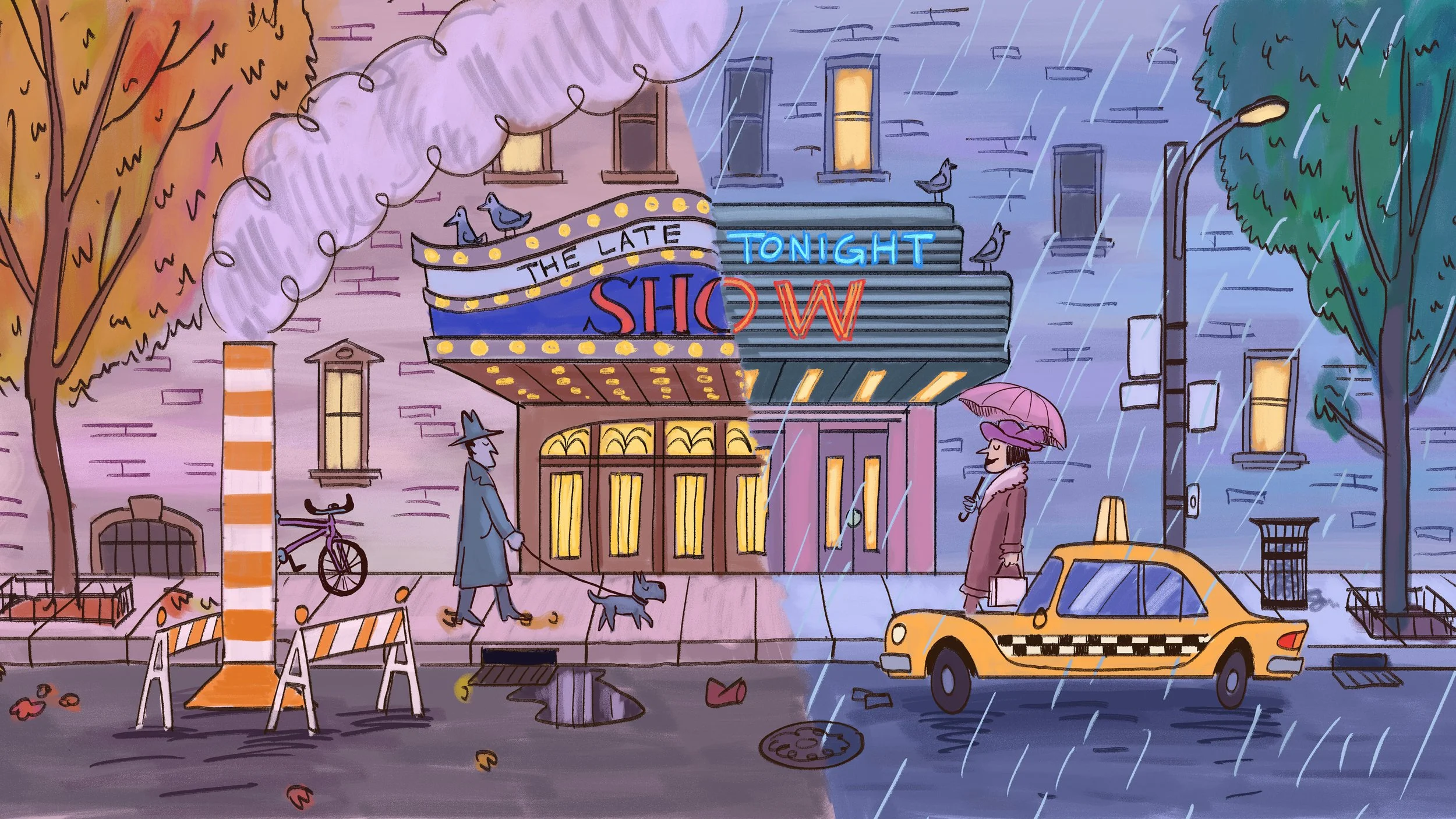
Mixing music for Late Night television means working fast, putting artists at ease, and delivering polished mixes under immense pressure. In this episode, the Music Mixers of The Late Show with Stephen Colbert and The Tonight Show Starring Jimmy Fallon swap stories from decades behind the console. They reveal performances that went sideways, why backing tracks can actually make their jobs harder, and what it’s like mixing everyone from Cynthia Erivo to Paul McCartney. Featuring Harvey Goldberg and Lawrence Manchester.
MUSIC FEATURED IN THIS EPISODE
Spring Gang - Weird Uncle
Ryan James Carr - Reasons
Ritchie Everett - Zambara Groove
Loyae - winter soul
Wesley Slover - Not Quite Summer
Enio Máno - Black Diamond
Daniel Fridell - Hot Thang
Twenty Thousand Hertz is produced by Defacto Sound.
Subscribe on YouTube to see our video series.
Follow Dallas on Instagram, TikTok, Facebook, and LinkedIn.
If you know what this week's mystery sound is, tell us at mystery.20k.org.
Support the show and get ad-free episodes at 20k.org/plus.
Get three months of free payroll with Gusto at gusto.com/20k.
Visit quo.com/20k for 20% of your first 6 months of business phone software.
View Transcript ▶︎
[20K Sonic Logo]
[music in: Spring Gang - Weird Uncle]
Ever since we launched our video series a year ago, I've had some amazing experiences... like going backstage at several Late Night shows, to learn how they craft the audio in these super high pressure environments.
Two of the ones I went to were The Tonight Show starring Jimmy Fallon at 30 Rock in Manhattan, and The Late Show with Stephen Colbert, over at the Ed Sullivan Theater on Broadway. I filmed Colbert's just a few weeks before that show ended. Between both shows, I interviewed lots of people, including the Music Mixers, who mix the In-House Band and the visiting musical guests.
Over on Colbert's show, the Music Mixer was Harvey Goldberg. Starting in the late 90s, Harvey worked on The Late Show with David Letterman, and then stayed on when Colbert took over in 2015.
Late Show Announcer: It's The Late Show with Stephen Colbert!
Over on Jimmy Fallon, the Music Mixer is Lawrence Manchester, who's been with the show since the very beginning.
The Tonight Show Announcer: It's The Tonight Show starring Jimmy Fallon!
After meeting both Harvey and Lawrence I thought it'd be really cool to bring them together here on Twenty Thousand Hertz to swap stories.
Dallas: Well this is so exciting. I'm so glad that the stars aligned to where I could get the two of you together, 'cause I wanted to interview both of you kind of individually, and I had an epiphany, and I was like, "What about together?"
Dallas: So why don't we start with Harvey? So what is the band experience at one of these shows? What are they coming into? Like how many rehearsals, how many recordings, and like what happens live versus not live?
Harvey: Yeah. One of the things that I learned pretty quickly is that even the most seasoned band that's made a lot of records and has done a lot of concerts, if you stop and think about it, the thing they've done the least is television. You know, even the most successful band in the world maybe at the most will do three television shows in the course of a year, and then they may not do another one for another three years.
Harvey: So they're always a little bit more nervous playing on television than they are in-concert or making records. You know, they've done that on a regular basis. And it's also probably, I would assume, pretty hard to come out for one song and just hit it.
[music in: Ryan James Carr - Reasons]
Harvey: We traditionally, on both Letterman and The Late Show, we would do a line check in the morning and just make sure all of their equipment works and all of our equipment works, and we'd get whatever rough sounds we could with their tech crew. Sometimes members of the band would show up themselves, which would help.
Harvey: But then at the camera block...
meaning, the on-camera rehearsal...
Harvey: I structured it that the director knew that I would get two audio passes before cameras would join in. And in those two passes, I would hear the final players and get together a mix that was close to what it should be. And then cameras always wanted a look at it another two or three times. So I would say I get to hear the song performed live without an audience four to five times.
Dallas: And even with that, I suspect that those four or five times are still different when the audience is there, like energy-wise, right?
Harvey: Oh yeah. Yeah. Well, the energy... you know, whatever levels I'm getting, I always assume they're gonna play louder once there's an audience there.
Lawrence: Oh yeah.
Harvey: And the other thing that I'm sure Lawrence has run into is it's very hard for me to judge the amount of reverb [verb on music] when there's no audience, because once there's audience in the room, the room dries up. [verb decreases]
Harvey: So almost without fail, whatever I thought was just the right amount of reverb on the vocal, I always have to go back and add a little bit more after the show because it's not as much reverb as I thought I had.
[music out]
Harvey: Have you run into that also, Lawrence?
Lawrence: I think the Ed Sullivan Theater is more ambient than ours is, and there's probably a more dramatic difference between there being an audience versus no audience. Ours is quite dry to begin with, and I find it doesn't change too much when the crowd is in there.
Harvey: Yeah, we have a very live room.
Lawrence: Yeah.
Harvey: I envy you that you have a dry room.
Lawrence: Uh, yeah, it does help most of the time. Uh, that's true.
Dallas: So this is a great time for me to chime in because what's very cool is I got to experience both of these rooms. And one of the things that I, I don't think I've ever heard anyone articulate... Because when you're on TV, it's TV. It's still the same, you know, 16 by 9. It's still, you know, similar-ish camera shots. But these two rooms are so vastly different from each other.
Jimmy Fallon's show is filmed in Studio 6B of 30 Rockefeller Plaza, also known as 30 Rock. That's the NBC skyscraper where they also shoot Saturday Night Live, Late Night with Seth Meyers, and various news programs.
Dallas: 6B feels like a large recording studio. The production mixer, Fred, took me around and was even showing me that all of the walls are perforated and dead quiet. Like everything is sound-soak everywhere.
Meanwhile, Colbert's show was literally filmed on Broadway inside the historic Ed Sullivan Theater.
Dallas: Over at the Ed Sullivan, it is a, like, Broadway theater. Like it is for live performances, and it feel... like the audience feels different, the size of the room feels different. So yeah, you both had very different rooms to work within.
Harvey: Yeah, they designed our space to be hostile to audio.
[music in: Ritchie Everett - Zambara Groove]
Like Harvey, each morning, Lawrence and his team work with the band's crew to get everything set up before the band arrives.
Lawrence: In a lot of cases, these bands are on tour, so they have Front of House Mixer with them, they have a Monitor Mixer with them.
The Front of House mixer is traditionally the person who mixes what the audience hears at a band's concert. Meanwhile, the Monitor Mixer controls what the band hears through the on-stage wedge speakers, and their in-ear monitors.
Lawrence: So we work with them ahead of time, and then by the time the band takes the stage, that's usually 10:45, 11:00. And yes, we'll, we'll try to get a couple of audio runs in just for us. And it's for them really because, they're trying to get their monitor mix dialed in a way that's comfortable and familiar with how they have it every night, and yet they're using our equipment, and our people are doing the work, and there's some negotiating that has to take place, and the only way to do that is just in real-time by running through the song a few times.
Lawrence: And that's also my chance to hear it and, uh, hear what the levels are gonna be and make a few... You know, I might call down to the stage and ask them to tune down the snare drum [snare drum tuning down] or a few things that I know are gonna help me out and help with the mix.
Lawrence: And then the band or the featured artist will usually take the stage and give us one more before camera block, and camera block is usually twice through. And we're done by lunch. And then, they don't play the song again until showtime.
Lawrence: At that point, it's, you know, 6:00, 6:15 in the evening when they take the stage to play the song, and they haven't played it in, like, six hours, and maybe they went to lunch and took a nap in between and have completely like gone on with their day. So, uh, it's not advantageous. I do feel for them because they have to come back and hit it right out of the gate, and that's not easy to do.
[music out]
Now, since the band's Front of House Mixer and Monitor Mixer is already there, you might think that they would mix these artists when they play a Late Night show. After all, they know the songs, they know the band's gear, and they know what the artist wants.
Dallas: But I'd love to hear it, maybe starting with you Lawrence, why is that not a good idea?
Lawrence: Sure. And I get it. I do understand why, and I've been on the other side of it too just wishing like, "Man, I wish I could be hands-on, you know, and what I just would be able to do very quickly, rather than have to coach and guide another mixer to do it."
Lawrence: But it makes sense when you consider how complicated these TV shows are, how custom-built the consoles are. They have to use our equipment because we have to work very quickly, it's all integrated.
Lawrence: There's also a rhythm to the show that we have to maintain. We can't get behind schedule. You know, we can't let a rehearsal become too precious that we then blow through lunch, and now we're behind schedule for the rest of the day. That's the kiss of death for a show that's as complicated as these are.
Lawrence: And so for that reason, our people sort of have to be in charge in order to make sure that things get driven on time and on schedule. And we have really good people, and they're very adept at working with an artist's team and interpreting the information that's being given, interpreting the creative guidance that's being offered, and getting a result that's going to get the job done. We've never not gotten the show on the air or I don't think anyone's ever left unhappy.
Harvey: The other thing too is that Front of House Mixing is very different than Broadcast Mixing.
Lawrence: Oh yeah, yeah.
Harvey: ...just as Front of House mixing is very different from record mixing. Front of House mixing is very literal. What everybody's gonna hear from the audience is all on the same speakers, in the same environment, in the same room. And whatever the Front of House Mixer is doing, he knows however he's hearing it is the way it's gonna be heard.
Harvey: Anybody that comes from making records is always mixing for a stereo that they will never hear. So you learn over the years how to do mixes that'll work in various different environments on different kinds of speakers. And Front of House mixers don't really have that skill. And I think most of the good Broadcast Music Mixers come from a record background where they were used to mixing where what they're listening to is not so literal. It's something that will translate in various different environments.
[MicroHertz bumper]
Unlike Saturday Night Live, Late Night shows are usually not live... Instead, they're what's called Live to Tape, where they film with a live studio audience, then air the show a few hours later. In that in-between time, the musical guest will often go into the mixing room with Harvey or Lawrence to hear the current mix, and request any changes. And those interactions add a whole other social dynamic to the job.
Dallas: You know, another thing I noticed that I found fascinating, and being in both of your environments, is this kind of under-the-surface social aspect, and the amount of pressure that's put on both of you.
Dallas: Everything from your roles, both of your roles, is so diplomatic. You have to put people at ease so instantaneously. You have to be a good hang. You're in service to these people. But can you talk to me a little bit about just, like, the underlying role that you have of making people comfortable very quickly?
[music in: Loyae - winter soul]
Harvey: Yeah, I mean, again, that goes back to my recording studio training. For new artists, recording studios can be very intimidating, and so as a recording engineer, you learned very quickly of how to make artists feel comfortable in what's a strange environment to them. And that sort of behavior and psychology just carried over into the same thing when I went over to television.
Harvey: Lawrence and our show have very good reputations, and people have seen both shows, and have seen a lot of their favorite music acts on both of the shows, and they've heard from both shows how their favorite music acts came off well on those shows. And, you know, I don't wanna speak for Lawrence, but I think that we probably both carry that, and convey it when the artist comes into our control room.
Lawrence: And I think it's probably pretty obvious, Dallas, that we both really, really care about the music and we really care about the people's experience when they're with us, and how it translates to the world. And that probably does come from the studio background. You're—It's a client service industry when you're working in a recording studio, certainly when you're on staff, but even as a freelancer, making people comfortable.
Lawrence: Putting them at ease so that they do their best work. And so that's something that we try to recreate in these TV environments where, yeah, it's very uncomfortable and it's very unusual. They're not our clients, but they're our guests, and so we kind of treat them as guests so that they feel at ease and taken care of.
[music out]
Dallas: So diving a little deeper, Lawrence, I'll start with you. But over, you know, this long history career, are there any artists who surprised you? Like a mix that you expected to be really easy, but was really complicated, or vice versa?
Lawrence: Sometimes the vocal to track bands can be some of the harder ones.
Dallas: And what is that?
Lawrence: Uh, instead of an artist coming in with a band behind them, they're coming in with a track, usually more like pop music, or something that is very, you know, synth-heavy or sample-heavy. Or the performance itself is heavily focused on the choreography, and the lighting, and the costume, and you know, it's a singer with a track.
For instance, in a recent Bad Bunny performance on The Tonight Show, it was just him onstage, singing and dancing while pretending to do laundry.
[clip: Bad Bunny - VOY A LLeVARTE PA PR]
Lawrence: And sometimes making all of that fit can be a challenge, 'cause you want the vocal to be integrated with this very carefully sculpted track that was done in the studio with tons and tons of effects and processing. And here you are, you know, trying to make that live mic sound like it fits in with the songs. So those can be sometimes a little harder than you might think. People think, "Oh, it's just track and vocal. How hard is that?" But making it really sit right can take a lot of doing.
Lawrence: And then other times, you'll see an input list, you know, with 40, 50 inputs come in and it's like, "Wow, this, this is gonna be really something." And then they come in, the band is prepared, they're well-rehearsed, they're really tight, their sounds are great, their instruments are great, and their sound team has really chosen just the right mic for every instrument, and you push the faders up and... and it just happens. And those can be very, very, surprisingly rewarding.
Lawrence: Just had Anthony Ramos on the show just last week, and he came in with a salsa band, and they were great.
[clip: Anthony Ramos - New York City (Fallon)]
Lawrence: Traditional salsa band, and they just had all their sounds dialed in, and it felt right and it sounded right right out of the gate.
Dallas: How about you, Harvey? Do you have that same experience? Is there anything...
Harvey: Yeah, very similar. I think actually the hardest for me is when it's 50% track and 50% live, because the track is such a... You know, there's a presence in the way it was recorded, and it was recorded in an entirely different environment than where the 50% that live is happening, to try and get those sounds to match together is very difficult.
Harvey: I find the more organic it is, the easier it is. We've done quite a few Broadway things that are very large, and large orchestra, but they all play so well, and their dynamics are so great as players, and as a unit, that it's far easier to mix those 40 microphones, 48 microphones than you would expect.
For example, here's Cynthia Erivo on The Late Show, singing a song from The Color Purple with a full orchestra.
[clip: Cynthia Erivo - I'm Here (Colbert)]
Harvey: It always cracks me up because tracks were supposed to make everything easier, and I would say 9 times out of 10 or even 10 times out of 10, the thing that will fail, or is giving us trouble, or isn't working in the line check, and it takes forever to get it to work, is any of the track stuff that they brought in. That's almost always what goes wrong.
Harvey: And I heard a very funny story where, um, you know, a bass player was saying, "Well, you know, if you spill water on me, I can still play."
Lawrence: I have a track story. Uh, long time ago, and I won't name names, but a band came in and, and they had their playback track was on an iPod.
Harvey: Oh, God.
Lawrence: And the left channel was the click.
[click track in left channel]
Lawrence: And the right channel was everything else.
[full track in right channel: Nylonia - Just You]
Lawrence: And it was on an iPod, and they didn't have the eighth-inch cable to go with it, so we, we found them a cable. And then they went to turn on the iPod, and the iPod was, um... it was not charged, so it wouldn't turn on, and they didn't have a charger. So, uh, we had to find them a charger just so that we could get them to play their one mono track with everything on it.
Dallas: Harvey, have you ever experienced kind of like a "What in the world" situation? I just assume that so many people come in here so prepared, but are there ever surprises on like, "What is happening right now?"
Harvey: Van Morrison came and did a great camera block where he did "Moondance."
David Letterman: Our next guest is one of the most brilliant and influential performers of the last 30 years. Ladies and gentlemen, it's a pleasure to have him back on the program. Here's Van Morrison. Van!
[clip: Van Morrison - Moondance (studio)]
Harvey: And then we take a break, and a few hours later, the show comes on, and now it's time for the music.
[clip in: Van Morrison - Moondance (Letterman)]
Harvey: And Van Morrison comes out, and he obviously spent the last five hours in a bar. And he comes out, and the band starts playing, and they do a four-bar intro...
Harvey: And he's supposed to come in, and there's nothing.
Harvey: So they do another four-bar intro, and there's still nothing.
Harvey: And they go around another four bars, and now he starts laughing.
Harvey: And then finally, around the 24th bar, he finally started singing.
[clip up, then under]
Harvey: What was your favorite meltdown, Lawrence?
Lawrence: Ooh, meltdowns? Uh...
Dallas: I have to mention that Lawrence is still working. And Harvey is... can say, uh, pretty much anything at this point.
Harvey: Right.
Lawrence: I can't recall any meltdowns. I, I, I know there've certainly been technical issues along the way. I remember we were doing a live show and, uh, we reset the band in the commercial break and, um, we're coming back, and we checked all the instruments really quickly and, and the bass, was there. I had the DI, but I didn't have the amplifier mic.
D-I stands for Direct Input, which is when you plug an instrument directly into a mixing console, rather than going through an amplifier and mic'ing it. With bass guitar, you often use a mixture of both... But in this case, Lawrence was getting only one of those two signals.
Lawrence: So I'm asking my A2, "Hey, you know, can you troubleshoot that?" And we're like 30 seconds left. And he says, "Try this." And then, then the bass was just completely gone. So there's no bass at all, and this is like a rock song.
Harvey: Oh no.
Lawrence: Like, you, you really need the bass.
Harvey: Yeah yeah.
Lawrence: And we couldn't get the mic to work, now we couldn't get the DI to work, and now we're about 15 seconds back. And I said, "Whatever you just did, undo it." And he did, and we got the DI back, and then I think he was sort of, like, stuck offstage, you know, just out off the wings. But we had the band, we had the bass, and we counted off the song and we did it. But that was, that was definitely a nail-biter moment.
Harvey: Yeah.
[music in: Wesley Slover - Not Quite Summer]
After the break, the unique musical preferences of Letterman, Fallon, and Colbert. And Harvey's number one favorite artist to work with.
[music out]
***MIDROLL***
[MicroHertz bumper]
Dallas: This is the most sensitive question I'm gonna ask, so apologies, and it might just be a "Pass." Um, I'll a-ask it delicately. What is the relationship of the pre-recorded vocals in a situation like this? That's always, like, the biggest question that comes up is, "Do people lip sync?"
Harvey: Uh, I'll answer that on Letterman and Colbert, we did not allow lead singers to lip sync.
Dallas: Were there times where people may be sick or just had to push through it and, you know, still came across successful, I assume?
Harvey: Yes. Now that being said, there have been several times that we've done [pitch correct voice] pitch correction after in post, but never lip sync.
Dallas: And that seems fair. I mean, that's just like a... That's what you would do. It's a plugin. Do you wanna, uh, touch that with a 10-foot pole, Lawrence?
Lawrence: Um, on occasion, there've been situations, and when it comes up, it's usually because of like very complicated choreography, or something that is just physically impossible to give your best vocal performance and your best physical performance that's, you know, physically demanding, or a lot of dance steps, or something where you're, you know, flying through the air or something like that.
Lawrence: So it comes up on occasion where maybe a section might have a prerecorded vocal. It's always the singer that did it. It's always done as a way to make the performance the best it can be as a whole. But no, by and large, we don't, uh, encourage it, condone it, seek it out. It's always driven by the artist if it's something that they just feel they have to do.
Dallas: So Lawrence, another thing I, I'm really curious about is, like, tell me about, the role of Jimmy and I believe Questlove is the Music Director on your side.
Lawrence: Yeah.
Dallas: What are they like in person, and how do they have an influence on, like, their specific preferences of how you do your role?
Lawrence: Well, they're both very deep people when it comes to music. Questlove is... is an encyclopedia of music.
Questlove is the drummer and co-frontman of the legendary hip hop band, The Roots.
Jimmy Fallon: To the left is the most talented band in all the land, trying to lend a hand, The Roots from Philadelphia, ladies and gentlemen. I love you guys.
Since 2009, The Roots have been Fallon's house band, with Questlove as the Musical Director... which is basically the band leader.
Lawrence: As a DJ, he's just incredibly knowledgeable about all styles, and how to fit it together, and everything else. And I say he, he Music Directs like a DJ, and he DJs like a Music Director because he- it's just one process for him, while he's playing the drums, in a lot of cases.
Jimmy Fallon: Please welcome Matt Damon!
[clip: The Roots playing on Fallon]
Lawrence: Jimmy is... is a huge, huge, fan of music. He's a musician himself, wonderful performer. And we were talking about sound earlier, the sound of the studios, it was Jimmy who had a lot to say about the sound of our studio. He wanted it to sound great. He wanted it to be a, an environment where we could really play and get a lot done with the musical performances and the guest bits that we do. And it was top-down from him, when it came to making sure that that studio sounded great. And I really, really, really appreciate that.
Lawrence: So then when it comes time to do the show, guest bookings might come from something that Jimmy stumbled upon and wants to give them a try, even if they're not famous, or maybe they don't even have an album, but we might put something on television that is new, that he's really into.
Lawrence: And Questlove, with his vast network of contacts and musical relationships, we can get some pretty cool things happening that, uh, might not happen anywhere else, because people are very excited to collaborate with The Roots and, and do things on TV that they just wouldn't have a chance to do otherwise.
On Harvey's side, he's worked with several Music Directors. When he was on The Late Show with David Letterman, the Music Director was Paul Shaffer.
David Letterman: He is a Grammy Award winner. He is our Musical Director, and most importantly, a good friend. Ladies and gentlemen, Paul Shaffer. Come on over here.
Once Colbert started hosting, Jon Batiste became the Musical Director...
Jon Batiste: Hi. I'm Jon Batiste.
Later on, Jon left, and was replaced by Louis Cato.
Stephen Colbert: So ladies and gentlemen, let me introduce for the first time, Louis Cato and The Late Show Band. Take us out, folks! We'll be right back.
Dallas: What are those relationships like as far as their role and your role?
Harvey: Well, I mean, were certainly three very distinctively different personalities. Paul is the one who originally pulled me into Letterman, so I was his choice to come over there. And again, Paul was never really that involved with the mixing unless it was something that the House Band was backing up a singer.
Harvey: Especially, we used to do these big Christmas extravaganzas with Darlene Love, the song that Darlene Love sang, "Baby, Please Come Home."
[clip: Darlene Love - Christmas (Letterman)]
Harvey: And Paul would always wanna get involved in the final mix of that. Other than that, you know, maybe occasionally he might listen to something on TV and decide that he would want more trumpet in the horn balance, but I'd maybe hear something like that once every three years.
Harvey: Then with Batiste, Batiste wanted to sort of reinvent the whole thing. Because as a jazz musician and an improviser, and just in general, he has a lot of energy, so he would get bored a lot. So he kept changing the setup of the band. He would just come in after two months when we'd finally get the sound locked in, he'd come in and say, "No, I want the drums to be on the other side." And... and so he was always changing it, not only where they were positioned, but the players kept changing.
Harvey: Again, I had a lot of respect from Jon, for Jon and from Jon. And so we were always pretty much on board what the final mix should sound like of the house band. But with Cato, it settled in much more. It settled into the same players all the time. And, uh, the only time he would really get involved in something is if the house band was part of the feature song, he would come down.
Harvey: But all three of them, from a mixing standpoint, were, I found, very easy to work with. In reality, I find most people easy to work with.
Dallas: Now, did Letterman or Colbert have any sort of strong preferences directly from them?
Harvey: Well, Letterman, there were two things. Letterman would loved if a band came in and, as he would put it, "Blow the roof off the joint." So he loved bands that came in with a lot of energy.
David Letterman: Please welcome Rage Against the Machine!
[clip: Rage Against the Machine - Guerilla Radio (Letterman)]
Harvey: Letterman was also very anti-track, and would really take the bookers to task if they booked an act that was mostly track. And the bookers would say, "Well, this is, like, the number one act right now." And Letterman would say that he didn't care. He was working, he wanted whoever to come on to play to be working.
Harvey: And a very funny story, Shania Twain was coming on, and we got the input list where all the instruments were what they call, "Plugged into the carpet," meaning that none of them were to actually be plugged in. Only the vocal was gonna be live, and the rest was gonna be track. And the booker know that Letterman would not be happy with that.
Harvey: And so they went back to Shania Twain's people and actually took a stand and said, "Unless you actually play, we're gonna have to cancel the booking." And if I'm not mistaken, they went into a rehearsal studio and rehearsed that one song for three days to get it as perfect as they could before they came out and did it on the show.
Harvey: And then they came on, and the drums had triggers so that the sounds, even though they were really being played, the sounds were just like on the record. All the guitar players had boxes, I forget which ones they were using, where it had the sampled sounds of what was on the record. So even though they were really playing, the sounds matched the sounds on the record exactly.
Harvey: And as I said, they had rehearsed this for three days, so they played it perfectly.
[clip: Shania Twain - I'm Gonna Getcha (Letterman)]
Harvey: And at the end of the show, I actually got a call from somebody in Letterman's office because he was convinced it was track, because that's how precise it actually came off. So Letterman was a real stickler that people had to really play.
Harvey: With Colbert, by that time, there were so many people using track that if you started turning people down doing that, I think they would've had trouble booking a lot of people. I would say about three years ago, though, it started drifting away from being so much track, which I was happy about for reasons that I mentioned earlier in the conversation.
Harvey: Colbert wasn't as hands-on, certainly not as hands-on as somebody like Jimmy Fallon would be. But he did have a great love for music, and occasionally, depending on who it was, he might perform with them.
Here's Stephen Colbert and Jack Black singing a song called My Kind of America.
[clip: Stephen Colbert & Jack Black - My Kind of America]
Harvey: Letterman never in a million years would've ever performed with anybody.
Dallas: Harvey, I wanted to tee you up to tell me the story that you told me, because it's one of the greatest stories I think I've heard in music.
Harvey: Oh God, I hope I remember it.
Dallas: Well, the, the entire story of how you fell in love with music through the Ed Sullivan, is just so great, and I would love to just, like, give you the space to tell that again, because it's such a good story.
Harvey: Yeah. The reason why I wound up getting into this, when I was 11 years old, I was sitting with my family in the living room watching the Ed Sullivan Show, as I think most of America was that night, when The Beatles debuted on the show.
Ed Sullivan: Now yesterday and today, our theater's been jammed with newspapers and hundreds of photographers from all over the nation, and these veterans agreed with me that the city never has witnessed the excitement stirred by these youngsters from Liverpool who call themselves The Beatles.
Ed Sullivan: Now tonight, you're gonna twice be entertained by them. Right now, and again in the second half of our show. Ladies and gentlemen, The Beatles!
[clip: The Beatles - All My Loving (Ed Sullivan)]
Harvey: And as an 11-year-old, the energy and the joy that I felt coming through the television, I thought to myself, "I don't know exactly what I'm watching here, but whatever's going on here, I wanna grow up and be a part of this." That's the moment where music became the center of my life, and why I wound up working in a recording studio, and why I wound up making records.
Harvey: And the full cycle for me really happened twice, which was finally when Paul McCartney came back to the Ed Sullivan Theater for Letterman, we did a small concert on top of the marquee. I think he played for like 20 minutes. Maybe 5,000 people showed up on the street.
David Letterman: Thank you very much. And now ladies and gentlemen, performing a classic from the marquee of The Ed Sullivan Theater, here's Paul McCartney.
[clip: Paul McCartney - Get Back (Letterman)]
Harvey: And then of course he came down to the control room for a playback. And for me, that was my 11-year-old watching him on the Ed Sullivan Show, now sitting in the Ed Sullivan Theater with him sitting next to me was sort of a full cycle.
Harvey: And then I got to do it one more time with even an extra added cherry on top, which was when he came back for the final show of Colbert. You know, they closed the show with "Hello, Goodbye."
[clip: Paul McCartney - Hello Goodbye (Colbert)]
Harvey: And the idea was for the whole staff to go up and join him on stage singing "Hello, Goodbye."
[clip: Paul McCartney - Hello Goodbye (Colbert)]
Harvey: And Mike Mueller, who's been my assistant through all 30 years, he and I looked at each other and thought, toward the end of the song, I knew I was gonna remix at the end, but we thought, "Let's just let the Pro Tools roll at the end of the song," and we both ran up to the stage and joined in in the singing.
[clip up, then back under]
Harvey: And so now I finally have a situation where not only did I first see the Beatles with Paul McCartney on the Ed Sullivan Show that drove me into this, but now I was singing with him on the stage that I saw him sing on when I was 11 years old. And that's really a complete circle of how I got into this in the first place, and how my tenure at the Late Show ended.
[clip fades under with verb]
Dallas: Wow.
Lawrence: Amazing.
Harvey: Not bad.
Dallas: Yeah, and I remember he, Paul McCartney was taking, like, the trumpet and playing it. It was like a party there at the end. What was... what was the vibe of the crew on that last singalong?
Harvey: Well, you know, it was a very unusual show, because we were clearly all sad about this, and angry. But Stephen Colbert was determined to make the show a joyous occasion as opposed to a memorial service, and I think he really succeeded in creating a very joyful show. And if you watch the close of the show, you can see that in the final music performance, how joyful it was.
Harvey: Again, it was very poignant how the show ended with Paul McCartney and Stephen turning off the lights to the theater, and the theater disappearing at the end.
[clip up, then out]
Harvey: Because really, both The Late Show and Paul McCartney are real signatures of that theater.
[music in: Enio Máno - Black Diamond]
Dallas: Lawrence.
Lawrence: Mm-hmm.
Dallas: Out of all the things you could have done with your life, why have you dedicated it to music?
Lawrence: I was drawn to music when I was very young. When I was three years old, I think I probably saw something on television and it, it connected with me, and I just always imagined myself being part of that world. Initially, I started as a musician. I played guitar when I was a kid, and drums through high school, and classical percussion in college, and then jazz drums in graduate school.
Lawrence: But along the way, I was always doing home recordings, and making my own music, and figuring out the technology side of it, and realized that the studio, and the recording tools, and the consoles, and the mics are an instrument in and to themselves. And so, uh, I diverted my attention over to that side of it.
Lawrence: But everything I do as a mixer comes from that musician's background, and that desire to be part of it. And, uh, it was never really anything I second-guessed or considered doing otherwise. It's really been there since being very, very young.
Dallas: I feel like that's the sentiment that I hear from a lot of music people or sound people is that it's like, "Wait, there was other options?" So Harvey, same for you. Like, out of all the things you could've done with your life, why did you dedicate it to music?
Harvey: Well, again, I explained that big bang for me when I was watching The Beatles on television, and just the joy that was coming across. And then I just became an avid record collector. You know, I'm somebody who, instead of spending my lunch money on lunch, I used it to buy records.
Harvey: But my obsession with listening to records, and dissecting them, and thinking about arrangements and sounds, and going to see people play live. And sometimes the record was better, and sometimes they were better live, but the record wasn't that good. And I really wanted to find out what that was about, and that turned out to be about record production. And so right out of high school, I immersed myself working in recording studios, and one thing just led to another. I never... I joined the circus and never left.
Lawrence: And my guess is, Harvey, if you're like me, you still get excited when the mix is really clicking, when the band is really playing great. You get a...
Harvey: Oh yeah.
Lawrence: A feeling about, of... all being right with the world when... when it's all sitting just right.
Harvey: Absolutely. Absolutely. I mean, that's, you know... That to me is a good day's work.
Lawrence: Yeah.
Harvey: You know, I mean, look, I'm an inspiration junkie. I'm always chasing after something that inspires me, and when you get to be a part of something that's inspiring you, that's the ultimate.
[music out]
Dallas: Well we have five more minutes left. We can freestyle a little bit. Is there anything I missed that would be great to include? Or do you have any questions for each other?
Harvey: Is there an opening?
Dallas: Oh, that's great.
Lawrence: Well...
Harvey: You don't have to answer.
Lawrence: Well, no. Honestly, I, I, I was thinking, you know, a few weeks ago as uh Late Show was winding down, it's like, "What is Harvey Goldberg gonna do when he doesn't have to get up and get to work on a Monday or Tuesday morning?" Umm...
Harvey: Yeah. Well, I mean, in all honesty Lawrence, the first two weeks I slept.
Lawrence: Yeah.
Harvey: The last month, you know, we were doing so much music, and everybody was coming on and playing two and three songs that I was putting in roughly 15 hours a day every day for a month.
Lawrence: Yeah.
Harvey: So a combination of that amount of hours and the emotional part of it, I was just drained at the end of it.
Lawrence: Yeah.
Harvey: So, I've only just started to decompress now. And this week, in all honesty, feels like a dark week to me. You know, it hasn't really sunk in yet.
Harvey: But you know, I'm getting out and talking to people, and I definitely wanna... I love mixing. Like I said, the addiction is, is that you're always feeling like you can go back and do it better,
Lawrence: Yeah.
Harvey: And that's not out of my system. So as quick as I can, I wanna find a way to get back into mixing so that I can keep pushing the envelope further. Plus, it's one of the few things in life where I really can shut out everything else in the world and focus on that one thing, and I find that very satisfying, and soothing, and very good for my psyche.
Harvey: So, for those two reasons, I have every intention of keeping on doing it. I'm hoping to pull the rabbit out of the hat one more time.
Lawrence: Happy to hear that. Actually, very happy to hear that.
[music in: Daniel Fridell - Hot Thang]
Twenty Thousand Hertz is produced out of my sound agency, Defacto Sound. Hear more at defacto sound dot com, or by following Defacto Sound on Instagram.
Other Voices: This episode was written and produced by Casey Emmerling, with help from Grace East. It was sound designed and mixed by Joel Boyter and Jade Dickey.
Thanks to our guests, Harvey Goldberg and Lawrence Manchester. To see the videos I made with Harvey and Lawrence in their spaces, head to my Youtube channel, which is under the name Dallas Taylor dot mp3. There are also direct links in the show notes, and you can also find video shorts on Instagram and Tiktok under that same name, Dallas Taylor dot mp3.
Thanks for listening.
[music out]