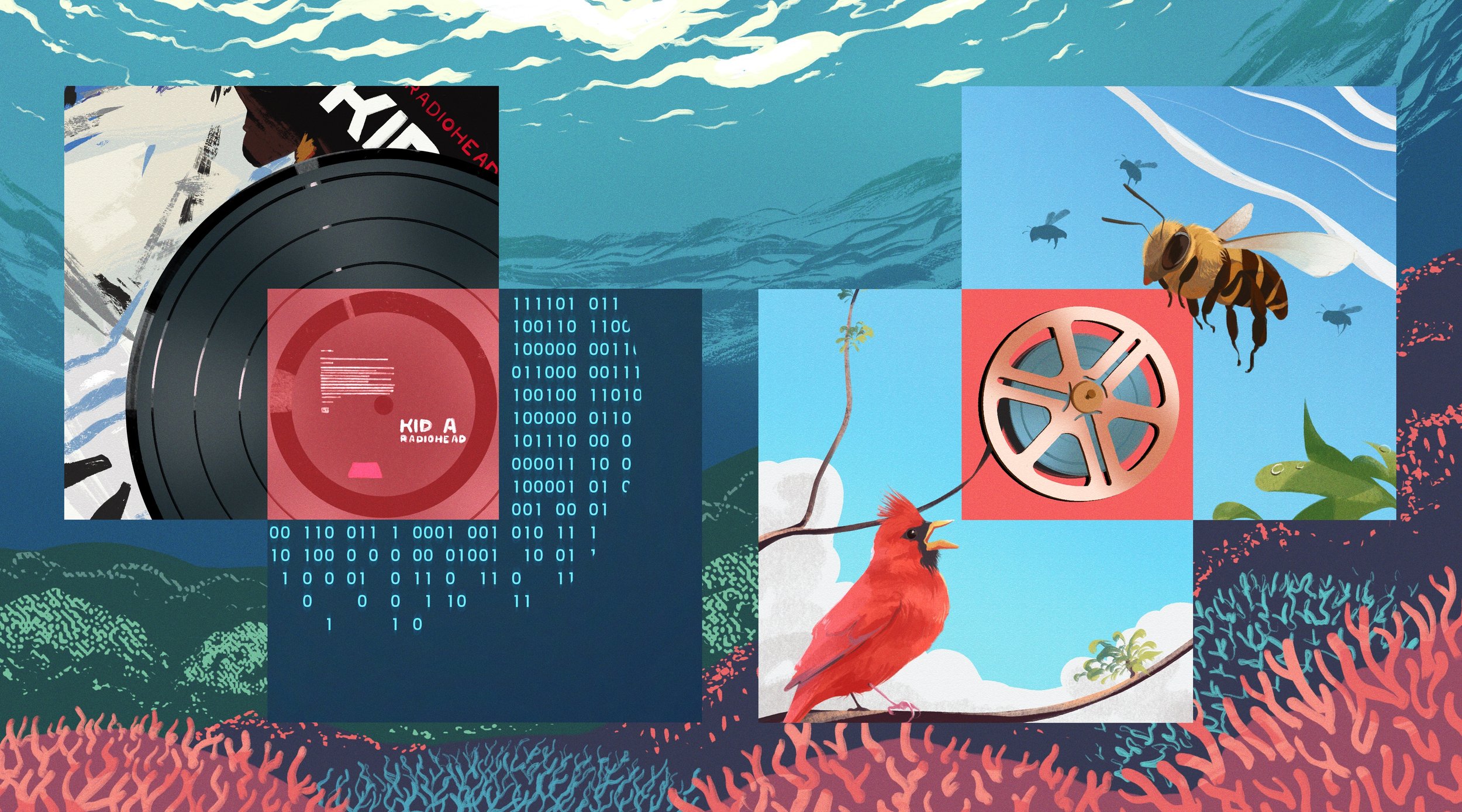
Art by Jon McCormack.
This episode was written and produced by the listeners of Twenty Thousand Hertz.
Twenty Thousand Hertz proudly presents the first five selections from our 2026 Listener Story competition. From AI-generated music, to the hidden crackle of coral reefs, to historic birdsong recordings, these bite-sized stories are crafted with curiosity and care.
MUSIC FEATURED IN THIS EPISODE
Still Sleeping by Wesley Slover
Sandra Robot by Wesley Slover
Twenty Thousand Hertz is produced by Defacto Sound.
Subscribe on YouTube to see our video series.
Follow Dallas on Instagram, TikTok, Facebook, and LinkedIn.
If you know what this week's mystery sound is, tell us at mystery.20k.org.
Support the show and get ad-free episodes at 20k.org/plus.
Listener Links:
Hear Maria Ordovas Montanes' work on the Out There podcast.
Follow Rob Porter's Songbirding podcast.
Follow Victor Sanchez's work with DC Producciones.
Try NetSuite Next for free at netsuite.ai/20k.
Shopify: Own your customer relationships. Own your revenue. Start with a free trial at shopify.com/20k
Visit quo.com/20k for 20% of your first 6 months of business phone software.
View Transcript ▶︎
[20K sonic logo]
[music in: Wesley Slover - Morning Arrival]
There's nothing I love more than hearing other people tell amazing stories on Twenty Thousand Hertz. So last year, we held a competition where we invited listeners to send us fully produced short stories about sound. Basically, they were mini Twenty Thousand Hertz episodes... made by you, our listeners.
The results were legit incredible, and we ended up filling three entire episodes with those stories. It was such a success that I knew I wanted to do it again. So now, here we are a year later, with another group of outstanding stories.
What you're about to hear is the first set of the stories from this year.... which we'll call the bronze collection. The silver and gold collections will follow later in the summer.
Enjoy.
[music out]
Story 1, by Miles
Miles: AI has gotten good at a lot of different things, from generating books, generating images, generating videos. It's gotten to the point where it's nearly impossible to differentiate AI-generated content from human-generated content, and that's scary. Nearly every single field and industry is getting impacted by AI in some way or another, but there's this one field that people don't often think about that is getting severely impacted, and that is the music industry.
Miles: When I was in seventh grade, I did this science fair project where I tested if humans could tell the difference between human-generated content and AI-generated content. And on the first test, which was just a sentence, it was a 50/50 split on who got it right and who got it wrong, which is just a coin flip.
Miles: But that was three years ago, and AI has gotten so much better since then. So I wanted to do that same thing, but this time with music. So what I did was I sat down my brother.
Miles: Okay. Oh, wait, hold up.
Miles: And I interviewed him.
Other Voices: My name's Caleb Krueger, and I'm going-
Miles: The first song was going to be the AI-generated song, and the second song was gonna be the human-generated song.
Miles: You don't know why I brought you here, do you?
Other Voices: Nope.
Miles: Okay. So I want you to put these headphones on, okay?
Other Voices: Cool.
Miles: And I'm going to play for you two songs. You ready to hear the first one?
Other Voices: Yep.
Miles: So the first song was written by Suno AI, and I have to admit, it's really good.
[clip: Suno string song]
Miles: And the second song is Deliver My Love, original composition by Vitamin String Quartet.
[clip: Vitamin String Quartet - Deliver My Love]
Other Voices: I liked them.
Miles: You liked them both? Okay Yeah One of those songs was made by AI. Okay?
Other Voices: Uh-
Miles: Song 1 or song 2, which one do you think it is?
Other Voices: Song 2.
Miles: Song 2?
Other Voices: Seems a little bit off a teensy bit.
Miles: Okay. You wanna know what it was? It was song 1. Isn't that crazy? What, what, did you think it was good song?
Other Voices: Yeah, kind of.
Miles: Well, no, did you think it was a good song - Yeah ... before I told you it was AI?
Other Voices: Yeah.
Miles: All righty. Well, um, thank you very much.
Miles: So AI already fooled one human, but what about other humans? Would you mind introducing yourself?
Other Voices: I'm Abby Krueger. I'm 13 years old. I'm in eighth grade. Um, I'm Cam Nash. I've known Miles- I am Heidi Hatfield through school for a long time And I've known Miles throughout both school years.
Other Voices: All right. Go ahead and put these on. Just tell me when the first one- The first song You liked it? Okay. Yeah.
Miles: One of those was made by AI.
Other Voices: Oh no. I'm terrible at this. Okay. I think it would be- You think it's the second one? The second one Is that what you- It could be more AI
Miles: I didn't stop at those four people. I wanted to get even more responses, so I put out an online form and got a total of 11 responses on that. And here's the thing, only three people out of that 11 got it correct, which for me is kinda mind-blowing because the AI fooled people that a human song was written by AI, and likewise, that the AI song was a human, and that's what interests me.
Miles: I also asked respondents if they would listen to AI music by choice, and everyone said no. Everyone was in agreement on "no AI music." From everyone I interviewed, no one said, "I would listen to AI music by choice." And I have to agree with them. Even if it is as good or better than human music, I'm still going to support the humans that put their time into it.
Miles: AI isn't getting smaller, and it isn't getting any less good at making things. At the time of recording, in the past week, Utah just approved an AI data center two times the size of Manhattan, and that... that is scary. It's gonna be harder for musicians to get their actual human voices heard among the voices that aren't human but AI.
Miles: This mini show and the music in it was produced and directed by me. A special thanks to Cale Mashton, Madden Hall, Heidi Hatfield, Abby Krueger, Caleb Krueger, as well as Jackson Wingler for taking the time to take my survey. Thank you for the entire Twenty Thousand Hertz team for hosting the competition which I made this for.
Miles: I'm Miles Krueger, and thank you for listening.
Story 2, by Maria
Maria: So I made my way down to the beach, and I got in the water, and it felt surprisingly warm, and I was surprised by how buoyant I felt, feeling as if I had a life jacket, but I didn't. I put my mask on, and I put my snorkel in my mouth, and I'm a little nervous because despite having done two months of scuba diving training, I have never just snorkeled in my life.
Maria: I got ready, and I put my face underwater, and the, the sounds of the children, like, playing and splashing faded away, and they were instantly replaced by this loud crackling. A kind of crackling that. I've never heard before.
Maria: And in that moment, I'm feeling like, "What's going on?" I'm wondering, "Why isn't anyone else reacting to this sound? Why isn't anyone going to get the lifeguard?" Um, "Is a boat about to run me over?"
Maria: But the sound wasn't getting louder, so I thought, "Okay, maybe it's not a boat." And I moved my head around, and it wasn't getting quieter or louder in any direction. It was just this constant loud crackle. And then I'm wondering like, "Oh, if no one's reacting, it must be my own gear."
Maria: And I figured there must be something wrong with my snorkel. But I just kept breathing normally and nothing felt wrong. It got to a point where I realized, like, "I'm probably okay, the people around me are okay. I guess I should just enjoy the coral reef." And once I was able to shift away from, like, panicking or being confused about this crackling, the whole reef just kind of opened up below me.
Maria: It was so colorful. I was so happy to be able to be in the water that day because I knew it was going to be my last time in the Red Sea for a while.
Maria: And eventually I got out of the water. I think I just like quickly looked something up and I realized, "Okay, reefs make that crackling sound. Okay." And I didn't come back to that for a while until a few months later, I heard this interview with a blind scuba diver. So to her, she knows she's diving above a healthy reef because she's hearing this crackling and popping, and she knows when she's near a damaged reef because it's pretty quiet. That totally took me back to the moment where I first heard the crackling.
Maria: And then I started researching more, and I found some articles describing how scientists are playing the sounds of healthy reefs to help revive damaged ones.
Maria: And so I've been thinking about something that's just this healthy sound for marine life felt like this worrying noise to me until I calmed down enough to see that all the fish were swimming normally, the humans around me were normal, too. And I just think it's kind of funny that this loud crackling that at first I thought was a sign of malfunction or danger is actually something that, the next time I'm underwater, I'll hear crackling as a sound of life.
Maria: Thanks for coming underwater with me. I'm Maria Ordovas Montanez, and I produced this story. Thanks to Katie Reuther for story feedback. You can hear more of my audio storytelling work on the Out There podcast 2024 season. I'm currently producing and editing the Outdoorsy Woman Plus book pod. Stay tuned. And for anyone still wondering, a lot of that crackling comes from snapping shrimp.
Story 3, by Rob
Rob: "Heard, but not seen." In birding, this phrase can be used to mark an encounter as incomplete. "You heard the bird, but you never laid eyes on it." As a birder myself, I've read and probably used this phrase many times. But in recent years, I've arrived to a very different perspective.
Rob: It's the evening of December 13th, 1948. A small pickup truck is driving in the rain down a rural road in Louisiana. Painted on its side, a bright red northern cardinal. Inside is Jerry and Norma Stillwell, a recently retired couple living their lives on the road. Towed behind them, a large house trailer.
Rob: Seeing some mud on the road from a previous overflow up ahead, Jerry becomes a bit nervous about the driving conditions, and so he begins to slow down. It's not enough, though. They're going a little too fast, and the road is becoming a little too steep. Now, the Stillwell's truck is being pushed by the trailer containing not only their whole lives, but also what may be the most sophisticated birdsong recording kit of its time. Their house trailer pushes them off the road into a ditch.
Rob: Nine months earlier, Jerry had acquired a Brush Sound Mirror BK 401, the first consumer-focused reel-to-reel sound recorder. One afternoon while he was at work, Norma was fiddling around, testing out the microphone when a bright red northern cardinal male belted out a song just outside her window. Norma had an idea.
Rob: When the Stillwells reviewed the recording together, they were both excited at the potential. This excitement led to numerous experiments and discoveries, culminating in some major life changes. They retired, bought a house trailer, and on December 3rd, 1948, they embarked on their new mission to record all of the bird songs of the US.
Rob: And ten days later, their truck is upside down in a ditch, their painted northern cardinal covered in mud, its crest pointing to the ground. Jerry and Norma wake up lying on the cab ceiling. They scurry out, soaked from rain and shaken from the crash, but relatively unscathed. Somehow their house trailer is in just as good condition as they are.
Rob: Norma and Jerry Stillwell lived to record for many more years. They even landed record deals, releasing three albums of LPs titled Bird Songs of Doryard, Field, and Forest.
Rob: When the Stillwells released their albums. The only way people heard birds was to go out and hear them themselves. It was pretty rare to have access to sound recordings of birds. And, uh, it was much more special in that era to hear a bird like this northern cardinal singing.
Rob: And so when I hear birders who only include birds on their life list that they've seen, and don't include ones they've only heard, I think they're missing out quite a bit, especially as a sound recordist myself. This bird just flew away on me. That's one of the wonders of bird song recording; I can't control the birds.
Rob: So for me, "heard but not seen," perfectly fine, especially if I get a good recording of the bird. My name is Rob, and I record the Songbirding podcast. And I hope you take a good listen next time you hear a bird song. And don't worry too much if you didn't see it.
Rob: Heard But Not Seen is a Songbirding Studios production and was written, recorded, narrated, and created by me, Rob Porter. It was produced by Lesley Loksi Chan. Thanks to Twenty Thousand Hertz for the opportunity to share the Stillwell's story.
After the break, a listener's life is changed by a song, while another listener finds freedom in a new pastime.
***MIDROLL***
Story 4, by Victor
Victor: There are songs that we just listen to, but there are others that can change you.
Victor: We all remember the year 2020 when quarantine forced us to stay in home for almost years. Loneliness was something very present for many people during this time. By 2021, I was still in high school, already with the need to decide what I wanted to do with my life. It sounds intimidating for a 16 or 17-year-old.
Victor: I had in mind dedicating myself to something related to music. I played the guitar, I liked composing, and I had a small notion about production. But my parents disagreed. They told me the typical comments like, "If you study that, you're going to starve," which I believed. This caused a lot of insecurity in me.
Victor: I started doubting not only my career, but also I started feeling insecure about my passion for music and audio. Adding the isolation, loneliness, and sadness, I started feeling like maybe I should not dedicate myself to music. And that's how I spent several months not knowing what my path should be. I did not like thinking about my future, but to distract myself, I started using music.
Victor: I started exploring more music until I found the album Kid A by Radiohead, and especially the song "How to Disappear Completely."
Victor: Kid A, released in the year 2000. An album that made me feel very similar to how I felt during the pandemic. An album the band made from feelings of emptiness, depression, and exhaustion. And one song that represents that a lot is the fourth song of the album, "How to Disappear Completely." In an album full of synths, drum machines, experimental jazz, et cetera, this song is the only one in the album with an acoustic guitar.
Victor: There are no drum machines. There are no experimental synths. It is only the band, an orchestra, and Thom Yorke singing about how he felt.
Victor: The melody of the strings does not make you feel comfortable. As the song develops, you feel how the strings play softer or more intensely. They go inside and outside of the key. We also have Thom Yorke's voice. In the lyrics, he mentions nightmares he had during his last tour, and the chorus is a phrase that his friend Michael Stipe from R.E.M. told him to repeat to himself whenever he felt the pressure was too much. "I'm not here, this isn't happening."
Victor: Wanting to escape from your reality, wanting to convince yourself that the fear, pain, or sadness are not real. The instruments evolve during the song. The tension keeps growing until there is a point where the song starts to sound dissonant, as if the voice was drowning an instrument. The voice feels lost, feels like everything that tormented that person finally caught up to him.
Victor: Until the music resolves. The song is once again in a key, as if at the end you have found the light at the end of everything. The song continues a little more, and finally it ends. When the song ended, I paused the album. I could not help but to cry while listening to the song. I felt tired after finishing it.
Victor: I felt loneliness, sadness, tension, desperation, and at the end, I felt like somehow all of those feelings ended. It makes you feel that even if everything is going wrong, at the end, there will be a light at the end of the tunnel. It is an album that makes you feel so much. It became a special album for me.
Victor: But the song that ended up impacting me the most was "How To Disappear Completely." What it made me feel finally made me decide to dedicate myself to audio and music. In that moment, I thought that I wanted to make someone feel what I felt with this song. I ended up convincing my parents so I could dedicate to what I truly wanted, because now I was finally sure of what I wanted.
Victor: Now I dedicate myself to work and study audio and music. It helped me find my path when I felt lost. It is the song that changed my path.
Victor: This podcast was written, narrated, and designed by me, Victor Sanchez. You can find me on Instagram as vic_sxanchez. I also work on a live audio and lightning company. You can find it on Instagram as dcproducciones.gdl from Guadalajara, Jalisco, Mexico. And yeah, thank you for listening to my podcast.
Story 5, by Diana
Diana: I retired five years ago. I was very happy to stop working, but I was flummoxed about how to respond to people who said, "Well, now you'll have time for hobbies." Because I didn't have any hobbies.
Diana: After all the years of work and taking care of family, I wasn't even sure what I actually liked to do. Sure, I like to read and garden and bake, but for me, that's sort of like breathing. I figured a real hobby should be something more challenging. So what would that be?
Diana: I used to listen to podcasts on my way to and from work, and it turned out that, like Twenty Thousand Hertz, a lot of them had to do with some aspect of sound. So it appeared that I was really interested in sound. But what kind of hobby involves sound?
Diana: I searched. "What hobbies involve sound?" "Field recording." Huh. "What is field recording?" Yeah, that's how much of a newbie I was. So after a lot more research, I bought a field recorder. I was excited as I unpacked it. Hmm, lots of buttons, a dial, switches, a screen. I have no idea how this works, and why does it look like a taser?
Diana: Okay. "What else do I need?" SD card, headphones, external mics, tripod, traveling case, XLR cables, rechargeable battery, dead cat. Dead cat? All right, now what? Once I collect the sounds, what do I do with them? How do I store them? Can I manipulate them? But as I continued to delve into this new world, I kept getting derailed by the jargon I encountered.
Diana: The tech speak about sound equipment and how to use it was so dispiriting because I couldn't understand 90% of it. The acronyms alone killed me dead. So despite me really wanting to do this new thing, some part of me was now whispering, "You're too old for this. You'll never get it. You don't even know what you don't know. You have the wrong equipment. People will think you're weird. You don't have the money. You will never learn to use it properly. You'll mess it up. You have no training. Just forget it." Those whispers got loud. "You have no business here. People will think you're weird. You'll never learn."
Diana: And then, through all of that noise, a realization emerged. Who cares? My whole life, I was responsible for many things that I couldn't afford to mess up. But this? It's a hobby. I mean, really, what does it matter if I mess it up? Who's gonna check? There's no field recording police. Who would even listen unless I let them? I'm not doing this for money, and no one's life or reputation is in peril.
Diana: Truly, really low stakes here. If it takes ages to figure something out, so be it. I forget to press the right buttons and that lovely bird song I thought I caught, I actually didn't. So I don't know the proper names of things, or what this or that doohickey is even for. Big deal. I have no deadlines, no boss, no clients. No one but me will ever care.
Diana: And that, that realization was truly liberating because once that was sorted, it got really fun. It was actually fun to figure things out on my own. I learned how to do Foley effects. I learned how to stick a contact mic to a tree to listen to its insides. The fact that I don't understand how a contact mic actually works is immaterial.
Diana: I discovered that I can contribute to a community that shares their sounds for free. This sound of bees in my backyard has been downloaded 700 times by others.
Diana: Someone who really knows this stuff would laugh watching me fumble about, but no one is actually watching. I do this for the joy of learning new things, of figuring stuff out on my own. Yeah, with lots of mistakes, and the way I MacGyver stuff might be nuts, but sometimes, sometimes the results are pretty good. Well, at least I think so.
Diana: Now, when people ask me what I do with my time, I tell them, "I capture sounds on a device, and then I play around with them on my computer." "Oh," they say. "That sounds cool." "Yes," I say. "It's my hobby."
Diana: I don't have anything to plug here. I sometimes share my sonic stories with interested family and friends, which is about three people. I guess I just wanted to share my experience of getting in my own way by worrying what others might think, even if it has no bearing on anything. There might be people listening to this podcast who are like me, super interested, but think they have no business here, and that's just not so.
Diana: Thanks for listening.
[music in: Wesley Slover - Sandra Robot]
Twenty Thousand Hertz is produced out of my sound agency, Defacto Sound. Hear more by following Defacto Sound on Instagram, or by visiting Defacto Sound dot com.
Other Voices: This episode was written and produced by the incredible listeners of Twenty Thousand Hertz.
Other Voices: It was story edited by Casey Emmerling, with help from Grace East. It was sound designed and mixed by Jade Dickey.
Thanks to everyone who submitted a story for our Listener Story competition. While we couldn't include all of them, we listened to every single story, and loved hearing them. Stay tuned later this summer for our silver and gold collections.
Subscribe to my Youtube channel Dallas Taylor dot mp3 to follow me as I go behind the scenes at amazing audio locations around the world. You can also find me on Instagram and TikTok under that same name, Dallas Taylor dot mp3.
Thanks for listening.
[music out]