Art by Michael Zhang.
This episode was written & produced by Casey Emmerling.
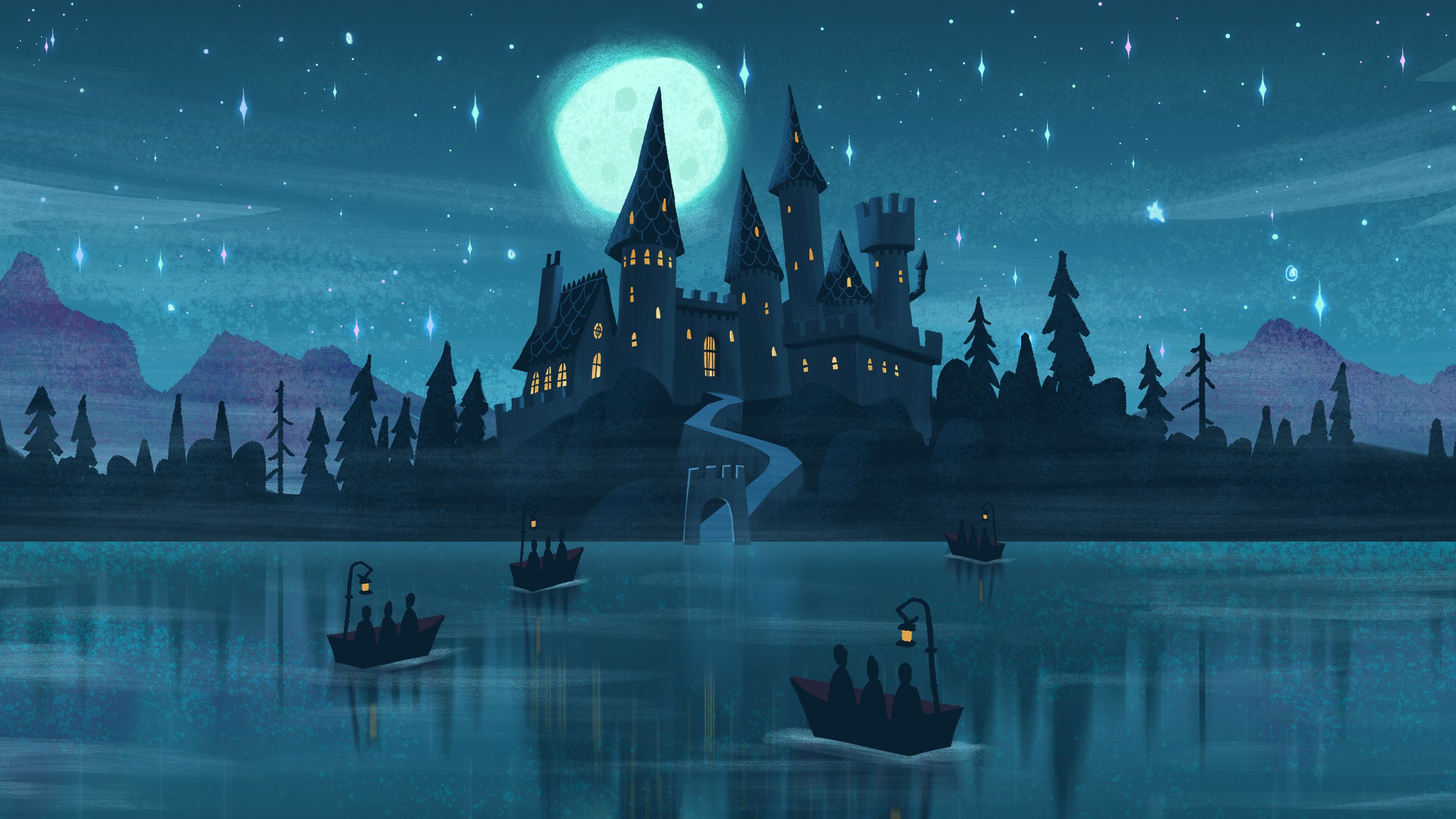
Harry Potter has been brought to life on page and screen. But what would it take to make the wizarding world come alive using sound alone? In this episode, we go behind the scenes of the new full-cast editions of the Harry Potter series, where a team of sound designers spent eighteen months crafting 130 hours of immersive audio. From the whistle of the Hogwarts Express to the rasp of the Dementors, every spell, creature, and location had to sound tangible and emotionally distinct. Featuring Will Cohen and Lawrence Kendrick of String and Tins.
MUSIC FEATURED IN THIS EPISODE
Raymond Grouse - Life on a String
Jay Taylor - Before Copenhagen
Jay Taylor - We Picked Irises
Guto Lucena - Hoodwink
Raymond Grouse - Tiny Footprints
Howard Harper Barnes - Underlying Truth
Kikoru - Live to Tell
Jon Björk - Curiosity's Awoken
Twenty Thousand Hertz is produced by Defacto Sound.
Support the show and get ad-free episodes at 20k.org/plus.
Subscribe on YouTube to see our video series.
If you know what this week's mystery sound is, tell us at mystery.20k.org.
Follow Dallas on Instagram, TikTok, Facebook, and LinkedIn.
Join our community on Reddit.
Follow You’ll Hear It wherever you get your podcasts, or subscribe on Youtube.
Explore incredible speakers, soundbars, and more at sonos.com.
Get 3 months of free payroll at gusto.com/20k.
View Transcript ▶︎
[20K sonic logo]
Dallas Reading: Then there was a great scraping of chairs, and next moment, Harry found himself shaking hands with everyone in the Leaky Cauldron.
[music in: Raymond Grouse - Life on a String]
I have three daughters, and I’ve been reading to all of them since they were born. Lately, I’ve been reading the first Harry Potter book to my nine year old.
Dallas Reading: “Doris Crockford, Mr. Potter. Can't believe I'm meeting you at last!” “So proud, Mr. Potter! I’m just so proud!” “Always wanted to shake your hand. I’m all of a flutter!”
Dallas: And how do you feel when I read it to you? Like how do you process it in your brain?
Daughter: Since it's kind of like a mystery book, I like try to stick all the pieces together, as in clues and stuff, and try to figure out what happens… or what's just about to happen next.
Dallas: Do you see pictures and stuff in your mind?
Daughter: Actually, yes. I think... Well, sometimes. Not that many though, just like a few. [downbeat]
I consume audiobooks all the time. And recently, I came across some new audio editions of the Harry Potter books on Audible. So, I queued up book one for my daughter.
[music fades under]
Dallas: I'm gonna start with chapter five, where you keep falling asleep. And I want you to tell me what you think about it, like give it a review.
Audiobook: Then there was a great scraping of chairs, and next moment, Harry found himself shaking hands with everyone in the Leaky Cauldron. “Doris Crockford, Mr. Potter. Can't believe I'm meeting you at last!” “So proud, Mr. Potter! I’m just so proud!” “Always wanted to shake your hand. I’m all of a flutter!”
[music resumes]
Dallas: So do you want to hear this kind of movie-esque version or dad?
Daughter: Ummm, movie-ish version. Sorry.
[downbeat]
Dallas: I have been reading to you for nine and three fourths years!
Daughter: Hey, this has different voices in it, and like sound effects. I guess you could add sound effects, but these have actually real sound effects. Sorry.
Dallas: I could be like, “Hagrid’s coat fell on the floor, boinnnggg!”
Daughter: You can still like sit over there while we read—while we listen to it.
[music out]
[music in: Jay Taylor - Before Copenhagen]
My daughter’s reaction stung a bit, and it’s tough thinking that my time reading aloud to her might be coming to an end. Buuut I can't say I'm too surprised. I mean, she is my kid, and these audiobooks sound awesome.
They were produced by Audible and Pottermore Publishing. And unlike a traditional audiobook with just a single voice, these editions include a full cast of voice actors, original score music, and enveloping sound design mixed in Dolby Atmos… They're basically full-on movies for your ears.
Will: It's perhaps one of the first audio experiences which is of this scale that has applied that much detail to the sound design and immersion.
That's Will Cohen.
Lawrence: It's such a new medium, this full, high-production-value world, people are still learning how to consume it.
And that's Lawrence Kendrick. Will and Lawrence both work at String and Tins, the company that sound designed these new audiobooks.
[music out]
For them and their team, it was a massive undertaking.
[music in: Jay Taylor - We Picked Irises]
Will: It's around about 130 hours of content for all seven books. And there isn't a moment in the sound where we haven't cut, for instance, the backgrounds. So it's like constant effects the whole time.
Lawrence: Scope wise, everything is covered, every movement, every location, the outside of those locations. If we're in Hagrid's Hut, I know where that is situated in the grounds, how close it is to the Black Lake, how close it is to the Forbidden Forest, how much of those elements should bleed in through the windows, what time of day it is, what time of year it is.
Lawrence: Every classroom, every bit of text was scrubbed through to see what details are in the classroom. You can't have a clock mentioned in book six and not have it in book one. So everything is totally canon to the books.
At first, the sheer scope of the project was pretty daunting. Will: We are used to working on shorter work, and we have an expectation within ourselves to make sound as great as we can. And to do that on such a scale has been really terrifying, actually.
They were also intimidated thinking about the millions of people who are obsessed with this series.
Lawrence: And they know every inch of it inside out. Yeah. Yes, I definitely was.
Will: It was a bit scary at the beginning. I've listened to the Stephen Fry version with my kids quite a lot...
Stephen Fry: Harry Potter was a highly unusual boy in many ways. For one thing, he hated the summer holidays more than any other time of year.
Will: You know, Stephen Fry, he's a part of British heritage, so to sort of be doing something quite different felt like a bit of a wrench, you know? But as soon as we heard the first passes of dialogue coming in, and the narrator...
These new versions are narrated by actress Cush Jumbo.
[music out] Cush Jumbo: Harry Potter was a highly unusual boy in many ways. For one thing, he hated the summer holidays more than any other time of year.
Will: When Cush Jumbo's first takes came in, I was like, "Oh wow. This is a really good switch up," you know? She's got such a wonderful voice and her performances are amazing. So once we got into it, the kind of overwhelming nature of it passed.
Compared to sound designing for a film or a TV show, the biggest difference for an audiobook like this has to do with pacing.
Lawrence: One of the challenges of an audio book is these moments can be very drawn out. So you're trying to make something that feels very naturalistic, and like it's happening in front of you, but a moment could be described over a page.
Will: Like, you know, if someone says, [vocal processing] “I'm casting a freeze spell," and then the narrator starts to talk about their emotional state, you know, you've already cast the freeze spell, but then five or ten seconds later, the thing happens. And so somehow, we have to work out how the pace of that works.
To deal with issues like this, they developed a rule of thumb.
Will: You need to lead the narration.
Meaning the sound of something should begin before the narrator mentions it.
Lawrence: I think it just feels more natural. Something that I, and the team were very keen was to ensure that it didn't feel too formulaic. So like a radio play. This isn't a radio play. [radio play sound effects] "He opened the door. Rrrr. Pat, pat, pat, pat, pat."
Will: Yeah, exactly. If you are told the thing before you hear it, then it's breaking the spell.
But hearing the sound a beat before you're told what it is helps immerse you in the story. Here's a quick example. Notice how you hear the eggs start frying before the narrator mentions it.
[clip: Book 1 - frying egg]
Audiobook: His hair simply grew that way: all over the place. Harry was frying eggs by the time Dudley arrived in the kitchen with his mother.
Lawrence: And it becomes this woven experience it's unfolding in the background. But the narrator and the performances are always right at the front.
[clip: Book 1 - letters flying]
Audiobook: Something came whizzing down the kitchen chimney as he spoke, and caught him sharply on the back of the head. Next moment, thirty or forty letters came pelting out of the fireplace like bullets. The Dursleys ducked, but Harry leapt into the air trying to catch one. “Out! OUT!”
While Harry Potter is filled with magic spells and fantastic creatures, Audible and Pottermore made it very clear that they wanted these sounds to feel organic and believable.
Will: They were quite strict on how organic it would be, like if it steered too far into anything synthetic or something that didn't feel attached to what the script says.
Lawrence: Broadly speaking, the rule was that it needs to feel like it's really happening in front of you. So if a wizard casts a spell, it's not sparkles and tinkliness.
[cheesy magic sound]
Lawrence: The physicality of what is happening in front of you is what drives the sound design.
Here's an example from book one, when Hagrid makes a passageway magically appear in a brick wall.
[clip: Book 1 - Diagon Alley Appears]
Audiobook: “Right, stand back Harry.” He tapped the wall three times with the point of his umbrella. The brick he had touched quivered. It wriggled. In the middle, a small hole appeared. It grew wider and wider. A second later, they were facing an archway large enough even for Hagrid.
But finding a jiggling brick sound that would last for that entire moment was harder than expected.
Will: There's quite long periods of narrative, and I'm like, "Oh my God, I don't have, I don't have this sound in my library that's even long enough.”
So Will had to do it himself.
[jiggly bricks in]
Will: I was in the middle of a renovation project at home. So I, fortunately, had some piles of bricks and off cuts of stuff in my back garden. So I just went out there and recorded a load of jiggling of bits and bobs.
Will: And so you can hear that I had to jiggle for a really long time, because the narrator's chatting away. And so, yeah, there was a lot of… a lot of jiggling.
[jiggly bricks under]
In the book, Harry steps through the hole into Diagon Alley, which is a bustling marketplace for wizards.
Lawrence: This is the first time that we move from the Muggle world, through to the wizarding world. So there was a lot of discussion upfront about The Wizard of Oz was a nice example of black and white initially, and then transitioning into color.
[clip: The Wizard of Oz]
Dorothy: Toto, I have a feeling we’re not in Kansas anymore.
Lawrence: And we wanted to make the Muggle world kind of colorless in a way. There's this difficult line to tread where you want things to be detailed, engaging, and interesting, but also have this feeling of something missing, or something a little beige.
Will: On a very basic level, we go from the Muggle world of, you know, you're lucky if you hear a Milk Float.
[sfx: Milk Float in]
For listeners outside the UK, milk floats were electric milk delivery trucks that were common for decades.
[sfx: Milk Float out]
Will: …to Diagon Alley that's full of potions being boiled just on the side of the road...
[clip: Book 1 - Diagon Alley potions]
Audiobook: The sun shone brightly on a stack of cauldrons outside the nearest shop.
Will: And owls squawking and squabbling in cages...
Audiobook: A low, soft hooting came from a dark shop with a sign saying “Eeyelops Owl Emporium.”
[clip: Book 1 - Diagon Alley owls]
Will: And all these people babbling away...
Audiobook: He turned his head in every direction as they walked up the street, trying to look at everything at once: the shops, the things outside them, the people doing their shopping.
[clip: Book 1 - Diagon Alley babbling]
Will: Suddenly, there's a huge palette of potential that we can ply sound onto. And this is the opening of that gateway.
[clip: Book 1 - Diagon Alley variety]
Audiobook: Windows stacked with barrels of bats’ spleens and eels’ eyes, tottering piles of spellbooks, quills and rolls parchment, potion bottles, globes of the moon.
A scene like this has tons of sonic layers in it. Some came from sound libraries, while others had to be found out in the world. So the team carried microphones around with them, just in case they stumbled across the perfect sound.
Lawrence: Most of us at String and Tins keep mics in our backpacks anyway. But definitely, I was pulling out and grabbing things whenever the opportunity arose that reminded me of a moment from the books.
For instance, crowd sounds, also known as walla, are pretty easy to find in sound libraries. But for Diagon Alley, they specifically wanted voices of an old fashioned stone street. Then one day, Lawrence and his family visited Stratford-upon-Avon. It's a medieval market town, which is famous for being the birthplace of Shakespeare.
[Stratford-upon-Aven sounds in]
Lawrence: So I was in Stratford-upon-Aven, walking down the cobbled street. And then ditched my wife and child to go and record this proper, authentic, oldie-wordly street with all of these excited people from all over the place.
[Stratford-upon-Aven sounds out]
For Will and Lawrence, one of their most exciting days of recording came when they captured sounds for the Hogwarts Express, the train that takes students to the wizarding school of Hogwarts. For that, they recorded a real steam train that was built in the late forties.
[music in: Guto Lucena - Hoodwink]
Will: It was like this little private railway called the Spa Valley Railway. And we got to go and record there for the day. And took a team out and recorded every bit of this amazing steam train that we could, including a whistle.
[Train whistle 1 & 2]
Will: We're setting up audio in this amazing old early 1900s steam train warehouse just full of bits of steam trains. Everyone hit record, and then they kicked off this thing. And it was the—probably the loudest thing I've ever recorded.
[Train whistle 3]
Lawrence: And yeah, just gushing steam.
[Train whistle 4]
Then, they recorded the train running down the track, from every possible angle and distance.
Lawrence: Because there's so many points when you're cutting perspective. Sometimes we're following the train from the flying car from above it. [sfx: train from above] Sometimes we're within a carriage. We recorded the ambience of every carriage. [sfx: carriage ambiance]
Will: Yeah, we stuck some clip mics underneath the train so that we could pick up the clacks and mix that into any background we wanted. [sfx: train from beneath] And then we had someone down the track. Our colleague George took this microphone out into a field and recorded some distant toots.
[music out with sfx: distant toots]
Once they had all of that material recorded, it could be woven together into scenes like this.
[clip: Book 1 - Hogwarts Express Departure]
Audiobook: “George!” “Only joking, mom!” The train began to move. Harry saw the boy’s mother waving, and their sister, half laughing, half crying, running to keep up with the train until it gathered too much speed. Then she fell back and waved. Harry watched the girl and her mother disappear as the train rounded the corner. Houses flashed past the window. Harry felt a great leap of excitement. He didn’t know what he was going to, but it had to be better than what he was leaving behind.
At Hogwarts, one of the most important settings is the Great Hall, where the students eat and socialize. To create that environment, they recorded at a real school.
[music in: Raymond Grouse - Tiny Footprints]
Lawrence: They had an amazing big hall and we managed to borrow a load of eager kids for a whole day, and captured them in their natural habitat, you know, being kids. And it was just so authentic. The best moments were those when we weren't directing them, when they were just left a mic running.
[sfx needed: casual chatter]
Lawrence: So we're capturing all of these kids being their true selves in schools, and then getting all of these songs, or moments, reactions.
[sfx: kids cheering at school]
[music and cheering out]
Here's that same moment in the book.
[clip: Great Hall - Cheering for Neville]
Audiobook: Someone standing outside the Great Hall might well have thought some sort of explosion had taken place, so loud was the noise that erupted from the Gryffindor table. Harry, Ron, and Hermione stood up to yell and cheer as Neville, white with shock, disappeared under a pile of people hugging him.
At one point in the books, the Slytherin kids make up a song called Weasley Is Our King to make fun of Ron Weasley. And that was one of the songs they taught the kids.
Lawrence: Yeah, so they're all being themselves, did an amazing job. The kids that are sort of struggling to keep focus that just adds authenticity.
[sfx: Weasley is Our King]
Lawrence: That one kid who sings it an octave higher than everyone else is just, uh, hilarious and just so true.
[sfx: Weasley is Our King]
[music in: Howard Harper Barnes - Underlying Truth]
Many of the scenes in the books were built around grounded sounds like these. But of course, there were also lots of magical elements that came with their own sonic challenges... from mythical creatures… [sfx: Dementor] to spells and curses of every kind. [sfx: positive spell]
That's coming up after the break.
[music out]
MIDROLL
[music in: Howard Harper Barnes - Underlying Truth]
While sound designing the new Harry Potter audiobooks, the team at String and Tins were obsessive in their attention to detail. For example, they gave every door in the story its own unique sound.
Lawrence: There's the authenticity about what these places sound like, and what would the acoustics of that space sound like, and making them all unique and iconic so that you recognize it. And then also even thinking emotionally about what each location evokes.
[music out]
For instance, each House in Hogwarts is represented by an animal. For the brave Gryffindor house, it's a lion.
Lawrence: So there's elements of roaring baked into the Gryffindor Common Room door.
[sfx: Gryffindor Common Room door]
For the cunning Slytherin house, it's a snake.
Lawrence: There's a hissing snake texture with the Slytherin Common Room door.
[sfx: Slytherin Common Room door]
Here's the door to Harry's vault in Gringotts Bank, which is filled with gold.
[sfx: Harry's vault door]
Will: That's a rare example of some sparkles there.
Lawrence: I think there's, uh, there's cash, right? Shifting around in there.
Will: Oh yeah, sorry. No, you're right. That's the shifting cash. It's not a broken rule.
Then, there's the door to Vault Seven Hundred and Thirteen, a high-security vault used by Dumbledore.
Lawrence: Yeah, a little more mysterious, 'cause it's a more mysterious vault.
[sfx: Vault 713 Door]
Lawrence: This level of detail and consideration's been given to literally every single door. It doesn't draw your attention to it, but it does something to you emotionally, I think.
[music in: Kikoru - Live to Tell]
One set of sounds that involved lots of this emotional layering was the spells.
Lawrence: They’re such a critical part of the wizarding world of course, so a lot of care was taken into their approach of them.
Lawrence: Also, within the book, like we were saying earlier, there's this multiple-beat approach to the way that books unfold in front of you. So there's a casting sound where the spell is manifested, sometimes there might be a traveling element to that spell. And then there's the action of it.
Lawrence: So if it unlocks a door, then it's the sound of a door actually unlocking. It respects the size of that lock. It might be a big clunky sliding gate, or it might be a little intricate box or something.
[clip: Alohomora]
Audiobook: “Alohomora!” The lock clicked, and the door swung open.
Lawrence and Will wanted there to be some kind of sonic relationship between the various spells.
Lawrence: I initially had this idea of making different spell castings for jinxes, curses, counter curses, and giving them all an individual flavor. I must have done 40 different options for spell castings, but it was just turning into quite a complex... It was becoming distracting, basically.
So they ended up dividing the spells into just two categories: positive and negative. Basically…
Lawrence: ...whether has a positive or negative intent.
[music out]
Lawrence: So I'll give you a little blast of the positive spells on their own.
[sfx: 3 positive spells]
As you can hear, these positive spells all have a kind of electric shimmer to them, and they're even a bit musical.
[sfx: 2 positive spells]
Lawrence: I also had this idea of striking a match. I thought, “It's kind of the closest that I can, as a Muggle, come to casting a spell" in my mind, like that strike and the flaring of it.
[sfx: match light]
Lawrence: So I, definitely, terms of the rhythm of it, that was always in the back of my mind.
Audiobook: “Lumos,” Harry muttered, and a light appeared at the end of his wand, almost dazzling him.
By contrast, the negative spells have an animalistic snarl to them, along with a sinister, breathy layer.
[sfx: 2 negative spells]
Lawrence: There's definitely animal layers in there.
Will: Feels a bit vocal as well, doesn't it?
Lawrence: Yeah, I'm a big fan of sitting in front of a mic, and making noises, and then wibbling them about. Especially 'cause we're making something organic, based in the real world, vocal things are real and alive. So that felt relevant and cool for this one.
[sfx: 2 negative spells]
One of the most famous spells in Harry Potter is the Patronus Charm, which conjures a magical guardian creature that's unique to each person. Harry's Patronus is a stag. And for the scene where he first conjures it, Lawrence crafted a whole ethereal soundscape.
[sfx in: Harry's Patronus]
Lawrence: It's literally an abstracted stag call.
Lawrence: There are choral layers.
Lawrence: I've got a layer called “Throbby Swirls.”
Lawrence: A trick we like to do quite often is drawing sounds out… with granular tools, and then using the textural elements that come out of it to make something that feels wide and all-encompassing.
Lawrence: This is a particularly musical element. Generally, we've always steered well clear away from music. There's a dedicated scoring team… But this one needed it.
Lawrence: There's an element of… I wanna say sadness? But it's melancholy or something. There's… It definitely makes me feel something.
[Patronus out]
In the book, Harry conjures his Patronus to fight against the Dementors... which are evil hooded creatures, sort of like the Ringwraiths in Lord of the Rings.
[clip: Fellowship of the Rings - Ringwraiths]
Lawrence: They've got to be terrifying because everyone that is within the vicinity of them has all the happiness drained out of you. And so you wanna try and get that feeling with the listener as well.
To create the sound for the Dementors...
Lawrence: I had a very clear, brief an idea, initially, where I watched this YouTube video about inhale screams, which is like a metal singing technique, where you literally inhale as you scream.
[clip: The Browning - OMNI]
Lawrence: It felt thematically right, because the Dementors are inhaling your soul. And it just sounds rad, and it sounds very dangerous
Will: Can you do one?
Lawrence: Oh, I definitely need to try to. It makes me cough quite a lot.
Will: Can I try one?
Lawrence: Oh yeah, go for it.
[inhale screams]
Will: Oh, that's good.
[inhale screams]
Will: Oh God. Yeah, that's a real throat tickler.
Lawrence: So that was, yeah, an initial idea which, I love having something to go on to start, rather than staring at a blank page and just throwing things at it.
**But then, their colleague Phil Lee took things a step further.
Lawrence: Phil gargled egg whites, because it has that sort of sticky, textural thing, and clings to your throat, and sounds particularly bubbly and gloopy.
[sfx: Raw egg white gurgling]
Will: Ugh.
Lawrence: So he took one for the team and did some “globblobblobbling” with egg whites in his mouth.
[sfx: Raw egg white gurgling]
Add some modulation and pitch shifting, and you end up with this.
[sfx: Dementor - Final Mix]
Here's a Dementor in the audiobook.
[clip: Dementor scene]
Audiobook: The hand was suddenly withdrawn into the folds of the black material. And then, the thing beneath the hood, whatever it was, drew a long, slow, rattling breath, as though it was trying to suck something more than air from its surroundings.
Now, the Dementors don't talk. But there are plenty of other creatures that do. And for those moments, they'd often use the actor's performance to trigger other sounds... That way, these extra layers would dynamically shift with the actors' pitch or volume.
Lawrence: So that it feels tied together like it's a singular item.
In book two, for example, Harry encounters a giant, talking spider named Aragog. Notice the clicking sounds underneath Aragog's voice.
[clip: Aragog scene]
Audiobook: “I was sleeping!” “We’re friends of Hagrid’s!” His heart seemed to have left his chest to pound in his throat. “Click, click, click” went the pincers of the spiders all around the hollow. Aragog paused. “Hagrid has never sent men into our hollow before.”
Lawrence: There's lots of elements to the clicking, but the main one that I wanted to play along with, I just wanted control over it. So I think it's just me going [click] and then putting that into a sampler through a bunch of effects [clicks] using an emitter to trigger that, kind of like an arpeggiator, but with some random elements to it.
In other words, he made those clicks into a digital instrument.
Lawrence: And then I could just play that along the voice. So… [clicks]
Lawrence: Obviously, it sounds a little pitch. So you'd find something tastier down lower. [clicks] And then as Arag go was performing, then I could dial that in and perform. So the… the more angry he gets, the more I'm able to bring them up.
Along with these mouth clicks, they layered in leathery sounds... [sfx]
And shifting hair sounds. [sfx]
Lawrence: And having them all dynamically move along with the performance.
[clip: Aragog 2]
Audiobook: “In trouble?” said the aged spider. “But why has he sent you?”
Lawrence: So yeah, a lot of our creatures are tied to keys on a keyboard, or even just a knob to twizzle. Being able to perform along with the story just lets you dial into those little nuanced storytelling moments.
[music in: Jon Björk - Curiosity's Awoken]
Both Will and Lawrence have been Harry Potter fans for decades. For Lawrence, he grew up with the books.
Lawrence: I stayed up late reading all the books. I got 'em as they came out. I won Harry Potter quizzes and stuff back in the day. Yeah, huge fan.
Whereas Will was more familiar with the movies.
Will: I've watched the films and I love the films. And so, recreating something that has been part of our upbringing is… is kind of cool.
After eighteen months of intense work, they completed the sound for all one hundred and thirty hours of material. Then, they waited to see how people would respond.
Lawrence: We love it so much, and we've been so excited about it, but you don’t know what anyone else is gonna say, right? It's very close to people's hearts. But the first reviews started coming out, and they were calling out specific moments that you remember putting in there. And the reception was so positive, and I was so very proud, and very pleased.
Will: Yeah, they really were flagging how cool the sound design was, which is immensely gratifying for sure.
For them, this was the rare project that even people outside the sound world could understand and appreciate.
Lawrence: It's not very often that all my friends are listening to this stuff. And you know, my friends are proud of me for what I'm making because they all grew up with it as well.
And unlike the endless stream of commercial work that comes and goes, they know that this will be remembered.
Lawrence: There are very few mediums like this which just stand, exist, and get played again, and again, and again, and are valid forever. I'll still be proud of this when I'm an old man.
[music out into music in: Jay Taylor - Before Copenhagen]
Twenty Thousand Hertz is produced by my sound agency, Defacto Sound. Hear more at Defacto Sound dot com, or by following Defacto Sound on Instagram.
Other Voices: This episode was written and produced by Casey Emmerling, with help from Grace East. It was sound designed and mixed by Colin DeVarney and Joel Boyter.
Thanks to our guests, Will Cohen and Lawrence Kendrick from String and Tins. Will and Lawrence wanted to make it clear that this project was a team effort.
Will: It's worth saying we just had a really awesome team: Pete Doggett, Phil Lee, Kevin Langhammer, and Damien Pace with our most excellent tech, George Hinson. We love you very much, George.
Finally, take a moment to think of the biggest Harry Potter fan you know. Then, tap the Share button in this podcast app, and send this episode to them.
I'm Dallas Taylor. Thanks for listening.
[music out]