Art by Jon McCormack.
This episode was written & produced by Leila Battison and Casey Emmerling.
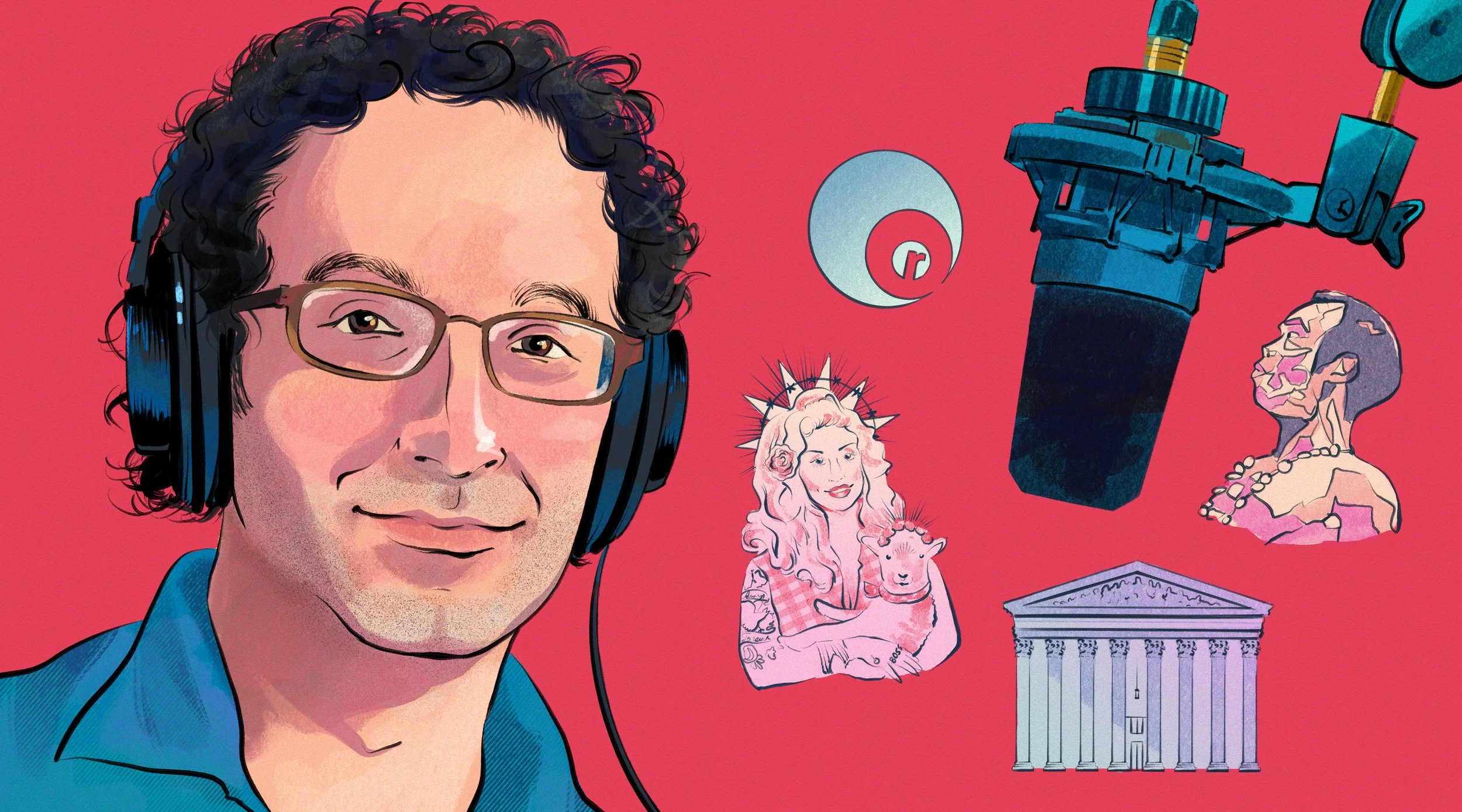
Before Radiolab became a cultural phenomenon, it was an experiment… one that Jad Abumrad built voice by voice, sound by sound. In this episode, Jad walks Dallas through his journey with the show, from its scrappy beginning in a New York basement, to leading a massive team, and ultimately stepping away. Along the way, he breaks down his signature sound design and storytelling techniques, and how he’s carried those into newer projects like Dolly Parton’s America and Fela Kuti: Fear No Man.
MUSIC FEATURED IN THIS EPISODE
Wesley Slover - Good Question
Wesley Slover - Process
Wesley Slover - Recollections
Wesley Slover - Into the Light
Wesley Slover - Control for Quality
Wesley Slover - Pursuit of Mastery
Wesley Slover - You're Not the Protagonist
Wesley Slover - Breach of Trust
Wesley Slover - Waiting Game
El Flaco Collective - Special Report
Wesley Slover - Forager
Learn about this year’s Listener Stories competition and submit your story at 20k.org/2026.
Twenty Thousand Hertz is produced by Defacto Sound.
Support the show and get ad-free episodes at 20k.org/plus.
Subscribe on YouTube to see our video series.
If you know what this week's mystery sound is, tell us at mystery.20k.org.
Follow Dallas on Instagram, TikTok, Facebook, and LinkedIn.
Subscribe to Radiolab, More Perfect, Dolly Parton’s America, and Fela Kuti: Fear No Man wherever you get your podcasts.
Sign up for a one-dollar-per-month Shopify trial at shopify.com/20k.
Visit quo.com/20k for 20% of your first 6 months of business phone software.
Get 3 months of free payroll at gusto.com/20k.
View Transcript ▶︎
[20K sonic logo]
[music in: Wesley Slover - Good Question]
Over the last ten years of Twenty Thousand Hertz, we've explored sound from so many different angles… from films and TV shows to history, brain science, and beyond. But I would be remiss if we never covered the person who I consider the most recognizable and interesting sound designer in podcasting… I also think about this person as simply being one of the greatest sound designers in history. And that's Jad Abumrad, who I first knew as the creator of Radiolab.
[Radiolab sonic logo]
[music resumes]
For years, Jad was Radiolab's main host, editor, sound designer, and composer. And the way that he uses immersive sound to craft emotional, enlightening stories inspired the sound of Twenty Thousand Hertz. But it's not just about inspiration… Twenty Thousand Hertz wouldn't exist without Jad Abumrad and Radiolab
And here's why. Unlike YouTube videos, Instagram or TikTok, podcasts don't grow by going viral through an algorithm… Instead, they often grow when a more popular podcast replays one of their episodes, or features the host as a guest. And back in 2011, Radiolab played an episode by a little show called 99% Invisible. That boost helped 99pi expand into a huge success. And then, years later, 99pi paid it forward by featuring Twenty Thousand Hertz several times… which I know is how many of you first heard us. So I like to think of our show as the grandchild of Radiolab, and that it continues the sonic standard that Jad created.
[music out]
Recently, I had the opportunity to spend the day with Jad at his home studio in New York City to learn all about his creative process, and his thoughts on audio storytelling. So, on a crisp autumn day, I knocked on the door of his studio.
Jad: Heyya. Come on in. Welcome to my studio.
[music in: Wesley Slover - Process]
Jad: My name is Jad. I'm not quite even sure what to call myself these days, but musician, composer, radio storyteller, podcaster. I created Radiolab and Dolly Parton's America and a bunch of other radio shows and podcasts, and mostly I do it here.
Jad's studio is a bright room with a desk, a computer, and musical gear all over the walls and surfaces. Microphones, synthesizers, stringed instruments, guitar pedals....
Jad: This has been my sanctuary and my workspace for about 14 years.
Like me, Jad didn't start his career wanting to tell audio stories. I went to college for music, and played trumpet in the orchestra. For a while, I wanted to be a conductor. And Jad actually has a pretty similar background.
Jad: So I went to Oberlin Conservatory for four years to ostensibly be a composer, which is what I kind of thought I was gonna do. Ever since I was five, I pretty much had that idea. I was like, "That's what I'm gonna be."
Jad: And so I came to New York to do that, and it didn't go well. I realized that writing music for other people actually turns out to be really hard.
[music abrupt out]
Jad: So a couple years outta school, I kind of had the post-college flail, "What am I gonna do with my life" moment. My then girlfriend, now wife, we were standing on the platform to the G train, and I remember she was like:
[subway platform in]
Jad: "Well, you like to write stories and then you like to play music. You don't seem to be doing well at either independently, but what if you stuck them together and like, I don't know, do radio?"
Jad: I was like, "Oh, okay."
[subway platform under]
[music in: Wesley Slover - Recollections]
Jad: I ended up volunteering at a radio station purely based on that insight of hers. And the first day that I showed up, there had been some sort of staff revolt the day before or something. The place was empty. There was the news director and he had nobody to cover the news. And I just walked in the door and he was like, [wordized] "Take this tape recorder, go to City Hall. There's a protest. Cover it."
[sfx: running, city passing by]
Jad: And I remember just like running towards City Hall being like, "What do I do with this thing?" Like, "What does it even mean to cover something?" I had no idea.
Jad: I recorded some tape, ran back to the station. And then you were [sfx] cutting it with razor blades. And first day, I was like [sfx] taping bits of tape together, [sfx] and long story short, by three o'clock that night, I had a 12 minute piece on the radio. [sfx]
Sadly, that segment has been lost to the sands of time… which Jad actually might be happy about.
Jad: I mean, it was horrible. It was terrible. I didn't know how to talk into a mic. I didn't know how to ask questions. I barely knew how to edit. But like it was… I just remember hearing that and being like, "Oh my God, this is everything I want in life."
Jad: You get to go out into the world, talk to people, ask them questions. You bring that material back. You choose the moments you like, that you find meaningful. You write the connections between them, and then you try and communicate that to an audience. And I had done all of that in the same day. And at that moment I was like, "This... This is what I wanna do with my life."
Jad: And then the surprise was that, years later, started Radiolab, and it got going. And then I started writing the music for the stories. And I realized, "Oh, I'm a composer. Like I'm still a composer." And not just with music, but when you're choosing the voices, and you're trying to figure out they go together, that's composing too. Like you're composing the relationships between the ideas and the voices. And then, increasingly, the sounds.
Jad: That became like, "Oh, this is the kind of composer I get to be. Not just the music kind, but the ideas, thoughts, worlds, voices, everything kind."
[music out]
Here's a clip of an early Radiolab episode called Memory and Forgetting. Listen to how the music and voices weave together to pull you into the story.
Radiolab: Maybe memory is more creative than that. Creative? Yes. On a literal level, it's an act of creation. Yeah exactly. We're reconstructing those memories. Construction. Maybe it's more like painting, or sculpture. Everyone's constantly their own artist.
Radiolab: We take bits and pieces of experience. Some things get sharpened, other things, leveled. And infused with imagination and… Out of that, construct what feels like a recollection. It's a… it's a beautiful process. It's… It's unbelievable.
Jad: My whole acoustic world is basically the idea that you take familiar sounds and you treat them to make them strange.
Radiolab: Growling and roaring. I mean, it sounded incredible. Raw power.
Jad: Which is sort of the storytelling philosophy, right? It's like, you meet the audience where they are, and then you gradually walk with them into new landscapes, new strange worlds. And so the sounds should have that quality too, of like, "I can kinda recognize what these sounds are, but they should feel uncanny, like they're also alien at the same time."
Radiolab: In terms of time, I do believe that we can travel in time. I'm not talking to you about actual time… time travel.
Jad: I am of the cast in mind where I can live in my head really easily, and I can dissociate from the world.
[subway interior - approaching station]
Jad: Like you have these moments when you're on the subway, and I'll look out of the window as we're pulling up to a platform and there's somebody like just reading a book waiting for the subway.
Jad: I'm just struck with like, "My God, that's another mind. That person is in a book who I couldn't even begin to imagine the thoughts that they're having."
Subway Voice: Stand clear of the closing doors, please.
[subway pulls away from station]
Jad: And for me, interviewing another person is a way to like, pull you into the now, pull you into like, "Here we are in this moment together."
Jad: And similarly, the sounds are my attempt to do that for the audience in a way to really pull them into the experience of being with this voice. And it's hard. I mean, it's hard to get to that place, especially these days when we're all so distracted. But that's the intent. That's the hope.
From the very beginning of Radiolab, Jad was treating sound in radical ways. The show began in 2002, before podcasts even existed. Back then, it was a three-hour radio show on New York's WNYC. Here's a clip from the very first episode, where Jad almost sounds like a beat poet.
[clip: The First Radiolab]
Radiolab: WNYC is about to embark upon an experiment. We're calling it The Radiolab. What were gonna do is take different great documentary radio and stories, of different sizes, and shapes, colors, from different places all over the planet, from different times even. And we're gonna mix them all together like this. A big brew of people and places. But it'll take 2 hours and 59 minutes to get through all of it.
Jad: I started the thing I'm most known for, Radiolab, in the basement of this house, so literally three floors down. And I did everything. I did every piece of that for years. I would literally like be scoring a thing, tracking, scoring, tracking, editing. I would just, everything was always happening at the same time. And I loved it. But also, it was crippling, you know?
Jad: There are days when you feel exalted because you have command of so many different things. And then there are days when you feel like you're gonna suffocate, because not only is the work too much, but also you feel like you're trapped in your own brain.
But soon enough, Jad was joined by two people who'd become key to the show's identity. First, there was Executive Producer...
Jad: Ellen Horne, somebody who doesn't get enough credit for Radiolab, but should. We would be nowhere without her.
Then, there was Robert Krulwich, who first appeared as a guest-host on an episode called Time.
Radiolab: This is Radiolab, I'm Jad Abumrad. My guest tonight for the next hour to help me wrestle with time is the science correspondent Robert Krulwich, of ABC News and Nova and Nightline. How are you sir?
Radiolab: I'm very well. I like this "Bathing in Beethoven" thing you've got going on here.
Radiolab: It's cool, right?
Jad: Robert, who I co-hosted the show with for many years, smartest man I ever met. Probably the smartest person I will ever meet.
By 2004, the show had morphed into a more distilled, produced format... exploring scientific stories, with a bit of philosophy mixed in.
[sfx: montage of early Radiolab eps]
[designed panning]
Radiolab: I'm Jad Abumrad. I'm Robert Krulwich.
Radiolab: This is Radiolab, a series about science and discovery…
Radiolab: This hour we'll be talking about…
Radiolab: The true healing power of lies…
Radiolab: The biochemistry of love…
Radiolab: Why do we sleep?
Radiolab: Why do we laugh?
Radiolab: Why do we blink?
Radiolab: What is a parasite, precisely?
Radiolab: We'll look at time so closely, we'll discover new things about it.
Radiolab: We will do as Steve urges, and step away from the individual to find mystery, beauty and order in the group.
Jad: The greatest joy for me would be in the latter stages of the process when it's just you. Usually it's late at night, and I've got a whole screen full of voices, and I'm trying to sort of push the little bits of interview tape, little colored blocks on the screen into the right order, and figure out how I'm gonna slide my own thoughts and narrations in between.
Jad: That process, that Lego-building process, was so pleasurable to me. And that's where I would take the most risks. That's what I would do little experiments, I would try stuff. That used to be the best part.
[music in: Wesley Slover - Into the Light]
In 2005, Radiolab started posting their episodes online, so that people could download them and listen anytime... In other words, the show became a podcast. And as it grew in popularity, more and more people came on board.
[downbeat]
Jad: Working initially with other people was like oxygen. It was like, "Oh, thank God. Like other thoughts, other perspectives." I loved it.
Jad: Then you have to figure out how to disentangle the process. 'Cause initially, I didn't think about process. It was just like me sitting here doing the thing. And you can't run a show that way. Like you've gotta have systems and a kind of algorithm that carries a work all the way through.
Jad: That took me a minute to figure out. I mean, talk to the folks I've worked with for years at Radiolab, they may say I never figured it out. But, um, I really took seriously like making space for people so that their ideas could be heard unadulterated, so that, in many cases, the music that they wrote would be on the story, that the interviews, the ideas suddenly were coming in from all over the place.
Jad: And as a deeply introverted guy, that was so fun. It was so fun to learn that. And I had to learn. It was not instinct. I had to develop those instincts.
[music out]
Jad: When the team grew, we started to put a lot more pressure on like finding stories you've never heard before. And when the show went in that direction, I actually started to really love the reporting part. Sitting and talking to people, particularly like working with a guy like Robert, getting to just sort of sit with him and ask people questions was so fun.
Radiolab: You ready for this?
Radiolab: Well, I don't know what we're doing.
Radiolab: You genuinely don't know what we're about to do, right?
Radiolab: I don't know. No idea.
Radiolab: Will you just state that for... for the record?
Radiolab: Audience, people, I have no idea what it's about to happen.
Radiolab: That's good. I like you in that state.
Jad: And then as the show grew and it went from like five to ten to like at some point twenty, thirty people. I don't—I forget exactly. Then it was about, "Well, how do you run a team?" It was never easy for me, but I began to really like the questions about, "How do you organize people's labor?" and… You know, we really did a lot of work to try and make the show feel better to work on.
Jad: And those problems, as hard as they were, were actually really interesting to me. Like, "How do you be a good steward?" And then, a lot of the times that meant stepping out of the room, not being involved, and like creating space for others.
[music in: Wesley Slover - Control for Quality]
By 2010, Radiolab was one of the biggest podcasts on the planet. One of their classics from this period was an episode called "Colors."
Jad: I think it was at one time, this was the episode of Radiolab that was the most downloaded.
Jad: The whole idea of this particular piece was that like suppose you had a bunch of creatures gathered together looking at the same rainbow. Like you had a, a cow, a sparrow, a uh, butterfly, and a whale, let's just imagine.
Jad: They're all right there together, and they're looking at a rainbow. "Who sees the best rainbow?" was the question. And it turns out that the champion rainbow-seer was the mighty mantis shrimp.
At this point, Jad pulls up some photos of this incredible multicolored shrimp. It looks kind of like a small lobster, with a shell that's vibrant green, blue, and electric pink.
Jad: Look at that. It's beautiful.
Jad: But anyhow, they have these incredible eyeballs. So like, we humans have three rods and cones in our eyes.
Rods and cones are the light sensing cells, and each one is tuned to different wavelengths, or colors. We have one for red, one for green, and one for blue, which combine to make all the colors we can see. But the mantis shrimp is different.
Jad: These creatures have 16. So they, presumably, can see thousands, millions of colors, we don't know. But way past our sight. And so we were trying to sort of render that for the audience. But the problem is we work in radio where you can't see anything. And also, even if you could see, even if you did have a picture, you cannot see what the mantis shrimp sees.
Jad: So what we ended up doing was using an extended audio metaphor of a choir.
[music out with sfx: choir chord]
Jad: So we sent a message to a choir listserv, and I was like, "We have two days to do this. There's no way that we're gonna get this done." But within a day, I was in a church, and there were like 150 people singing the colors of the rainbow, because choir people are the most amazing people on earth.
Jad pulls up a video of him working with that choir.
Jad: So this is the choir.
[clip: choir video]
Jad: So all those people just showed up, like literally within 12 hours.
[clip: choir video]
Jad: So I was just figuring it out on the spot.
[clip: choir video]
Jad: The idea was as you go from like a dog singing the rainbow, dogs have two rods and cones, you'd hear a very narrow band of frequencies.
This is how it sounded in the Radiolab episode.
Radiolab: In the case of the dog… very different rainbow. It's gonna start off blue, he'll be able to see blue just fine. So it would see a rainbow starting with blue. Same blue we see. And then grading off into green. Same green as us. And then disappearing. The rainbow would end there.
Jad: And then as you go to like sparrow, butterfly, and then ultimately the mantis shrimp, you could hear the sound world just expand to contain all of this like density of notes and frequencies.
Radiolab: They would start the rainbow way, way, way, inside where we see violet. Where we see violet, they would see extraordinarily deep ultraviolet. And then they would go on through several kinds of ultraviolet. Probably five or six kinds of ultraviolet.
Radiolab: And then they would get to violet, which, now they're reaching our colors. And go through violet and violet blue and blue and blue green. Where they have those green green blue blue blues as well? Yep. And they would go out into the reds. So they would be about as red as us when they got to the red end. But only in the reds? Yeah.
Jad: And it was a really good way to not just explain Mantis vision, but to feel it, to like experience it. And that's the thing, it's like whenever you're explaining something, if you're actually just explaining it, you've already lost. You have to create an experience that someone can have with you.
[music in: Wesley Slover - Pursuit of Mastery]
The "Colors" episode is a perfect example of how Jad weaves storytelling with sound.
Jad: The way that it lives in your mind is so different than visual storytelling. There is something that happens when you hear a voice and you don't have the image of the person. It just fills your imagination. You imagine that person, they seem simultaneously a thousand feet tall, and like right there, human-scale in the room with you.
Audio storytelling requires a kind of collaboration between the speaker and the listener.
Jad: Because of the thing that's not there, the picture, it forces the person listening, and the person speaking to come together to fill in the gap. It's almost like I have to hand you the paintbrush and you finish the picture. So we're doing it together.
Jad: Whereas visual storytelling, as powerful as it can be, it's very much a sort of lean back, and it just kind of comes at you. But when it's in your ear, it pulls you in, in a way. And in that way, it's a very warm feeling. And it's a very special feeling when you can fill a person's mind that way.
[music out]
As Radiolab evolved, they started tackling more complex social questions.
[montage: middle period Radiolab topics]
Radiolab: So today on Radiolab, we're continuing our thought about citizenship. Yeah, about what it means to belong to a place or a country.
Radiolab: Who has a right to be forgotten? Or who doesn't have the right to be forgotten? Who's making those decisions? What are the kinds of things that they're thinking about?
Radiolab: I just keep wondering, like, in this moment, can one person stand for all of us anymore?
Jad: It was so many people creating the show, and then it did get much, much bigger than any one person. It became an attitude towards information. Like, "How do you move through a world that is complex and sometimes scary and full of delight, and sometimes hard to tell the difference?"
Jad: And I think we were modeling that, initially for each other on the team, but then for the audience: you do it with great humility, with like joy, with a sense that you're always looking for the small T truth.
Dallas: What does "small T truth" mean?
[music in: Wesley Slover - You're Not the Protagonist]
Jad: "Small T truth" would be the recognition that we all define it differently, and yet there is some kind of objective reality, but I don't think any of us can really get there. There's always an intersubjective gooey space where you get lost.
Jad: We started as a science show, and I think one of the sort of fallacies that science reporters make is that they just assume that science is the definitive path to truth. I don't think it's the only way to measure truth. I think there are other ways.
Jad: Some people hate it when I say stuff like that. I have great faith in the scientific method, and I trust it a lot more than most things. But if somebody has a lived truth that leads them in another direction, you have to respect that, you know?
Jad: And so that's what I mean by "small T truth" is that there are many different kinds. Often you can have many different in conflict, and yet simultaneously true. So for me, like the reporting has to acknowledge that, that a fact can happen and we can all define it. But then the interpretation of that takes us in… night and day, right? There's just a subjectivity to it that I think cannot be discounted.
[music out into music in: Wesley Slover - Breach of Trust]
In his two decades with Radiolab, Jad became a podcasting icon. But in 2022, he chose to leave the show behind. After the break, Jad explains that difficult decision, and reveals the new ground he's broken since then.
[music out]
MIDROLL
[music in: Wesley Slover - Breach of Trust]
Jad Abumrad is the creator of Radiolab, and one of my personal sound and podcasting heroes. But Radiolab is just one of the excellent shows he's created.
[music fade under]
Jad: Initially, the first thing that spun out of Radiolab was More Perfect.
More Perfect: More Perfect, a miniseries that we're just getting going about some of the ideas and the cases that flow through the Supreme Court.
Jad: …which was really applying the Radiolab lens to the Supreme Court.
[clip: More Perfect theme]
Jad: And then Dolly Parton's America was also concurrent with Radiolab.
[clip: Dolly Parton's America]
Dolly Parton's America: What is Dolly Parton's America? Well, Dolly Parton's America would be the same as Dolly Parton's World. Hey, I'm Jad Abumrad. Let me explain how I got here to a podcast about Dolly Parton.
For this nine-part series, Jad spent two years following Dolly around to learn about her world... from her rise to fame, to her lyrics, to her complicated place in pop culture. And Jad's studio is still littered with things he used in that show... like a stringed instrument he pulls off the shelf.
Jad: I created a lot of that score using this. This is a, uh... dulcimer? Is that what this is?
Jad: I don't know. I ordered it. And it's horribly outta tune right now. But, um, I ended up sampling it using this mic, creating a lot of instruments that then became like these very big lush pads.
Dolly Parton's America: The only other thing I would say is treat her lyrics seriously in a way that Johnny Cash has had books written about his lyrics, Hank Williams has been taken seriously, but Dolly Parton hasn't.
[clip: Dolly Parton's America]
Next, Jad pulls a stack of Dolly Parton cassette tapes off a shelf.
Jad: For the Dolly score, I got—ended up getting a ton of cassettes off of eBay. And I would play it through these old cassette recorders where you could vary the speed and like kind of create effects with the cassettes.
[clip: Dolly Partons' America - Jolene Remix]
While making these shows, Jad continued working at Radiolab. But after two decades, his role there had completely shifted.
[music in: Wesley Slover - Waiting Game]
Jad: Because of the way the show started, I was doing every aspect of it. It was very personal. And then, you know, as the show grew, I started trying to learn how to be a better leader of people. But where that puts you is that you're deliberately on the outside of the action.
Jad: It would always be the case, toward the end of the show, where I was simultaneously the most important and least important person in the room. And that it was important I be in the room, but it was also important I not speak. Because if you're the founder of a thing, your words always create a kind of a distorting effect. That's how it felt in any case. And that started to feel a little bit torturous, frankly.
Jad: And also I was just feeling restless. I was like, "I—I wanna try weird things." And like, it was so easy to be weird and try experiments when no one was listening. But then now there's like a whole business logic wrapped around the show, and it's harder to experiment.
So in 2022, Jad decided it was time to move on. This is from the episode where he announced his departure.
[downbeat]
Radiolab: Everybody here at the team has worked so hard to establish this group, and it really is the most beautiful, talented collection of people I can imagine. And you guys are poised to take the show to new places, and I just can't wait to be a listener and to just experience what you guys make along with everybody else.
Jad: One of the things I'm most proud of in my work journey is that I handed that show off in a way that took care of those people. And they're still doing it. And they're still killing it.
[music out]
Jad: After Radiolab had kind of transitioned, I started teaching, and then I did a lot of music and theater projects, really sort of thinking to myself, "I think I'm done with podcasting. I think I want to go in a different direction." And then the Fela Kuti series was the thing that really pulled me back into the podcast world.
[music in: El Flaco Collective - Special Report]
Fela Kuti was a Nigerian musician and political activist who was hugely influential in the 1970s. He pioneered the Afrobeat genre, and became a symbol of resistance against Nigeria's military dictatorship.
[downbeat]
Jad: The through line was the power of music. Like these musicians in our lives, like Dolly and Fela, they both exist in that place where like, they defy every category. And I've always been fascinated with music and musicians who do that, where the music that they make holds our histories and our culture and our politics and our personal stories, you know? Like it's all in the music and we can see ourselves in a kaleidoscopic way through the music that they create.
Early in the process, Jad got the rare opportunity to license Fela's music. Then, he started making calls and collecting interviews.
Jad: Even before I admitted to myself that I was making another podcast, I had done like a hundred interviews. Just because I was like, "This is so interesting. I can't not do it."
Jad wound up spending three years making the show, which is called Fela Kuti: Fear No Man. It's a twelve-part series all about Fela, his music, and the movement he helped spark.
Jad: It's like this idea that you can see everything... It's almost like the universe in a blade of grass, you can see the universe in a song. You can see the entire history of the African independence movement in one of Fela's songs. And it felt like such a privilege and a luxury to be able to learn about this man, and this place, and this history.
[music out]
As always, a key component of this new series is the sound design.
Jad: One of the episodes that I think is the most sonically interesting, it's called "Enter the Shrine," and it's trying to give you the experience of what it would've been like to be in Fela's club, The Shrine. And we interviewed dozens of people who described what it was like, and they described, like, falling into a trance as the music kind of goes round and round and round.
Jad: So the whole episode is designed to sort of make people feel like they're in a trance.
Jad pulls up the episode's Pro Tools session, scrolls partway through, and hits play.
[clip: Fela Kuti - Fear No Man in]
Jad: So the whole idea of this particular session… woop!
Fela Kuti - Fear No Man: This idea of the spiral…
Jad: Everything is always repeating and looping…
Fela Kuti - Fear No Man: In circles….
Jad: …because the music and loops and so the—the idea was to treat the interviews as if they're musical elements. So they're constantly, like, you can hear…
Fela Kuti - Fear No Man: It's another way to deal with time.
Fela Kuti - Fear No Man: React to music. I always describe it as a swirl.
Jad: So I spent weeks taking each interview and trying to sort plot it in a much… in a very… And then it gets very… Oh, let's go flip here. So skip forward.
Fela Kuti - Fear No Man: Get bigger. Get bigger. Get bigger…
[Fela Kuti episode up, then under]
Jad: So I'll do a lot of scoring that way, where the story and the sound are actually literally holding hands.
The way that Jad integrates the voices of a story into the musical score is unlike any other podcaster I know of.
Jad: There does feel like there's some… that story sometimes wants that. There's an internal world locked within the voices that you just kind of wanna surface. You wanna bring it out. And, um, sometimes I just won't stop until it feels like it feels to me. Like it conjures in my imagination something, I'm like, "Oh, we gotta go there."
Jad: There are days, though, when I'm like working to try and make a really specific sound work where I'm like, "This is so stupid." But, um… Then, if you get it right, and then, you know, four years later after you've forgotten it, someone encounters that thing and has an emotional reaction, you're like, "Okay, that's why."
[music in: Wesley Slover - Forager]
If you ask me, Jad has done everything I aspire to as a podcaster, and that's to inform and inspire as many people as I can, while crafting sonic masterpieces that will stand the test of time. The artform of audio storytelling, as well as my own career, would not be the same without Jad.
As our time together was wrapping up, I asked him something that I try to ask all of our guests.
Dallas: So why have you personally devoted your life, and I wouldn't even narrow it down to music, but to sound?
[downbeat]
Jad: Oh… That's a big question. It's kind of, it was the first and only idea, you know what I mean? Um... There's a lot of things that I feel like I could be okay at. But like sound was the thing that compelled me, and then I figured out I was good at it. That set me on a path, and I haven't ever really questioned it.
Jad: All I know is that when I am in the middle of trying to figure out a story, I learn so much about the world and about myself in that process. It's like you—it's always a—the sense of who you are at any given moment, like you're always becoming a thing, and it's always slightly out of reach. And for me, I always sort of grasp it, momentarily, sitting in the seat, doing an interview, or like trying to edit that interview. Somehow, that's where I understand the meaning of it.
Jad: I love the materials of sound. I love manipulating sound. I love the feeling it gives you, the way it vibrates your skull. I just love every aspect of it. But ultimately it's like… it's scratching some much deeper existential itch. So for me, sound is, um… it's a search.
Jad: I don't know. Is that the right answer?
[music transition]
Twenty Thousand Hertz is produced out of the sound design studios of Defacto Sound. Hear more at defactosound.com.
Other Voices: This episode was written and produced by Leila Battison, and Casey Emmerling, with help from Grace East. It was sound designed and mixed by Joel Boyter, with original music by Wesley Slover.
A huge thanks to Jad Abumrad, for welcoming me into his studio, and telling me his story. If you'd like to see Jad in his studio, go watch the video about him over on my YouTube channel, which is under the banner dallastaylor.mp3. There's also a direct link in the show notes.
I'm Dallas Taylor, thanks for listening.
[music out]