Art by George Butler.
This episode was written & produced by Casey Emmerling.
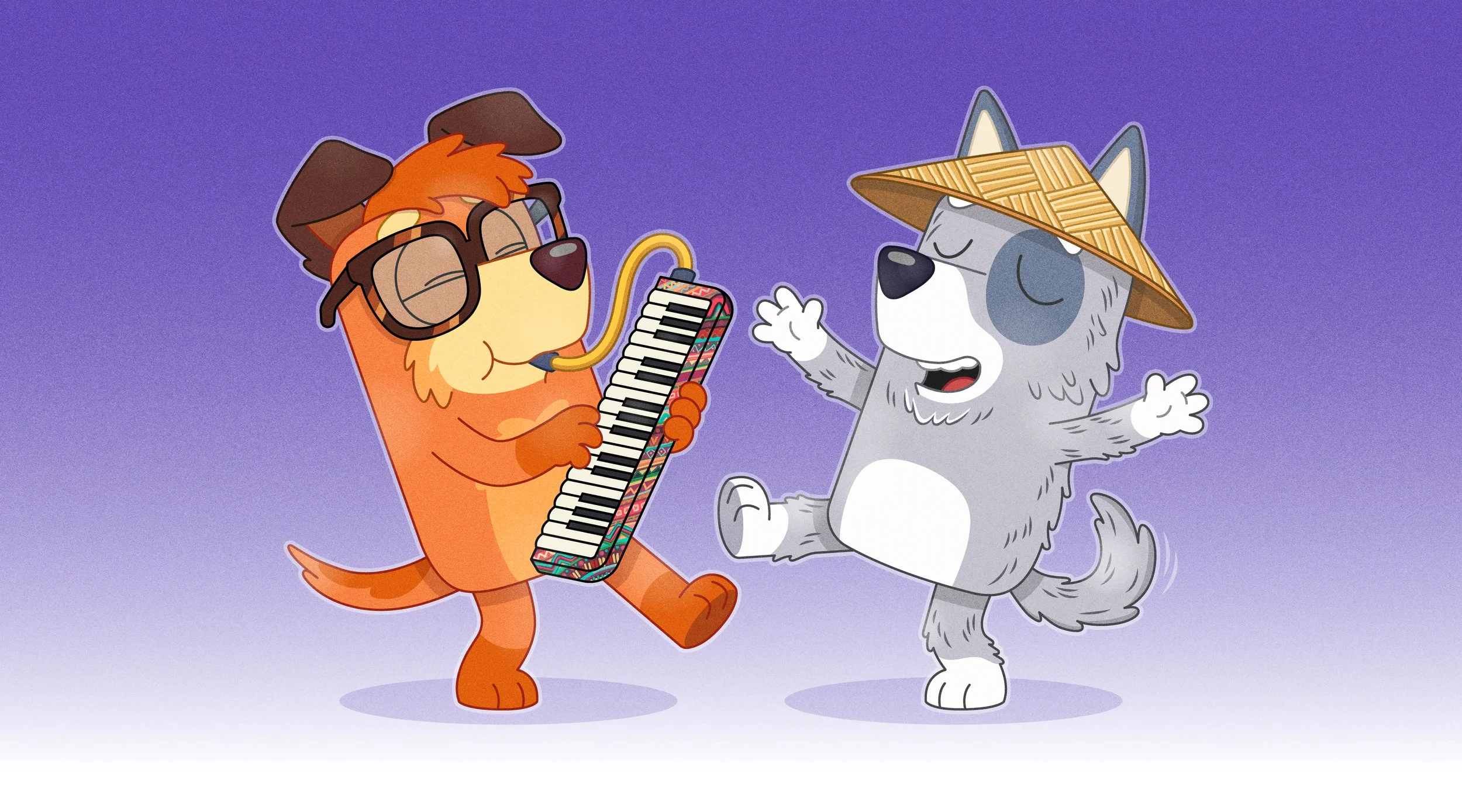
What makes the music of Bluey feel so warm and alive? In this episode, Dallas travels to Brisbane, Australia to visit the studio of Bluey’s composer Joff Bush. There, Joff reveals the quirky instruments, musical easter eggs, and songwriting philosophy behind this beloved series. Along the way, he breaks down the music of two iconic Bluey episodes, “Sleepytime” and “The Sign.”
MUSIC FEATURED IN THIS EPISODE
Trevor Kowalski - A Winter to Remember
Harry Edvino - Jungle Harry
Josef Bel Habib - Next to Our House
Trevor Kowalski - Saltwater Glide
Raymond Grouse - Here We Are
Martin Lindstrom - Bossa for Two
Alexandra Woodward - First Wives Club
Alexandra Woodward - Family Life
Rachel Sandy - A Marvelous Companion
Anna Dager, Hanna Ekström, Anna Landström - Promise of Tomorrow
Mr. Steve, the Music Man - I Have a Friend
Learn about this year’s Listener Stories competition and submit your story at 20k.org/2026.
Twenty Thousand Hertz is produced by Defacto Sound.
Support the show and get ad-free episodes at 20k.org/plus.
Subscribe on YouTube to see our video series.
If you know what this week's mystery sound is, tell us at mystery.20k.org.
Follow Dallas on Instagram, TikTok, Facebook, and LinkedIn.
Find out how you can get the iPhone 17 Pro at no cost with an eligible iPhone trade in at att.com/iphone, or by visiting an AT&T store.
View Transcript ▶︎
[20K sonic logo]
[music in: Trevor Kowalski - A Winter to Remember]
At this point, Bluey is a worldwide phenomenon. And if you have kids under twelve, you almost certainly know this show, and its quirky, loving family of cartoon dogs. But for those of you who don't know Bluey, let me tell you why my family and I love it so much.
It's the rare show that speaks to kids in a fun and wholesome way, while also speaking to parents, and the struggles that we go through. It's truly a work of art from the clever writing, to the authentic voice acting, to the gorgeous animation, to the immaculate sound design… And then, there's the incredible music.
Dallas: What do you think about the music in Bluey? Do you think it's pretty, or happy, or sad?
Dallas' Daughter: I think it's like happy. Happy and sad.
That's my youngest daughter, who's six.
Dallas: How would you describe the music in Bluey to somebody who's never seen it before?
Dallas' Daughter: It's kinda bumpy, and gets in your head. And it's pretty, and makes you feel good.
Dallas: Aww. If you could say anything to the Bluey team, what would you say?
Dallas' Daughter: I love it thiiiiii—THIS MUCH! That much. Yeah, I love it a lot.
Dallas: Okay. Is there anything else you wanna say about Bluey before we end?
Dallas' Daughter: I think that Bluey is just out of this world. And I really like Australia, even though I've never been there, but it sounds fun. My dad went there. His name is Dallas Taylor.
It's true. I'm so fascinated by Bluey, that I flew halfway around the world to Brisbane Australia, to meet the people who craft the show's sound and music.
[music out]
Joff: Hi Dallas. Welcome to the, uh, Bluey music studio. This is where we make the music.
[music in: Harry Edvino - Jungle Harry]
Joff Bush is the main composer of Bluey. His studio is a quirky, colorful space filled with plants and knick knacks... as well as lots of musical instruments.
Joff: There's a bunch of, uh, stuff around here that might have been used in one episode or ten episodes.
But even though Joff makes the music for one of the biggest shows on the planet, he doesn't often choose the highest quality instruments that money can buy. Instead...
Joff: I always like instruments that have a bit of character or a bit of a story to them. We start with this piano.
Joff: The story behind this piano is that I wanted the cheapest, most broken piano they had at the shop. And I found one, I was like, "Oh, this sounds like cardboard. It's really quiet. I love it." And, the shopkeeper said, "I can't, in good conscience, sell you this piano. It's the one we use as an example, to show how bad secondhand pianos are."
Joff: And so that was their, like, bad example piano. But I was like, "But I love it! I'll take it!" But, um, I like things with character. And this was the next model up. So this was uh… the one that they were willing to sell me.
[music out]
Joff: But I use it on everything. [piano chord] Uh, you know that this, the real test. [piano melody]
That little melody comes from Bluey's iconic theme song.
[clip: Bluey Theme]
In the main version that you hear when the show starts, Joff plays it on a melodica, which is a little keyboard with a tube that you blow into.
Joff: And then the famous melodica collection. This is the brand that we did the Bluey theme on.
[Joff melodica demo]
Joff: But that's the sound of the show.
[clip: Bluey Theme]
Hearing him casually play these little melodies that have become such an important part of my life was surreal.
Later, he picked up a baritone ukelele...
Joff: The main guitar I use for Bluey is probably this one, this one was like a hundred bucks. But I like this one, 'cause it sounds like cardboard, which is a trait I like from guitars.
Joff: But that's, that's… [playing ukelele]
And that's the theme to a classic episode called Turtleboy, where Bluey's little sister Bingo finds a toy turtle on the playground.
[clip: Bluey - Turtleboy]
[music in: Josef Bel Habib - Next to Our House]
Dallas: What do you look for in the sounds when you're sourcing instruments, what are you latching onto?
Joff: It's pure feel. Like, I can't talk to any of the staff at a shop or anything. I just have to play everything and just go "What feels good?" And then trust that. 'Cause otherwise someone will tell me what a good instrument is. And every time that happens, I always regret. I'm like, "Oh, why did I get this? Just because someone said it was good."
[music out]
Next, Joff revealed one of Bluey's secret musical ingredients.
Joff: So I've got these, actually I'll show you. These are called "Bling Sounds."
These bling sounds are actually chords made up of three instruments layered together. A bright electric guitar... [guitar] An autoharp, which is an obscure stringed instrument... [Autoharp chord] And a glockenspiel, which is similar to a xylophone. [glockenspiel chord]
Put them together, and you get this. [bling chord]
Joff recorded blings in a bunch of different keys.
Joff: Rather than me doing that every time, I've just created a library of bling chords. So if you listen carefully to the Bluey stuff, I often put these over all of the little chords, just drag them over. And it's just this little... [bling chord]
Joff: Sort of just gives it this little high-end magic and sparkle to a lot of the pieces.
Here's one in an episode called Daddy Dropoff.
[bling chord example 1]
Since that moment he told me about them, I've been noticing these bling chords everywhere in Bluey. You usually hear them right as the music comes in.
[bling chord example 2]
Joff: It's become a bit of a running joke of, "Oh, how we make it sound Bluey?" "Oh, chuck some blings on it!"
[bling chord example 3]
Then, Joff opened a small wooden case, and pulled out a music box. He also grabbed a little paper scroll with holes punched out for the notes... like what you'd see in a player piano. On the paper, it said Family Law Theme.
Then, Joff started feeding that paper into the music box.
Joff: And I used to do this with all the themes. and this is from another show I worked on ages ago called The Family Law.
The Family Law was an Australian sitcom that Joff made the music for. Here's the theme song, which sounds very Bluey to me, in a scene from the show. You'll also hear the main character Ben practicing clarinet.
[clip: The Family Law]
And here's Joff turning the handcrank on his music box to play that same song.
[The Family Law theme on music box]
Dallas: That's beautiful.
Joff: I used to do this for all the different shows I worked on up until Bluey. It was just like a little thing at the end of the series, I was going, "I'm gonna make it a little music box of the themes." But it was also a way of encouraging me to sort of like keep the music simple enough to be able to be recognizable and playable on a music box.
[music in: Trevor Kowalski - Saltwater Glide]
Dallas: Why is simplicity important to you?
Joff: I think it's really important for kids music because I think a sense of clarity, a simple melody or something, simplicity ties into a sense of clarity. Having a sense of clarity I think makes the show feel comfortable in a way. And that's particularly important for young kids.
Joff: It's not that you can't have themes or music that feel scary, or is adult, or isn't too kiddie, it's just that you have a clarity about the music that helps tell the story, and then it feels safe, 'cause they understand what's going on.
[music out]
Joff: I also just like it. I always like something you can whistle or something like that. I sound like such a boomer talking about, "They don't make good tunes anymore!" sort of thing. And maybe I'm also really bad at that sort of mixing palettes and stuff like that, so… Like I have my sound, but whenever I venture out it's like... It doesn't quite work. It's a bit fake.
[music in: Raymond Grouse - Here We Are]
Personally, I can't imagine Joff composing something that sounds fake. His music on Bluey is full of authentic emotion, just like the show itself. And it's also incredibly varied. If you listen carefully, you'll realize that every episode has a unique melodic hook... which is something that Bluey's creator Joe Brumm decided early on.
Joff: That was one of the first things he told me, 'cause I was like, "Oh, well, we'll come up with a sort of library and a palette for the whole show," and we talked about that and he goes, "No, I want something different every episode, like we're starting from scratch, like we're making a whole new short film."
Joff: And so one of the first things we do is, after we talk about it, is we often come up with like a macro theme, like a single hook for that episode. And that's often from the perspective of the kids.
[music out]
Joff: If the kids are playing a game of hotel, for example, I'll write something that's like, "What would a 6-year-old imagine the soundtrack to a fancy hotel to sound like?"
[clip: Bluey - Hotel]
Joff: So that's a very "perspective approach," rather than following the drama.
You can hear this perspective approach in tons of Bluey music. Here's some swashbuckling adventure music for when the kids play pirates.
[clip: Bluey - Pirates]
And here's some Celtic sounding music for when the kids think there are fairies in the house.
[clip: Bluey - Fairies]
Dallas: How does your brain get, like if I just made up a scenario, you know, like how would kids going up to the top of a skyscraper for the first time. How do you, like where does your brain go with something like that?
Joff: Yeah, I mean, I think it's like… It's a little bit more story behind it. You know, is it a game in the elevator or is it about them conquering their fear of heights? What is it? Because even if it's not shown on screen, or even if it's not in the script, we wanna press for what that is, so we know what the music can be covering that might not be seen.
Joff: So if it's… it's oh, it's actually just about them having fun in the elevator on the way up, I'll a game of elevator and maybe we'll play around with, I don't know, elevator music style, some Muzak.
[clip: Martin Lindstrom - Bossa for Two]
Joff: But a kid's perspective of what Muzak is, and we'll have some fun with that.
Dallas: And say that there is, you know, a fear of heights element to that, the delicacy of communicating that to children, how do you communicate fear, but also in a warm, kind way?
[music in: Alexandra Woodward - First Wives Club]
Joff: Yeah. I mean, yeah, there's a million ways I suppose, but I probably… This imaginary episode, probably going through like, "What's the approach we're gonna start with?"
For an episode that deals with a heavy emotion like fear, Joff said he might build the music around the story arc of the episode... or what he calls a structural approach.
Joff: So we could do something that is a bit more structural where we talk about maybe there's some smaller accomplishment that happens earlier in the episode, or something that we can seed an idea of things being okay at the end.
In other words, even though the kids might be afraid at first, the music is hinting that things will turn out alright. And on the other hand...
Joff: I think if you had that perspective approach with the kid's fear, it'd be like watching a nightmare. It's just like this kid's terrified. But I probably take a bit more of an external approach for something like that and something that maybe is trying to reassure at the end. But I probably wouldn't play the fear so much. I don't know. Have to see it.
[music out]
Now, one of the most beloved Bluey episodes is called Sleepytime. It's the episode that I often send people when I talk about Bluey, as an example of the incredible range of emotions the show can achieve in under eight minutes. I also think that Joff's score for Sleepytime is one of the most brilliant uses of music in all of media.
Joff: Something like "Sleepytime," it's a bit more philosophical, or psychological really.
The episode starts with Chili, the mom, reading Bingo a book about the planets before bedtime.
[clip: Bluey Sleepytime]
Chili: And what's this planet called?
Bingo: Mercury!
Chili: Good. And the big hot star in the middle?
Bingo: The sun!
Chili: That's right!
When it's time to go to sleep, Bingo decides she wants to try sleeping by herself.
Chili: Mom, I want to do a big girl sleep tonight, and wake up in my own bed.
[clip: Bluey Sleepytime]
Then, Bingo has a dream where she flies through the solar system, visiting different planets. And for the music, Joff adapted a classical suite by Gustav Holst called The Planets. Here's the refrain from the Jupiter movement, as recorded by the Berlin Philharmonic.
[clip: Berlin Philharmonic - Holst - Jupiter]
Joff: The big message of that episode is Bingo's journey to finding independence. But she also has her parents' love all the time. So how do we help sell that?
Joff: So when we use the theme at the end, Holst's Jupiter, we took little snippets of that, and seeded them throughout, whenever the parents are showing love to their kids.
Again, here's that Jupiter theme.
[clip: Berlin Philharmonic - Holst - Jupiter]
And here are some snippets of that melody in the episode, like when Chili responds to Bingo wanting to sleep alone.
[clip: Sleepytime]
Chili: You do your best honey. But remember, I'm always here if you need me.
Bingo: Okay.
Chili: Sweet dreams!
Or when Chili gets up to get Bluey a glass of water. Listen to the high, sustained melody behind the plucked strings.
[clip: Sleepytime]
Joff: So it's like you're subconsciously reminded of what that is. The parents' love is that little melody from Holst.
Towards the end, Bingo's blanket falls off the bed, and she starts shivering. So Chili snuggles up to her and warms her up. In Bingo's dream, she flies to the sun, which represents Chili. Then, the full Jupiter theme begins.
[Sleepytime clip in]
Joff: And so when we get back to the end, it hits you a bit more emotionally, 'cause you've got both the story showing Bingo going, "I'm a big girl now, I've got independence."
Bingo: I have to go. I'm a big girl now.
[Sleepytime clip out]
Joff: And then marrying that with this concept of "I'll always be there for you," as Chili says, "And I will always love you."
[Sleepytime clip in]
Chili: Remember I'll always be here for you, even if you can't see me. Because I love you.
Joff: And that's a really powerful concept for anyone.
[Sleepytime clip fades under]
Joff: And so yeah, we're manipulating people in, in that way. But that's a very structural and philosophical and psychological approach.
[music in: Alexandra Woodward - Family Life]
Apart from Sleepytime, one of my favorite pieces of music from Bluey is from the episode The Sign. It's Bluey's longest episode ever, and it might end up being the series finale. For Joff, scoring that episode was a unique and delicate process, and he even hid a secret melody inside the key theme.
That's all coming up, after the break.
[music out]
MIDROLL
[music: Rachel Sandy - Ripples and Raindrops]
Up until now, there have been three seasons of Bluey, and season three ended with an episode called The Sign. In it, the main family is planning on selling their house and moving to another city. Bingo is excited about it, but Bluey is sad about leaving her friends and her life behind. It's a really special episode, for multiple reasons.
While most Bluey episodes are around eight minutes long, The Sign is twenty eight... which makes it feel like a deep emotional journey. I won't spoil exactly what happens in the plot, but by the end, it feels like a finale... which was very intentional.
About six months after The Sign came out, Joe Brumm, the creator of Bluey, revealed they were working on a Bluey movie. In the same message, he announced that he was planning on stepping away from the TV series. Quote "In the event I can't wrap my head around doing more seasons myself, The Sign will mark my TV finale for Bluey, and I wrote it as such."
[music out]
Now, it's unclear if the show might continue without Joe... but Bluey has really been his baby from the beginning. He wrote almost every episode, and it's hard to imagine the show without him guiding it.
Joff: We knew this was gonna be such a beautiful, important episode, so we really, um, spent a lot of time, playing around and perfecting it. It's like "Alright, alright, this is a once in a lifetime opportunity to make something work on a show that's this special, and an episode that's this amazing. Let's make something that we can really be proud of."
[music in: Rachel Sandy - A Marvelous Companion]
One of the main story themes of The Sign is the idea: We'll See, which comes from a story that Bluey's teacher reads to their class.
Calypso: It's called The Farmer. See what you think of its ending.
In the story, a series of good and bad things keep happening to the farmer. But every time his neighbors say...
Calypso: That's such bad luck!
or...
Calypso: That's such good luck!
The Farmer just says...
Calypso: We'll see.
The point is, you never know how things will turn out. What might look like bad luck now could end up being good luck later... and vice versa.
Calypso: We'll see.
Joff: And that's quite a hard thing for young children to like compute.
Bingo: Is that a happy ending, or a sad ending?
Calypso: It's both.
Joff: …Coming to terms with, "Sometimes not everything works out the way it should, and sometimes it works out. And whatever will be is meant to be."
Joff: But that was such a theme of the episode. So I wanted to write a "We'll See" theme. And I felt like this was like a bookend to the three Bluey series as a whole. And I don't know what the future of Bluey's gonna be, but regardless, it felt like there is a little encapsulated story within there. So I wanted this theme to feel like a bit of a bookend.
[music out]
But how do you encapsulate an entire series in a single piece of music? Well, if you're Joff Bush, you start with the theme song, and then do something musically mindblowing with it.
Joff: The melody is the Bluey theme in reverse. So if I go to a piano, maybe I should go over to a piano. So like, okay, the Bluey theme's in E.
[playing piano]
[clip: Bluey theme]
Joff: The first thing was to take it to its relative minor, which is C# minor.
[playing piano]
Joff: And then reverse it, and…
[playing piano]
Joff: So....
[playing piano]
Joff: It's kind of generously twisting on, that obviously had to change a bunch of notes to make it into it… not get too, um, scientifically and mathematically exact with a reverse, but it's based off that. I wanted it to feel familiar, but also almost like a bookend. And by having that reversal of the theme, it felt like it tied in there, but it was the end of something.
Next, Joff pulled out his phone, and opened up the Voice Memos app. He scrolled through, and found the original piano demo that he recorded for this theme.
Joff: I recorded this right after reading the script. So we hadn't seen any visuals yet. And I wanted to create this "We'll See" theme.
[We'll See demo in]
Joff: So it's got the theme in reverse.
Joff: It's got this sort of like… I like to think of it as almost like a "river flowing, never-ending pulse of life" type riff going underneath.
Joff: And then we've got this little bit in the middle, which is like, "We'll see, we'll see, we'll see."
[We'll See demo out]
Dallas: It's beautiful.
For the final version, Joff left out the piano chords, and just kept the melody...
[piano stem]
He also layered in mandolin…
[mandolin stem]
Acoustic guitar…
[guitar stem]
Accordion…
[accordion stem]
And vocals.
[vocal stem]
Joff: This has become a such a big part of the Bluey sound, I think this...
Joff: This is me going, "ooh," as high as I can.
Once it was in decent shape, he sent it to his regular violinist.
[violin stem]
Here's the We'll See theme in the episode, when Bluey's mom Chili admits that she doesn't know if moving is the right choice for their family.
[clip: The Sign - We'll See parable]
Chili: I guess we'll see.
Bingo: We'll see!
Brandy: Yeah, we'll see.
Joff: But at the same time, that contrasts with the Bluey theme that is also played throughout. It's the first time in any of the series where we actually use the Bluey theme as underscore as well.
[clip: The Sign - Bluey Theme underscore]
Bingo: Dad, wake up!
Bandit: What, huh? Oh, hi Bingo. How's it going?
Joff: And we use it in a very like, almost sitcomy way for transition. So you know, like a little
[playing celeste]
Bingo: Where is Bluey!?
Bingo: Bluey, you're supposed to be at flower girl practice!
[clip: The Sign - Bluey Theme transition]
Joff: There's these two themes that contrast each other and bounce off each other. One sort of represents the world of Bluey as it is.
[clip: The Sign - Bluey Theme underscore]
Joff: And the "We'll See" represents what is upsetting the regularity of the day in the life, the world there.
[clip: The Sign - We'll See Theme]
[music in: Anna Dager, Hanna Ekström, Anna Landström - Promise of Tomorrow]
Dallas: You've brought so much joy to a world that has experienced it in a different way that you've experienced it.
Joff: Yeah.
Dallas: And so if you were to describe your experience on Bluey, from your eyes, and your mind, how would you describe that?
Joff: At its best, it was just a bunch of friends making something together. I love those moments, that comradery, and everybody working together to make it as great as it can be. And I love the spotting sessions when we're just in this room here coming up with ideas and throwing around the room, jumping on the piano, and—and just getting in that flow state, and forgetting about anything, just making the show that we wanna see, and we want to hear.
Dallas: How does your brain comprehend, when you are creating something, or a composer, or a creator, an artist of any sort, you create, create, you know, and as soon as you hit Send and it's done and approved, you're just right back to it again. And then again, and again, and again…
Joff: Yeah. But even, even then, I mean, there's been times where we've pressed send, and then we go, "Hang on, I think we can do this better," and we come back and do it, which is insane. Nobody does that in this industry. It's like, "No, it's done, it's done." But there might be some little things where we you know, finish it, send it, then we lie in bed and go, "No, no, no, no." And then go back and, and tweak it.
Joff: But, um, yeah, I think there is a real passion from everybody on my team and everybody everywhere to make something that we will be really happy to look back on over the years and go, "Oh, we made that, that's beautiful."
[music out into music in: Mr. Steve, the Music Man - I Have a Friend]
Twenty Thousand Hertz is produced by my sound agency, Defacto Sound. To hear more, follow Defacto Sound on Instagram, or visit defacto Sound dot com.
Other Voices: This episode was written and produced by Casey Emmerling, with help from Grace East. It was sound designed and mixed by Joel Boyter.
A huge thanks to Joff Bush for welcoming me into his studio, and being so open and generous during my trip to Brisbane.
To see my visit to Joff's studio, subscribe to my Youtube channel, Dallas Taylor dot mp3. Over there, you can also see me join Joff for a recording session of the new orchestral Bluey album, Up Here. You can find clips of these videos on Instagram and TikTok under that same name, Dallas Taylor dot mp3. All of these links are in the show notes.
Thanks for listening.
[music out]
Joff: Bye!