Art by Michael Zhang.
This episode was written & produced by Casey Emmerling.
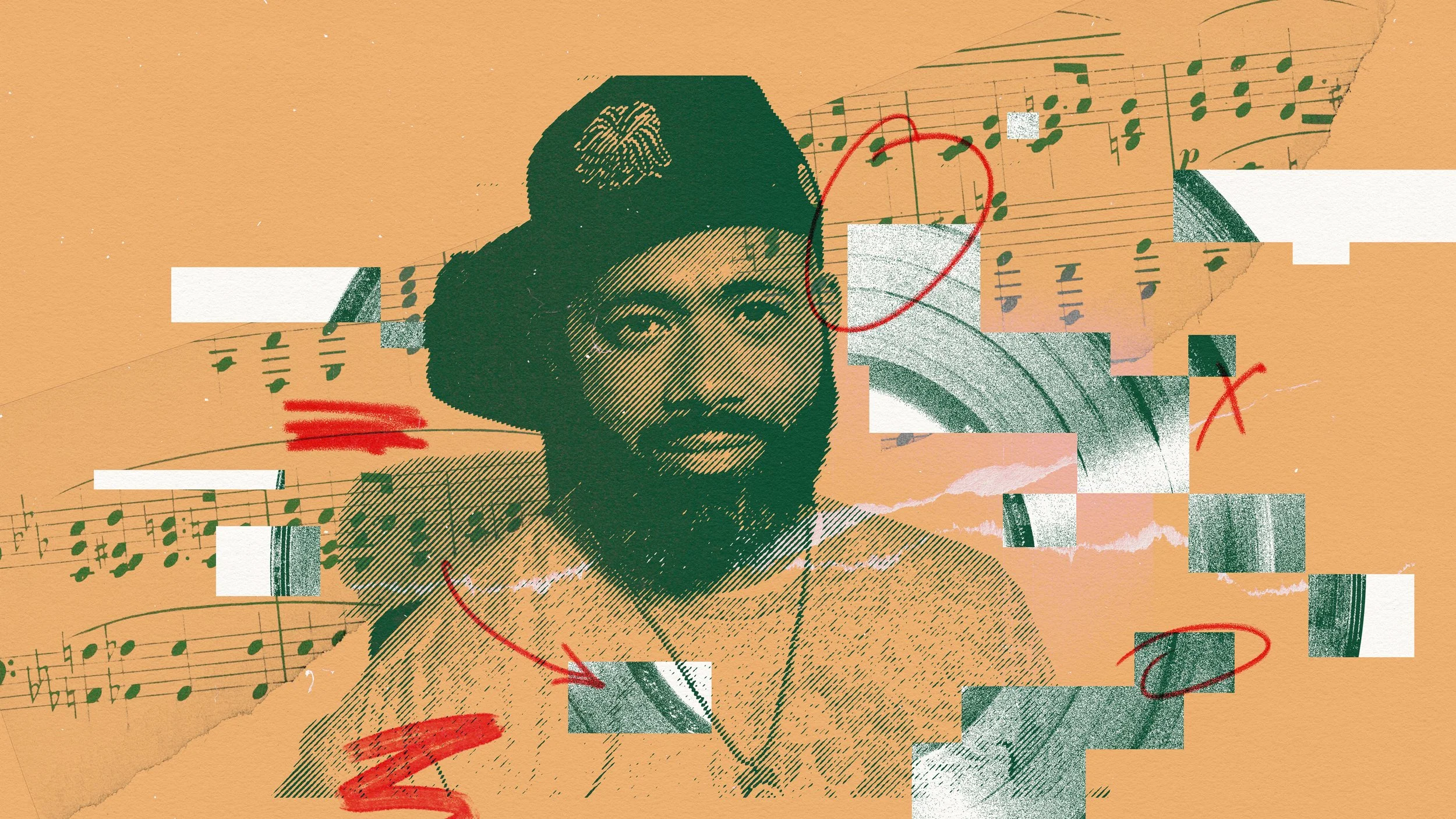
David Jeffers has always understood the world through sound. As a kid, he bounced beats between tape decks and built speaker boxes from spare parts. After college, he founded an underground hip hop label. Then came the day that split his life in two. And in the quiet that followed, David started listening more deeply… and piece by piece, he built a new life, guided not by what he lost, but what he could create.
MUSIC FEATURED IN THIS EPISODE
Scientific - How It Go
Scientific - With You
Dama Beatz - Kickin’
Scientific, Matt Large - Meeting of the Minds
Timothy Infinite - First Born
Matt Large - Hear Me Out
Matt Large - Eastern Shades
DonVayei - Here and Now
bomull - hostlov
Matt Large - The Wait is Over
Matt Large - The Star of the Show
For news about Quad Life, the upcoming documentary about David, follow Quad_Life_Doc on Instagram.
Explore David’s sound design work and book with him at quadriphonicsound.com.
Twenty Thousand Hertz is produced by Defacto Sound.
Support the show and get ad-free episodes at 20k.org/plus.
Subscribe on YouTube to see our video series.
If you know what this week's mystery sound is, tell us at mystery.20k.org.
Follow Dallas on Instagram, TikTok, Facebook, and LinkedIn.
Join our community on Reddit.
Explore incredible speakers, soundbars, and more at sonos.com.
Get 3 months of free payroll at gusto.com/20k.
Sign up for a one-dollar-per-month Shopify trial at shopify.com/20k.
Visit quo.com/20k for 20% of your first 6 months of business phone software.
View Transcript ▶︎
[20K Sonic Logo]
David: I vowed that if somebody wanted to hear my story, I was gonna keep it real with them, and let 'em know what things are really like.
[music in: Scientific - How It Go]
David: My name is David Jeffers and I'm a sound designer.
[downbeat]
David has worked with companies like Google, Meta, the YMCA, 23 and Me, and many more. His sound design style is always very musical... which goes back to his childhood.
David: Around my house, music was always going. My dad had a record player, and he played music all the time. My older brothers, they started getting into hip hop, so I wanted to be like them, and started listening to hip hop.
David: One day, I guess around seventh grade, I met my friend Ricardo. For some reason, we just got the idea like, "Hey, let's make some music."
David: He was a MC. I was a fake DJ. I say that, 'cause I never was that great at actually DJing. We ended up taking a music class in high school in our ninth grade, and that was like really the jump off of producing.
[music out]
David: We had two tape decks and, uh, we'd bounce tracks back and forth on this tape deck to, uh, make beats using a DJ sampler. So we started out doing that, saved up some money, and we bought a Fostex Four Track. And we started making these remix tapes.
[music in: Scientific - With You]
David: So we started selling these remix tapes at lunch and promoting it. We ended up getting one of our remixes to like number three on the local college radio.
[downbeat]
At the same time, David was also building and installing sound systems.
David: Anytime my parents or somebody was throwing something away, I'd want to take it apart, see how it worked, see if I could build something with the junk parts. So I think it was just in my DNA.
David: Eighth or ninth grade, I made my first speaker box, got really into it. So when I got my first car, I bought it when I was 14 from my older brother. By the time I could drive it, I ended up with like two fifteens in a ‘78 Volkswagen Rabbit.
[car start transition into: Dama Beatz - Kickin’]
For reference, those are huge speakers for a very small car.
David: The first time you get in a car and you just feel that power. It was loud, it felt rebellious. It almost was like a mini concert.
[music out]
Dallas: At what point did you meet your wife? Where were you and when did you meet her?
David: The first time or the second time?
Dallas: Ooh, let's start with the first time. I wanna hear both times.
David: All right. Well, the first time, I was a senior in high school and she was a junior in high school. We went to, uh, two different high schools and, um, I guess because of Friends was real popular at the time, [Friends bit in background] we found ourselves hanging out at this local coffee shop.
[coffee shop ambiance in]
David: One day we're just hanging out and um, I see these two girls come into the coffee shop [entry bell] I'm like, [thinking reverb] "Oh man, she's pretty, you know, I wouldn't mind talking to her.” But, you know, I wasn't like the girl crazy, just walking up to girls and talking to 'em.
David: So my friends were like, [panned + room verb] "Oh, we're gonna, we're gonna hook y'all up. You're gonna talk to her." So my friend basically makes the introduction. So that's how we first met.
[coffee shop fades under]
David: We went to the movies and it turns out she was spending the night at a friend's house who went to a club, so she couldn't go home until her friend got back. So we ended up staying out super late, waiting for her friend to get back.
David: I get home, I get in trouble for staying out too late, and that kind of soured things for me on the first go around. So we really didn't talk too much after that.
[music in: Scientific, Matt Large - Meeting of the Minds]
Soon after, David and Ricardo graduated high school, and David left for college.
[downbeat]
David: So I go off to uh, A&T and that's in Greensboro. My sophomore year, I'm walking across campus, and guess who I see? My current wife, Yasmine. And, uh, we started talking. And pretty quick after that, we were dating.
In college, David studied mechanical engineering.
Dallas: What did you think you would be doing with that mechanical engineering degree? Like, what was your goal at the time?
David: To get a design position at an automotive company. You know, I love cars. That's another one of my loves. Honestly, at that young age I just was like, "Any way I can get in, I'll be happy with it."
Dallas: Do you see that connection between that systems-based thinking and the way that you approach sound design now?
David: Oh yeah, definitely. You know, I'll look at something that needs to be sound designed and try to like pick it apart into individual components, and then try to rebuild the total sound, combining different components of sound to make the final product, for lack of a better word.
[music out]
After college, David and Yasmine moved to Detroit, where David worked for Ford.
David: I actually landed up in vehicle testing, which was really fun and interesting.
Then one day, he got an email from his old friend Ricardo.
David: He was like, "Hey man, we need to crank this machine up. We need to do some more music." And uh, we started a online record label called Neblina Records.
[music in: Eternia - Forward]
Neblina was an underground hip hop label that David and Ricardo led in the early two thousands. This track is from one of their compilations. It's called "Forward," by Canadian rapper Eternia.
[music up, then under]
Dallas: How does that hip hop background influence your sound design approach?
David: My style of hip hop production was primarily sampling, and I feel like sound design is really just sampling on a whole nother level. You're taking bits and pieces of sound from all these different places, putting them back together to make something new and something beautiful.
[music in: Timothy Infinite - First Born]
While David enjoyed his job at Ford, Detroit wasn’t the right fit for him and Yasmine.
David: So her mom had moved to Charlotte, North Carolina. So I was like, “Hey, why don't you move with your mom, try to find a job, and then I'll try to find a job down there.”
So Yasmine relocated to Charlotte, and David soon followed. They got married, and had their first child.
David: So at that time, I was working at uh Bearing Manufacturing Company doing test engineering. It wasn't my dream job, but that was when family life was really my main focus. My oldest son, Jackson, he was two years old at the time.
And Yasmine was pregnant with their second.
David: So it was a hundred percent dad mode at that time.
[music out]
And then came the most pivotal day in David's life.
David: We were planning a big, I would say, my first real family vacation, and we were headed to the beach.
[sound design begins]
David: It was actually our first day really being there at the beach for a full day. The water's kind of rough. Tide's coming in. Really not too many people in the water.
David: But I decide to go in. And, uh, Jackson, he's playing in the sand on the beach. My wife is chilling with Jackson and uh, my nephew, who was about 15 at the time, was there hanging out with us as well.
David: I was in the water, and I saw a big wave coming. And you know how you can dive through the wave to kind of cut it so it doesn't hit you so hard? So I've done that a million times.
David: So I go, I dive through the wave. [sfx: dive + underwater sounds]
David: And I didn't know it, but apparently there was a sandbar or something just ahead of me where I dove. And I hit my head on the sandbar…
[water swirl + impact]
David: And immediately I, I knew that was it.
David: I couldn't move, I couldn't do anything and I'm, I'm in the water just like, [vocal processing] "Oh my God, am I gonna drown? You know, please don't let me drown."
[underwater sounds fade under]
Dallas: Were you in pain?
David: No, actually it was the crazy part. I, I really did not feel anything. I don't remember being in any kind of pain.
Dallas: Are you able to call out or anything? How did you get out?
David: Yeah, luckily since I was on the sandbar, it wasn't that deep. I was able to call out to my nephew. And uh, he thought I was playing at first, and uh, so he didn't come immediately. And then all of a sudden, I guess he realizes, you know, like, I'm not moving. And my wife kind of stands up and she realizes. And so, my nephew gets over there first and tries to pull me out.
This is Yasmine's recollection of that day, from a documentary about David.
Yasmine: My nephew was able to pull him out of the water, and David said to me he said, "I'm sorry." He said, "I just ruined our lives." And I said, "No, you're probably just in shock. Like, there's no way." And he's like, "No." He said, "I broke my neck. I hurt it. I, I'm sorry. I have ruined our lives."
[beach sounds resume]
David: I remember being on the beach. A couple people came over and luckily, a lady was on the beach that happened to be a doctor, and she was like, "Stop, don't, don't move him anymore. You can make it worse."
David: And then after that, things get a little bit foggy, but I'm still there. I'm still awake.
[footsteps, beach sounds transition to helicopter + whipping sand]
David: And I remember getting on the gurney and they had to take me up to a parking lot where this crazy wind just started hitting me and sand, because, you know, they had to call a helicopter.
David: And the last thing I remember is being in the helicopter.
[helicopter fades under]
David: And I think at that point, they gave me some sort of pain medicine or something to knock me out, I guess. But that's when I, I don't really remember a lot from there until I'm actually at the hospital about to go into surgery.
That's coming up, after the break.
MIDROLL
Dallas: Okay, so there's a helicopter that takes you to Wilmington to put you into surgery. And I'm assuming surgery is to examine the extent of the damage, or keep it from becoming worse in some way?
David: Yeah, I guess it was both. To see the damage, I'm assuming they did scans and all types of stuff before the surgery. But they had to put fixtures in my neck to help everything heal, because I shattered one of my vertebrae and cracked another one. So now I have a fake vertebrae and some metal structure on my neck to kind of hold all that together.
David: And I also had to, uh, get a halo, which is, you've probably seen in movies, on TV, the big thing that goes around your head and to your shoulders. So basically you can't move your head at all.
Dallas: So there's this period of recovery. Can you tell me where your mobility ends, exactly?
David: Basically just right after my shoulders, around my nipple line is about where it stops. Um, even, you know, like my arms, as a quad, I don't have full function there. I don't have triceps. My hands really don't have any function, no finger function. So my main muscles of use are my shoulders at this point.
Dallas: Okay. I was under the assumption that you had mobility on your thumb and top fingers, but not your bottom. But I'm incorrect on that.
David: Yeah, that's what you call, I call it the "fake grip." The technical term is tenodesis grip. And it's basically, if you flex your hand up, bend your wrist, your tendons will pull your fingers in and your thumb in. So it gives you a little bit of a grip. It's not really strong. You know, I can pick up some things. But yeah, I can move my wrist, flex it up, but I can't forcefully bend it down, if that makes sense.
[music in: Matt Large - Hear Me Out]
David spent four months in the hospital. And as you can imagine, it was a dark period. He had to reevaluate his whole life, and what those changes would mean for his kids, for his marriage, for his work, for everything.
[downbeat]
David: It's just a total flip of life when this happens. I felt like I lost my identity. I didn't know who I was.
Coming home from the hospital was just the beginning of a long recovery journey… physical and occupational therapy, retraining the muscles that he still had access to, navigating the world in a powered wheelchair, driving a car with hand controls... and finding a new career path.
David: After the injury, I didn't know what I was gonna do for work at all. Because at the, uh, test facility, I've always been hands on. So I couldn't imagine going back to work and just sitting at a desk doing that. I didn't know how I could do it physically or mentally.
[music out]
But in those early weeks and months of his recovery, a seed was planted. With barely any ability to move on his own, he started listening more deeply.
[hospital sounds in]
David: When I was in the hospital, just being in the bed, stuck in the bed for so long, I started paying attention to sound a lot more where it got to the point where I could tell what nurse was about to come into my room based on the way they walked.
[hospital sounds out]
But that seed would still take a few more years to grow into anything more.
David: I ended up doing some engineering consultant work, like updating technical manuals for some companies and stuff like that. I did not enjoy it at all.
David: But then, probably four years or so after my accident, once again, my friend Ricardo, you know, we're still friends, still tight as ever. He had a animation motion design company based out in LA. And uh, his partner had the idea, was like "Your friend David, he knows how to make music, smart guy, engineering... I think he could do sound design."
David: So they hit me up and was like, [phone filter] "Hey man, what do you think? Do you want to give it a shot?" And that’s where I kind of did the pivot from engineering to getting into sound design.
[music in: Matt Large - Eastern Shades]
Early in his sound design journey, David found a mentor.
[downbeat]
David: Ricardo introduced me to Joe Basile. He's also a sound designer. He has his own sound design company called The Chicken.
Joe is actually someone that I know of through Defacto Sound, and he’s really good.
David: And Ricardo just was like, "Hey Joe, can you just talk to David, you know, just kind of answer some questions for him, you know, tell him about the industry" kind of thing when I first started out.
David: And, uh, Joe, super nice guy, he was like, "Look, I will give you an hour every week to mentor, teach, whatever you wanna do, free of charge." And basically we started doing that and until now we, we still do it. We've become great friends. He's taught me so much. I am forever in his debt. A great guy, man.
[music out]
Gradually, David picked up different sound software. He started with a simple iPad app, then moved on to industry-standard programs like Ableton and Pro Tools. He also did a lot of experimenting to find a good hardware setup... which he pretty much has down now.
David: Basically, it's almost like a splint that goes on my hand and down my forearm where there's a stylus in there. So I can just use my shoulder and bicep and move around on the track pad. And over the years I've gotten pretty good at controlling it.
David: I've ended up getting a secondary keyboard where I program all my shortcuts and stuff like that, and that's been the game changer there.
Eventually, David formed his own sound design company, called Quadriphonic Sound. Slowly but surely, he started making contacts, and landing more gigs. Over the years, he's done lots of work with Ricardo's company, Bien, which is the Spanish word for good, or well.
David: Their whole background is inclusive motion design. Basically it means "design with, not for." You know, “put inclusion in the process, and innately it'll come out in the final.”
Dallas: Can you help articulate why that methodology is so important? "With" not "for," the role of different experiences and different lived lives, and how your unique process and others' unique process helps drive creative?
[music in: DonVayei - Here and Now]
David: If you haven't lived it, you're not necessarily gonna be thinking about it. There's a lot of stuff, me being a able-bodied person for 33 years, that I know for a fact that I never thought about once, and definitely did not include in my creative process.
David: For example, if you're creating an app for a phone, the spacing where you put dropdowns or selections, it's a big deal for somebody like me who might not have the fine motor skills to use it. It could make the difference of me using it at all or using it on a daily basis.
David: I think everybody probably feels like they're empathetic to people with disabilities. But me actually living it, realizing how much it affects someone's day-to-day life... I spent so much time in rehab. I learned a lot, not only about my condition, but other conditions, just seeing how they work, how they live, how they do things differently... So, it's so ingrained in me now.
[music out]
Recently, Bien and a company called Only Today TV collaborated on a documentary about David called Quad Life. It's a raw, vulnerable window into David's world, including his morning hygiene routine, the insecurities he still struggles with, his love for his family, and his journey into sound design.
[music in: bomull - hostlov]
Dallas: I think that what struck me is just how… gosh, just how open you are to people seeing your real world. And I think that it just, it's so deep and rich because you are not sugarcoating it. It's something I have never seen before, and I think it grew empathy inside me. I feel close to you because you were able to open up so much.
[downbeat]
David: I really appreciate that, 'cause it was tough. I mean, obviously I didn't wanna do the shower scene. But I felt that it was important that people see how intricate, how humiliating, and how hard that process is that I have to deal with every morning.
David: And honestly, it came from being traumatized by people not being real and not being honest. You know, they say, "comparison is the thief of joy?" I learned that in such a real way after my accident.
David: Being on social media and seeing other quads, I would be like, "Oh man, me and this guy, we have the same injury. So he's doing this, this way. And, you know, life is great and it looks all shiny and normal and fun. Why isn't my life that way?"
David: And it really, I mean, it caused me to be depressed, be hard on myself. But once I realized like, "You can't compare yourself, and half of the stuff that they're saying is not really true to life," I vowed that if somebody was listening to me, somebody wanted to hear my story, I was gonna keep it real with them and let 'em know what things are really like.
David: You know, you can do that and not be a Debbie Downer, 'cause there's still a ton of joy in my life. I love my life. But there is barriers, there are hardships. And I think to be fair to the people that are listening and going through what I'm going through, I have to be honest.
[music out]
Today, David, Yasmine, and their two sons still live in Charlotte. And David is grateful for how much time he gets with them.
David: Another positive change after my accident was I was able to stay home and be with my kids. Whereas, you know, if I didn't get hurt, I'd probably be still at some boring engineering job working nine to five, rushing home and only having a couple hours with the kids when they were young before they go to bed.
Dallas: Even zooming out from sound, like what are your favorite hobbies, or what brings you joy in the creative world?
David: I still love producing music. Actually my son, he's become an artist now as well, and he's doing some recordings. So I love watching him. I love giving him advice and him not listening. But that's a big joy. And of course, hanging out with my family, doing stuff with them.
David: My other son, he’s into basketball and I've never been into sports. So I'm totally learning something totally new. If he loves it, I'm gonna love it. I'm gonna support him and figure out as much as I can about whatever he's doing.
[music in: Matt Large - The Wait is Over]
For David, it's been a long road of self-discovery.
[downbeat]
Dallas: So this happened when you were 33, which was 14 years ago. Do you feel like you're a different person? Where are you a different person and where are you the same person?
David: As far as being the same person, my mind is fully intact. I'm still the creative, excited, fun. I want to help people. I want to build things. But where I'm different is, unfortunately, a lot of the physical things I simply cannot do, or it's very difficult and time consuming to do a lot of times.
The accident transformed David's life. And in that chaos, he lost himself.
David: But actually getting into sound design is what I feel really brought me back. It just gave me a lot of purpose. I felt like my creative need to put something out in the world is being fed. And that is like the great positive change.
David: One thing that's always exciting is there's still a ton for me to learn. Whether it's just music or sound design, there's a ton that I'm ready to explore and hone my skills on, and uh, just really make my place in the industry.
[music out into music in: Matt Large - The Star of the Show]
Twenty Thousand Hertz is produced by my sound agency, Defacto Sound. Hear more at defacto sound dot com, or by following defacto sound on Instagram.
Other Voices: This episode was written and produced by Casey Emmerling, with help from Grace East. It was sound designed and mixed by Jade Dickey and Colin DeVarney.
Thanks to our guest, David Jeffers, for sharing his story with me. For updates on Quad Life, the upcoming documentary about him, visit Quad Life Doc dot com, or follow quad life doc on Instagram. And to book David for your next sound design project, visit quadriphonic sound dot com. All of these links are in the show notes.
I'm Dallas Taylor. Thanks for listening.
[music out]