Art by Michael Zhang.
This episode was written & produced by Casey Emmerling.
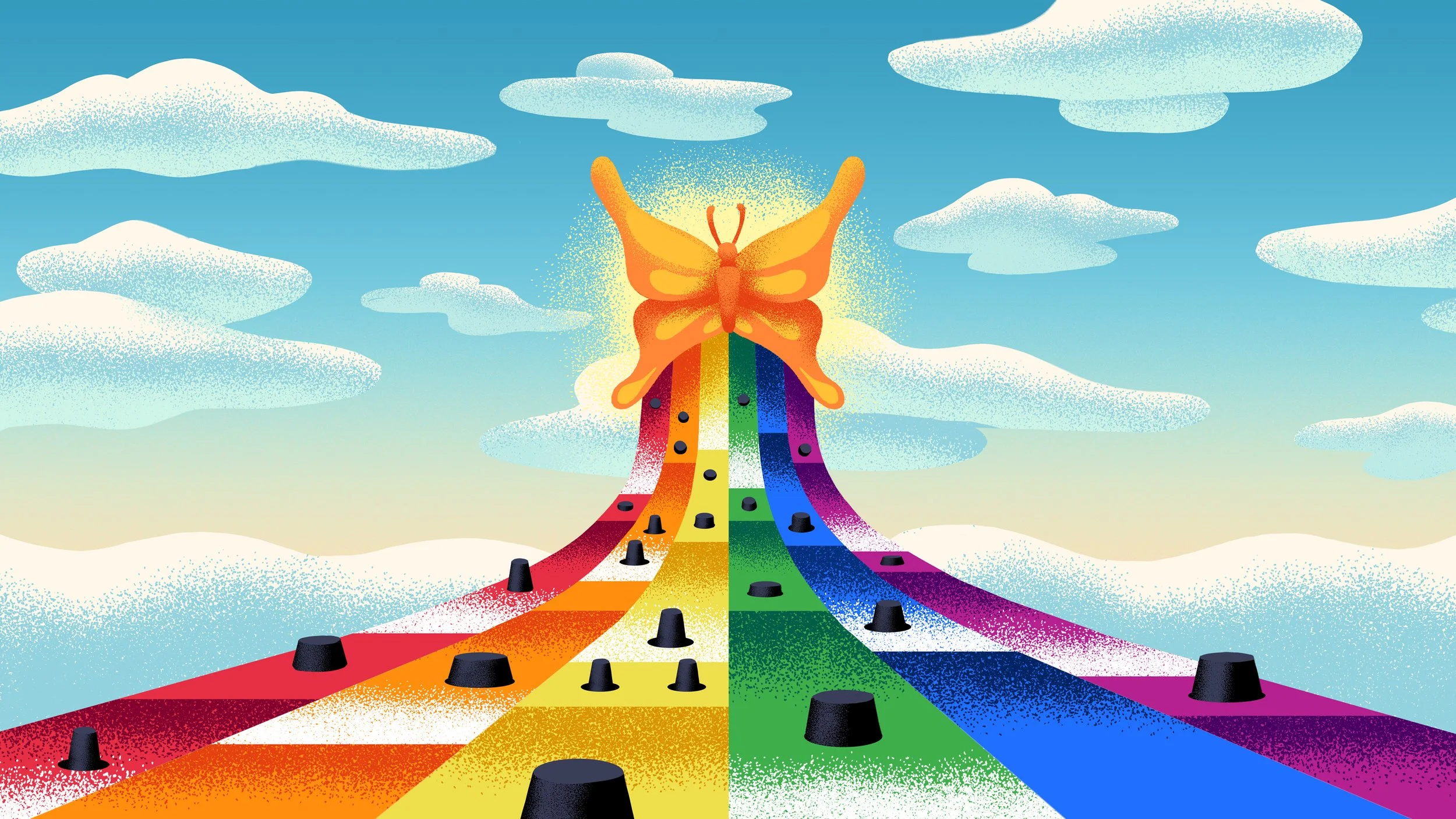
The theme song to Reading Rainbow has been delighting kids (and nostalgic grown-ups) for over 40 years. But how did this instantly iconic track come to be? In this episode, composer Steve Horelick reveals the unlikely story of its creation, from its empowering lyrics, to its “fluttering butterfly” synth sound, to how Chaka Khan and a mystery drummer helped shape one of its later versions.
MUSIC FEATURED IN THIS EPISODE
Wesley Slover - Control for Quality
Wesley Slover - Back in Time
Ennio Mano - Woodblock Print
Wesley Slover - Little Cables
MV Archives - Me vs. World
Wesley Slover - Whack
Sugoi - Mechakucha
Wesley Slover - Enjoy the Voyage
Wesley Slover - Designing for Sleep
Twenty Thousand Hertz is produced by Defacto Sound.
Subscribe on YouTube to see our video series.
If you know what this week's mystery sound is, tell us at mystery.20k.org.
Support the show and get ad-free episodes at 20k.org/plus.
Follow Dallas on Instagram, TikTok, Facebook, and LinkedIn.
Join our community on Reddit.
Explore Steve Horelick's work on his website and YouTube channel.
Visit expressvpn.com/20k to find out how you can get 4 extra months of protection.
Get 3 months of free payroll at gusto.com/20k.
View Transcript ▶︎
[20K sonic logo]
[TV on with filter - Fraggle Rock theme]
As an eighties kid who watched a lot of television, there are certain TV theme songs that instantly take me back to childhood. Stuff like Fraggle Rock… [Fraggle Rock up]
Teenage Mutant Ninja Turtles... [TMNT theme]
And the Wonder Years… [Wonder Years]
Then, there’s Reading Rainbow.
[Reading Rainbow instrumental in]
As a little kid, that song felt magical. And it still does. Which is why I was so excited when out of the blue, I got an email saying “Hey Dallas, I’m the original composer behind the Reading Rainbow theme, and I’d love to come on Twenty Thousand Hertz and talk about it.”
[TV turn off]
Umm, yes please.
Steve: Hey, I'm Steve Horelick, composer, producer, performer of electronic music.
[music in: Electronic Art Ensemble - Cauldron]
In the late 70s, Steve co-founded an experimental band called The Electronic Art Ensemble. They played wild, improvisational music through interconnected synthesizers and effects. This is a track called Cauldron, from their album, Inquietude.
[music up, then under]
Steve wanted to bring that adventurous spirit into the world of commercial music. And he knew just the people to do it with.
Steve: My musical partner at the time was Janet Weir and another partner Dennis Neil Kleinman
[music in: Wesley Slover - Control for Quality]
Steve: Dennis and I had been working together for several years doing some songwriting, and Janet and I were basically business partners starting our music production company in New York City.
The company was called Patchworks, as in, the patch cables used to connect modular synthesizers and other audio gear.
Steve: At the time, there were very few music houses in New York City that did like crazy, avant garde electronic music.
Patchworks was going to try and fill that niche. And in 1980...
Steve: There was word on the street that there was going to be a new kids TV show and they were looking for a theme song.
It was a PBS show called Reading Rainbow. Its purpose would be to get kids to fall in love with reading. And through a mutual connection, Patchworks got the opportunity to prove what they could do.
Steve: We got invited to create a demo.
But they weren't the only ones.
Steve: The legend goes is that they had asked maybe 10 different music production companies to write theme songs.
Meaning they'd have a lot of competition.
[music out]
Steve: The producer showed up at our little homemade studio and presented us with a storyboard. And basically it was a book, and a butterfly, and lots of different characters. And that's where we started working.**
[music in: Wesley Slover - Back in Time]
**They started with the lyrics.
Steve: Dennis is a very fine lyricist, and presented us with some ideas. But they were a little singsongy. Like um "a butterfly..." Uh, wait, I'm trying to remember them exactly.
[music peters out]
Steve: You know what, can I run upstairs real quick and grab them?
[footsteps leaving and returning]
[hold music: Ennio Mano - Woodblock Print]
Steve: Yeah so I, I actually have the archeology right here in front of me of the development of the theme song. Kept the papers all these years.
Steve: So the original lyric was really cute.
[music resumes: Wesley Slover - Back in Time]
Steve: “A butterfly can touch the sky. A book can take you twice as high. Open up a book and see fantastic things that you can be." And it went on from there. But it didn't kind of meet the energy that Janet and I were looking for. We wanted something that was more empowering, more energetic.
Steve: So Janet took these lyrics and turned them into, “Butterfly in the sky. I can go twice as high. Take a look, it's in a book, a Reading Rainbow.”
Steve: So Dennis had the initial inspiration, and Janet had the concept that actually turned into the final theme song.
[music out]
Once they had the lyrics, Steve could begin laying down his synth tracks. Now at the time, synthesizers were still fairly new. And they were not common in TV theme songs... especially kids shows.
[theme montage: Sesame Street, Scooby & Scrappy Doo, Muppets]
But the producers of Reading Rainbow wanted a wide range of options. So, they didn't give Patchworks much direction.
Steve: I think they were expecting us to like, just kind of dive in and be as creative as we could. At least, I'm hoping that's what they thought.
In their studio, Steve had several high end synthesizers, including a Fairlight CMI, which stands for Computer Music Instrument. He also had an Oberheim Four Voice, named for the fact that it could play four sounds at once. But the crown jewel of his collection was...
Steve: A Buchla 200 series made by the great instrument designer, Donald Buchla.
[Youtube demo: Sarah Belle Reid - The Electric Music Box: Exploring a Vintage Buchla 200 Modular System]
Don Buchla is a legend in the world of synthesizers. He made experimental instruments that you played with touch-sensitive metal plates, rather than traditional piano keys.
[Buchla 200 demo out]
Using this setup, Steve got to work. And as it turned out, the biggest challenge was the very first sound.
[music in: Wesley Slover - Little Cables]
Steve: Janet said we have to create a sound in the beginning so that when people hear it, especially kids, when they hear it and they're two rooms away, they'll come running to the TV set and sliding themselves right into place. So she tasked me with trying to figure out what that sound was.
Steve wanted the sound to represent a fluttering butterfly.
Steve: ‘Cuz if you ever watch a butterfly fly, it's constantly kind of changing its altitude, and bouncing around in a kind of a random way.
He wanted to recreate that randomness musically. To do this, he turned to his Buchla.
Steve: What makes the 200 series unique is that it only had touch plates, right? It didn't have a black and white keyboard. But it had this amazing module called the [robot voice] Multiple Arbitrary Function Generator. It was a souped up sequencer.
[music out]
A sequencer allows you to make repeating patterns of notes. Each piece of that pattern is called a stage.
Steve: And you would set the knobs to create the different pitches for each stage.
So, let's say you made an 8 stage pattern...
[sequencer - 8 note pattern]
Steve: In those days, every sequencer in the world, except the MARF, the Multiple Arbitrary Function Generator, went from one to eight and back to one. It would just cycle through those pitches, right, in a specific order.
Steve: What made the Multiple Arbitrary Function Generator unique in its time is that you could randomize the location of the sequencer.
[pattern become random]
Steve: That allows you to create a set of sounds that you can access randomly.
[pattern up, then out]
The next step was to decide which notes he wanted the synth to randomly choose between.
Steve: So I'll go over to the piano, and I'm gonna play you the first five notes of a major scale in A major.
[piano notes]
Steve: Those were the notes that the theme is based upon. But what I did is I kind of transposed them.
[piano notes]
Steve: Basically I've taken the two lower notes and transposed them up.
With those five notes, Steve made a 16 step sequence. And even though the order of the steps would be random, he could still prioritize some notes more than others.
Steve: In that set of 16, let's say, maybe there were four of them that were A [four As] and only three of them, and that were E [three Es] and two of them a B. [2 Bs] So I could weight them more towards different notes.
For our interview, Steve wanted to demonstrate how he shaped the sound. Unfortunately, he no longer has his original Buchla, or the MARF that went with it. In the mid 90s, he sold them both...
Steve: …to Danny Carrey of the band Tool.
[clip: Tool - Forty Six & 2]
Steve: What I didn't know at the time was that Donald Buchla only made eight of those modules. And they're pretty much worth what a Ferrari is worth today. And Danny, if you're listening to this, you know, send it back.
[laugher + clip: Tool - Forty Six & 2]
Fortunately, Steve has the next best thing... A newer model called the Buchla Easel.
Steve: So I'm sitting next to my Buchla Easel, and I'm gonna try and replicate how I created it. So here are those same notes that I played on the piano.
[Buchla demo]
Steve: But, a butterfly isn't percussive like these notes, right?
[Buchla demo]
Steve: A butterfly is more fluffy, shall we say. So I had to shape the timbre a little bit.
[Buchla demo]
Steve: Soften the attack…
[Buchla demo]
Steve: And then soften the release a little bit.
[Buchla demo]
Steve: So here are the notes. I'll add them one at a time.
[Buchla demo]
Steve: But they're not random, right? They're a typical sequencer or arpeggiator. So now I'm going to make them random.
[Buchla demo]
Steve: So I'm shaping the attack and decay a little bit more.
[Buchla demo]
Steve: And I remember back in the day, I had a Lexicon delay line which sounded like this…
[Buchla demo with delay]
Steve: And I had a spring reverb that sounded like this...
[Buchla demo with reverb]
Steve: And that kind of sounds like the Reading Rainbow theme song.
[transition into Reading Rainbow demo]
Here is Steve and Janet’s original demo version from 1980.
Steve: …which is similar to the broadcast version, but it had a little bit of an islandy feel.
[demo up, then under]
Steve: And by the way, the demo was sung by my writing partner, and actually now my wife forever, my lovely wife, Janet Weir.
[demo up, then out]
They submitted the song to the show's producers.
Steve: I wasn't there when they listened to it.
But soon after, they got the news. Out of all of the submissions they'd received...
Steve: They picked ours.
[music in: MV Archives - Me vs. World]
But Steve and Janet weren't done yet. To bring this song to life, they'd need to redo the instrumentation...
Steve: Everything was kind of running wild, 'cuz I had no synchronization.
And they needed to find the perfect singer.
Steve: We really searched hard to try and find the right singer for the project
That's coming up, after the break.
[music out]
MIDROLL
[music in: MV Archives - Me vs. World]
The pilot episode of Reading Rainbow was filmed in 1981. As the show's host, they cast LeVar Burton, who had a breakout role in the 1977 miniseries, Roots.
LeVar in Roots: I am Kunta Kinte, a Mandingo from the villa of Jujufureh.
Each episode of Reading Rainbow was built around an illustrated children's book, which was often narrated by a celebrity. Then, LeVar would visit places related to the book, and talk about its themes. The pilot featured a book called Tight Times, about a boy whose family can't afford to get him a pet dog.
LeVar in RR: There are times when problems can’t be solved, at least not right away. Sometimes, the only way that people can help each other is to hug and show they care.
In the pilot, they used Steve and Janet’s demo as the theme.
Steve: But once they got funded, they came to us and said, "Well, do the actual final version of it."
[music out]
The final version was built around the same fluttering Buchla sound, but it was a bit funkier and more energetic. It included a bass part that Steve played on his Fairlight CMI…
[bass stem]
And a drum beat from a Linn LM-1 drum machine.
[drum stem]
Steve: And the Fairlight was playing like these sax parts.
[Reading Rainbow theme clip]
Steve: “Dum ba dum, bum ba dee dum” kind of stuff. And there were some electronic, chords and stuff that was being played by the Oberheim.
[Reading Rainbow theme clip]
[music in: Wesley Slover - Whack]
Now, this was just before the invention of MIDI, which allows digital instruments and devices to communicate. One of MIDI’s biggest advantages is that it lets devices sync up their timing, so they all play at the same tempo. But without MIDI, Steve had to do that manually, and time everything perfectly.
Steve: Everything was kind of running wild, 'cause I had no synchronization. You'd hit a tape machine Go button and you’d run to your synths and try to get everything lined up together. So It was quite a task actually, and a lot of fun, and sometimes really, really frustrating.
[music out]
Eventually, he got it down, and the instrumental track was ready. But they still needed a professional singer.
Steve: We really searched hard to try and find the right singer for the project. And that turned out to be a wonderful singer named Tina Fabrique.
[music sneaks in: Tina Fabrique - Alive with Love]
Steve: …who was really big in New York City at the time, doing a lot of shows. Really, really terrific singer
[Alive with Love up, then under]
Steve: I remember Tina walked into the studio at M&I recording in New York. And she just lit up the room. Her energy was so amazing. She had heard Janet's demo, of course, and she just nailed it, man.
[Reading Rainbow vocal stem]
Steve: She got the whole vibe, even though she was in those days like a disco singer, she really, instead of being like real cool, she just was really joyful.
[Reading Rainbow vocal stem]
Steve: And it was, it was wonderful.
Here's the classic version of the Reading Rainbow theme song, which was used from 1983 to 2000.
[Reading Rainbow Theme]
Reading Rainbow debuted in 1983, and quickly became a cultural touchstone. And Steve and Janet’s music was a key part of the show’s identity.
Steve: I produced all the music for every episode of Reading Rainbow, and wrote about 90% of it. That theme and all of the music for Reading Rainbow kind of exploded my career, ‘cause it led to 155 episodes for Reading Rainbow, and lots of different TV series, like Shining Times Station...
[clip: Shining Time Station - Don't Be Afraid]
Steve: …and the Puzzle Place.
[clip: The Puzzle Place theme]
But the evolution of Reading Rainbow’s theme song wasn’t done yet. In the late 90s, the show got a new intro, with updated graphics, and more focus on LeVar Burton. So Steve and Janet crafted this new arrangement.
[clip: Reading Rainbow 1999 instrumental]
This time, they dropped the fluttering synth sound, and gave it more of a live band feel.
On vocals, they got another New York R&B singer.
Steve: Johnny Kemp, who was just an amazing singer.
[transition into vocal version]
Steve: Brought tremendous energy to it.
[Reading Rainbow 1999 theme up, then out]
Now, this version is in the key of F rather than the key of A.
Steve: Johnny couldn't sing it in the original key. It just didn't work out for his range. So we had to change keys, bring it down a little bit so that it would hit his high range better.
[clip: Reading Rainbow 1999]
Steve: But because they were kind of tagging it onto the other episodes, the music cues that came out of it in all of those other episodes were related to the original key.
So they made the song end on a key change, to get it back up to the key of A.
Steve: So we had to do this kind of magical modulation.
[clip: Reading Rainbow 1999]
Steve: I really liked the Johnny Kemp version. But it was only about a year, year and a half later, LaVar came and said, “You know, I think I can get Chaka Khan to sing a version of the theme song.”
Chaka Khan is a legendary R&B singer who first got big in the 1970s with the band Rufus. Since then, she's had lots of hit songs, like "Ain't Nobody" from 1983.
[clip: Chaka Khan - Ain't Nobody]
Steve: So we created another version for Chaka Khan.
Steve flew out to LA to meet with Chaka Khan's team. And together, they crafted a new arrangement that would gel with her singing style.
[music in: Sugoi - Mechakucha]
Steve: I was still kind of a young guy. I was a little intimidated, right? Because she was a superstar and one of my favorites. But, uh she did a beautiful job. She's an amazing person to work with. Just a delightful human being and so, so talented.
Steve: But what I learned as we were working on this arrangement is that Chaka wanted to play drums. I had no idea that Chaka was a funk drummer, and she was amazing. So we recorded it with the band. We recorded it with Chaka playing drums.
But after Chaka left, they realized there was some issue with the drum recording, and it would need to be redone.
[record wind down]
Steve: And so here I am, we have this great rhythm section and no drums. So I remember running out to the common area of Westlake Recording where we were recording it in LA. And I said, "Is there any drummers around? Please, I, I need someone to redo the drum track."
Steve: And some guy says, "Oh yeah, sure, what's it for?" I said, "Well, Reading Rainbow," he said, "I'm there man.”
Steve: He came in, listened to it once, put on headphones, and he just killed it.
[drum stem in]
Steve: You know, to this day, I don't know who he was. I have no idea. I would love to say “thank you” to him again.
[drum stem out]
Here's the third official version of the Reading Rainbow theme song, with vocals by Chaka Khan and drums by… some guy in the studio that day.
[clip: Reading Rainbow 2000]
The original run of Reading Rainbow finally ended in 2006. Over the next couple of decades, there were some starts and stops, like a special called Reading Rainbow Live.
[Reading Rainbow Live theme]
Then in 2025, fans of this beloved series got great news... Reading Rainbow was coming back.
[music in: Wesley Slover - Enjoy the Voyage]
[TV turn on]
Other Voices: Nearly 20 years after the show went off the air, Reading Rainbow is returning with a new digital platform, but the same message: open a book.
The new host is Mychal Threets, better known as Mychal the Librarian. He's an actual librarian who became a viral star for his kid-friendly videos. In them, he recommends books, and tells inspiring stories about working in the library.
[clip: Mychal the Librarian]
Mychal the Librarian: Library kids are helpers helping with empathy and kindness. That's the library. Let's be like the library kids. A library is for everyone.
[music out]
This series includes a new version of Steve and Janet’s classic theme song. It was created by a singer-songwriter named Bukola, and her producer Anthony Anderson.
[Reading Rainbow 2025]
[music in: Wesley Slover - Designing for Sleep]
Back in 1980, when Steve, Janet, and Dennis dreamt up this song in their little New York studio, they could never have guessed what an impact it would have.
Steve: I had no idea that it would become so beloved. You know, to this day, I hear people singing it on the street. It's like crazy. I emails almost every week from someone who talks about how it changed their lives and how important that song is to them. So, the theme means a lot to me now.
With this theme song, the creators hit on the perfect combination of a catchy melody and a moving message. And that's what makes it so timeless.
Steve: It was about empowerment. You know? That song is all about empowerment. I mean, who doesn't wanna sing, "I can go anywhere. I can be anything." We weren't saying, “You can go anywhere. You can be anything.” It was always sung from the perspective of the child.
Steve: Those are really powerful things for kids to hear. And they were delivered in such a melodic way that they'll always be remembered.
[music up, then under]
Twenty Thousand Hertz is produced by my sound agency, Defacto Sound. To hear more, follow Defacto Sound on Instagram, or visit defacto Sound dot com.
Other Voices: This episode was written and produced by Casey Emmerling, with help from Grace East. It was sound designed and mixed by Brandon Pratt, and Jade Dickey, with original music by Wesley Slover.
Thanks to our guest, Steve Horelick. To learn more about his work, visit Steve H Music dot com.
Finally, subscribe to my Youtube channel, Dallas Taylor dot mp3. Over there, I go behind the scenes with the music and audio crews of Bluey, Disney Imagineering, Cirque du Soleil and more. You can also find clips of these videos on Instagram and TikTok under that same name, Dallas Taylor dot mp3.
Thanks for listening.
[music out]