This episode originally aired on Sidedoor.
Every New Year’s at midnight, we raise our voices to sing a song that few of us understand: “Auld Lang Syne.” So when and why did this become the anthem of the holiday? In this episode, our friends at the Smithsonian’s Sidedoor podcast trace the mysterious rise of “Auld Lang Syne” from rural Scotland, to a New York jazz club, to a classic film and an iconic actor. Featuring folklorist Jim Deutsch.
MUSIC FEATURED IN THIS EPISODE
Wesley Slover - Fun Secrets
Megan Wofford - Auld Lang Syne
Twenty Thousand Hertz is produced by Defacto Sound.
Subscribe on YouTube to see our video series.
If you know what this week's mystery sound is, tell us at mystery.20k.org.
Support the show and get ad-free episodes at 20k.org/plus.
Follow Dallas on Instagram, TikTok, Facebook, and LinkedIn.
Join our community on Reddit.
Subscribe to Sidedoor wherever you get your podcasts.
Get 3 months of free payroll at gusto.com/20k.
View Transcript ▶︎
[20K sonic logo]
[music in: Wesley Slover - Fun Secrets]
As social creatures, there are lots of things that we learn to do without ever knowing why. When someone sneezes… [sfx: sneeze] we might say God bless you. To avoid jinxing something, we might knock on wood. [knock on wood]
And in the English-speaking world, there’s this song with a confusing name that we sing once a year… Why? Well, no one’s totally sure. But the Smithsonian’s Sidedoor podcast has an interesting theory. Here’s host Lizzie Peabody.
[music out]
Lizzie: Every year on December 31st, many of us gather with loved ones to watch a clock, a phone or, you know, some timekeeping device, and count down to the new year. And as the clock strikes midnight, countless parties across the country sing together this song.
[ARCHIVE CLIP: "Auld Lang Syne" (choral)]
Lizzie: "Auld Lang Syne." It's a song we've come to associate with the new year. But ...
[ARCHIVE CLIP, Billy Crystal: Wait a second, wait a second. What the heck is "Auld Lang Syne?"]
Lizzie: Do you have any idea what this song is about?
Jim Deutsch: It's funny you ask that question, because that's exactly what Harry asks Sally in the 1989 film When Harry Met Sally.
Lizzie: This is curator Jim Deutsch.
Jim Deutsch: He says, "What does this song mean? My whole life, I don't know what this song means."
[ARCHIVE CLIP, Billy Crystal: I mean, "Should old acquaintance be forgot?" Does that mean we should forget old acquaintances, or does it mean that if we happen to forget them we should remember them, which is not possible because we already forgot ‘em.]
Lizzie: [laughs]
Jim Deutsch: To which Sally, played by Meg Ryan, replies, "Well, maybe it just means we should just remember that we forgot them or something?"
[ARCHIVE CLIP, Meg Ryan: Anyway, it's about old friends.]
Jim Deutsch: And I think that's the key, is that what's important are not so much the actual words, but rather the emotions that the song conjures, especially at this moment of transitioning from one year to the next.
Lizzie: It's the holiday season, and that means we find ourselves doing all sorts of things without always knowing exactly why—or how we started doing them.
Lizzie: What does "Auld Lang Syne" mean?
Jim Deutsch: Literally, "Old Long Since."
Lizzie: Old Long Since. And what is it about?
Jim Deutsch: It's about remembering the past, remembering your friends. And I think what's most curious is how did it become the standard for New Year's Eve?
Lizzie: "Auld Lang Syne" is one of those so-old songs that nobody can say for sure exactly when it dates to. But we do know that it comes from Scotland. People there have been singing it for ages. And in 1788, Scottish poet Robert Burns wrote the words down as part of an effort to document and preserve Scottish traditions in the face of growing British influence. As for how it became a New Year's tradition, well, I called up Jim Deutsch, curator of folklife and popular culture with the Smithsonian Center for Folklife and Cultural Heritage. And he had a theory to share.
Jim Deutsch: So I've done some historical research on this, and looking at old newspapers. This is one from the newspaper The Scotsman, January 1st, 1890, and it describes what is happening on New Year's Eve in Edinburgh: "Bottles were much in evidence, the swaying of the crowd, the New Year was pledged, the steeple bells afterwards chimed 'Auld Lang Syne.'"
Lizzie: Oh!
Jim Deutsch: And here's one from the New York Times just a few years later—1895—where it talks about the chimes that were rung on New Year's Eve at the various churches.
Lizzie: Wait a minute. The Times reported on what the different church chimes were ringing?
Jim Deutsch: Yes.
Lizzie: Okay.
Jim Deutsch: Yes. [laughs]
Lizzie: I guess that was news. [laughs]
Jim Deutsch: Yes. New York Times, January 1st, 1895. So at the Trinity Church, which is one of the most famous churches in lower Manhattan, so the final four songs are "Little Maggie Mae," "The Blue Bells of Scotland," "Auld Lang Syne" and "Home Sweet Home."
Lizzie: So does that tell us that "Auld Lang Syne" was sort of in circulation here in the United States, but it wasn't synonymous with the dropping of the ball yet?
Jim Deutsch: Exactly. Right. It was one of many songs that were chimed on New Year's Eve at the stroke of midnight, but it wasn't the one song. And if you Google, "Why is 'Auld Lang Syne' so popular in the United States?" the answer inevitably looks to Guy Lombardo.
Lizzie: Guy Lombardo.
Jim Deutsch: Yeah. Guy Lombardo was a band leader, Canadian. And his band was known as the Royal Canadians. And he grew up in Western Ontario, where there's a large Scottish population. And so the story is that Guy Lombardo heard this song—it was a song that would mark the end of a party, the end of a dance. Now we know that it was also used on New Year's Eve, but not specifically New Year's Eve. But every New Year's Eve in New York City at the Roosevelt Grill in Manhattan, Guy Lombardo and the Royal Canadians would mark the stroke of midnight by playing this song, starting in 1929.
Lizzie: So it was Lombardo, a Canadian, who created this American tradition.
Jim Deutsch: A Canadian living in the United States, and being on American radio and then transitioning from American radio to American television, and watched by millions of people in this at the stroke of midnight.
Lizzie: So that's the answer. That's it. That's how the song came to be played at New Year's.
Jim Deutsch: If you look at what's on the internet, yes. [laughs]
Lizzie: Do you have another theory?
Jim Deutsch: I have another theory. I do have another theory, because four years before Guy Lombardo came to New York in 1929, in 1925, Charlie Chaplin released a film called The Gold Rush.
Lizzie: Oh.
Jim Deutsch: Which has a remarkable scene set on New Year's Eve.
Lizzie: So before we get into that scene, can you give me just a brief synopsis of the movie, which by the way, has 100 percent on Rotten Tomatoes.
Jim Deutsch: Oh! Okay. [laughs]
Lizzie: And there's 53 reviews, so it's not just like one person ranked it 100 percent. It is a well regarded film.
Jim Deutsch: I have very high regard for that film. The Gold Rush is quintessential Chaplin, because he plays the underdog, the character of The Tramp. With a mustache, bowler, cane, oversized floppy shoes, baggy pants, tight jacket.
Lizzie: The character you picture when you think Charlie Chaplin.
Jim Deutsch: Yes. And very much the underdog.
Lizzie: Charlie Chaplin was the most popular American film entertainer of the time, but he was born in London.
Jim Deutsch: 1889. Would have been familiar with traditions in London and the British Empire.
Lizzie: Hmm. He would have been hearing those church bells.
Jim Deutsch: He would have been hearing those church bells. And grew up very very poor.
Lizzie: Not unlike the character he often played on screen: The Tramp.
Jim Deutsch: When he is introduced in the film, he's introduced as the Lone Prospector who is somewhere in the north—Yukon, Alaska—during the Klondike Gold Rush of the 1890s. And he is trying to find his fortune, and like almost all of Chaplin's films, he's searching for love.
Jim Deutsch: So as occurs in many of Chaplin's films, he is smitten with a woman. He's stricken by a woman he meets in the dancehall whose name is Georgia. He admires her beauty, he admires her personality. He's just in love with her, but he is invisible to her. She doesn't see him.
Jim Deutsch: And somehow, Georgia and several of her friends end up in his cabin and she jokingly says, "Oh, why don't we come back here on New Year's Eve?" having no intention, absolutely no intention of visiting his cabin on New Year's Eve, because she's the most popular woman in this town.
Lizzie: Why would she do that? Just to be mean?
Jim Deutsch: Just to be mean. But of course, he doesn't know that. We see him going out and shoveling snow to earn money to be able to provide food and the decorations for the party.
Lizzie: Oh, to save money just to throw the party.
Jim Deutsch: Just to throw the party.
Lizzie: Wow!
Jim Deutsch: At eight o'clock, he's got everything ready. The table is set, he's dressed beautifully, but no Georgia and the other women that he had invited.
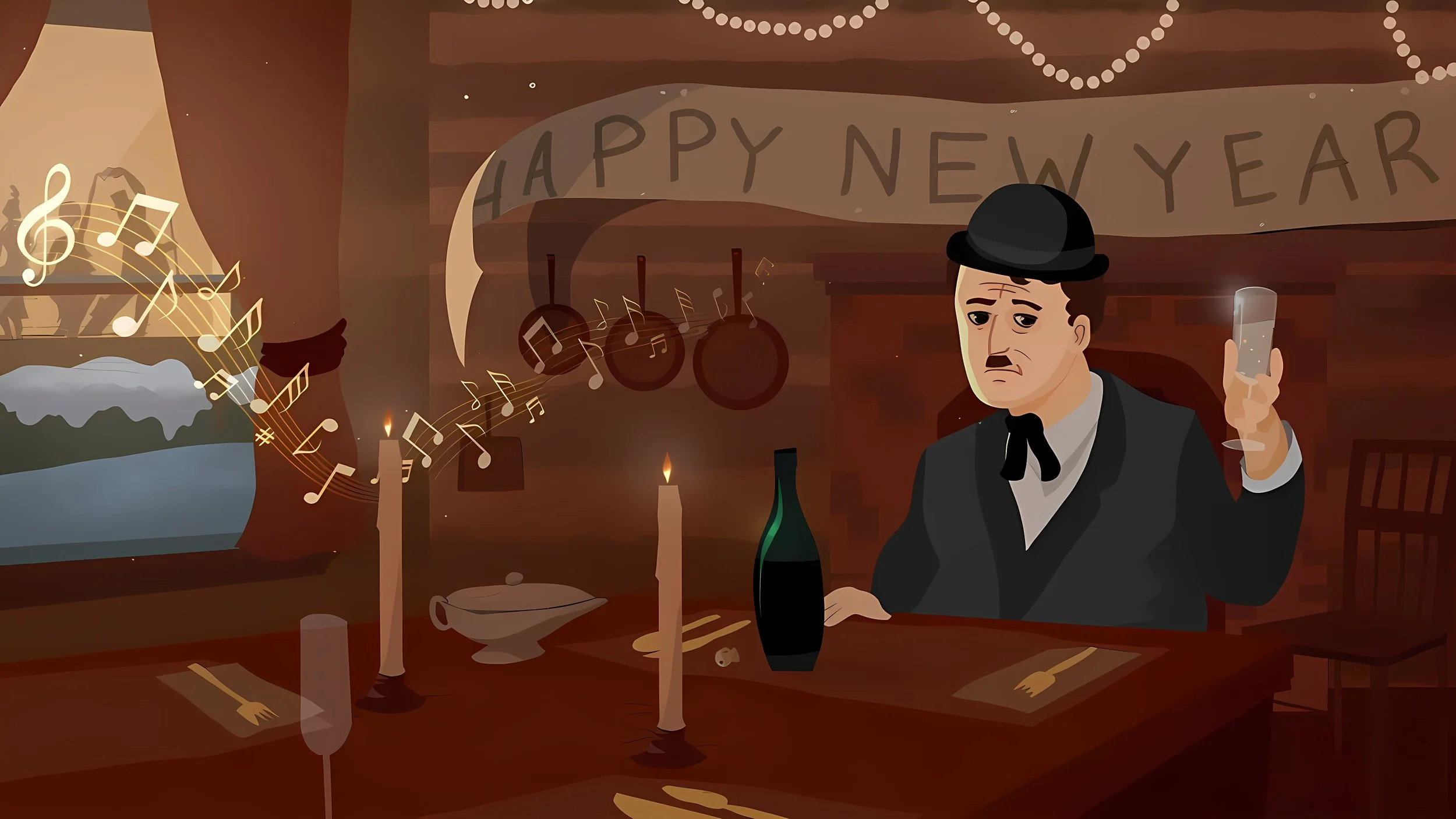
Lizzie: In the film, we see Chaplin's character, the Lone Prospector, sit down at the dinner table to wait for his guests. He waits, watches the clock, and eventually, the candles burning down, he falls asleep at the table and starts to dream. And we see what he’s dreaming about—or at least, we will when we rejoin the Lone Prospector after the break.
MIDROLL
Lizzie: We're back, and we're talking about a scene in one of Charlie Chaplin's early films, The Gold Rush. Curator Jim Deutsch has a theory that this scene might be responsible for making "Auld Lang Syne" the New Year's classic it is today, nearly a hundred years later.
Lizzie: In the movie, Chaplin, who plays a prospector in the Klondike Gold Rush, waits in his little cabin for the beautiful Georgia and her friends to come to dinner as they've promised to. But as he waits for them, he falls asleep at the table, and starts to dream.
Lizzie: We see him sitting around at a table surrounded by ladies. These ladies in party hats, and they're laughing, and they're dressed to the nines, and they're asking him to give a speech.
Jim Deutsch: Yes. And Georgia plants a kiss on him, which sends him falling to the floor.
Lizzie: And he faints! [laughs]
Jim Deutsch: Because he's—he's so overcome with emotion. And then fade to black, and fade in to people in the dancehall. We see signs in the background saying "Happy New Year." And that's Georgia, who's given two guns. It's the stroke of midnight, she shoots the guns.
Lizzie: Blam blam! Everybody cheers.
Jim Deutsch: Everybody cheers. Cut back to the cabin, the Lone Prospector waking up and goes to the door.
Lizzie: Oh. Yeah, he's standing at the door. He's—he's sort of gazing out into the night, and he's—he looks heartbroken.
Jim Deutsch: Yeah, he is heartbroken. And cut back to the scene in the dancehall where everyone is holding hands singing "Auld Lang Syne." Chaplin knew how to just connect.
Lizzie: Oh, gosh! Oh, his body language. He's just hunched over. He's so dejected. He’s so sad…
Jim Deutsch: Right. In a silent film, it's all body language. It's body language, it's gesture, its expression. Audiences in the theater—and remember in the theater, it's different from us watching it on small screen laptop. You would have been surrounded by hundreds of people, many of them crying, I think. The film elicits emotions, which is—and again, you don't have to watch this in English. People around the world were watching this and connecting in 1925, four years before Guy Lombardo ever came to the Roosevelt Grill in Manhattan.
Lizzie: [laughs] Okay, so 1925. This is years before Guy Lombardo started playing his famous New Year's Eve concert in New York City. So how much of the American population would have seen this movie in 1925?
Jim Deutsch: I would say at least half.
Lizzie: Okay.
Jim Deutsch: And then the film was rereleased in 1942 with a synchronized soundtrack.
Lizzie: I see. Okay.
Jim Deutsch: And with the synchronized soundtrack, we can hear them singing "Auld Lang Syne." So people would have seen this film, and it's not just the singing of the song, it's the pathos and the melancholy and the emotions that Chaplin and his Tramp character bring to the screen that would have been so memorable.
Lizzie: So the song itself, you know, it has a particular quality to it. Do you think that there's something about this song that gives it particular staying power—whether it's the words or the actual notes?
Jim Deutsch: Yes. The words are relatively few, and I should note that most people hear only the first verse. "Should old acquaintance be forgot and never brought to mind? Should old acquaintance be forgot in the days of Auld Lang Syne?" I don't think it's the words that are so important as the emotions that are inherent.
Lizzie: Yeah, there's something in this song that makes you want to wrap your arm around someone's shoulder and sing along with them—even if you don't know them, even if you don't know the words, you're there in this moment, inhabiting it together. And it's—I don't know. I guess in any moment of real presence, you are confronting this sense of—of communion, but also the fleetingness of any gathering of people, of any—of time.
Jim Deutsch: Yes, I agree. And it is a song that people don't sing alone. Well, I don't—is it a song that we sing alone in the shower?
Lizzie: [laughs] I actually was humming it to myself this morning in the shower in preparation for this interview. It's been in my head, okay?
Jim Deutsch: Okay, but I think it's more common to sing it in unison.
[music in: Megan Wofford - Auld Lang Syne]
Jim Deutsch: And again, which brings me back to that wonderful scene in The Gold Rush of people joining hands, arms crossed across their bodies, linking everyone together. The camera is panning as we see this absolute community of people who are connected, and then cut to the Lone Prospector, alone in his cabin, absolutely solitary, looking so longfully at something that he is not part of.
Lizzie: Hmm. It's the distillation of yearning.
Jim Deutsch: Yes, the sense of wistfulness, nostalgia. But also as we're saying, you know, looking back at the year that has just passed, but looking forward with some optimism and hope for the future. One of the other traditions at New Year's is we set resolutions. You know, what shall we do in the year ahead to make our lives better and more meaningful?
Lizzie: Yeah.
[ARCHIVE CLIP: "Auld Lang Syne" (choral)]
Jim Deutsch: I think "Auld Lang Syne," as we're saying, is a wonderful way of both looking back at the year that has just ended, and looking forward to the new year. And it's not insignificant that the first month of the new year is January, which is named for the Roman god Janus, who was two faced—one direction looking back, and one direction looking forward.
Lizzie: You know, this may not be the last song that our listeners hear this year, but it is the last Sidedoor episode that they will hear in this calendar year. So I feel that this is a nice note to go out on.
Jim Deutsch: No pun intended.
Lizzie: Yeah. Oh, pun—I'll pretend that I intended the pun. [laughs]
Jim Deutsch: [laughs]
Lizzie: Thanks so much, Jim, for talking with us.
Jim Deutsch: You're most welcome, Lizzie. It's always a pleasure to be on one of our podcasts.
Lizzie: And Happy New Year.
Jim Deutsch: And Happy New Year.
[ARCHIVE CLIP: "Auld Lang Syne" (banjo)]
Lizzie: And because "Auld Lang Syne" does have a bit of a melancholy edge to it, I wanted to end this episode with one of my favorite recordings of it. This is from the Folkways catalog, and it's a bluegrass banjo recording from the 1970s. This is a version that makes me want to start the new year dancing. So if you want to, you can get up and boogie with me.
That story came from Sidedoor, a fantastic podcast from the Smithsonian. On their show, host Lizzie Peabody sneaks listeners through the Smithsonian's side door to search for stories that can’t be found anywhere else. In recent episodes, they investigated a monkey kidnapping mystery, and explored how America became obsessed with martial arts. To hear more, follow Sidedoor right here in your podcast player.
Twenty Thousand Hertz is produced by my sound agency, Defacto Sound. Hear more at Defacto Sound dot com, or by following Defacto Sound on Instagram.
Lizzie: Sidedoor is produced by James Morrison and me, Lizzie Peabody. Our associate producer is Nathalie Boyd, who really led the charge on this episode. Executive producer is Ann Conanan. Our editorial team is Jess Sadeq and Sharon Bryant. Tami O'Neill writes our newsletter. Episode artwork is by Dave Leonard. Our show is mixed by Tarek Fouda. Our theme song and episode music are by Breakmaster Cylinder.
Lizzie: Special thanks this episode to Jim Deutsch at the Smithsonian Center for Folklife and Cultural Heritage. Other music you heard in this episode comes from the Library of Congress and Smithsonian Folkways Recordings.
Lizzie: I'm your host, Lizzie Peabody.
And I’m Dallas Taylor. Thanks for listening.
[music out]