← BACK TO SHOP
← BACK TO SHOP

Virtual Choir: 8,000 Voices, One Song

Artwork provided by Jon McCormack.

Artwork provided by Jon McCormack.

This episode was written and produced by Colin DeVarney.

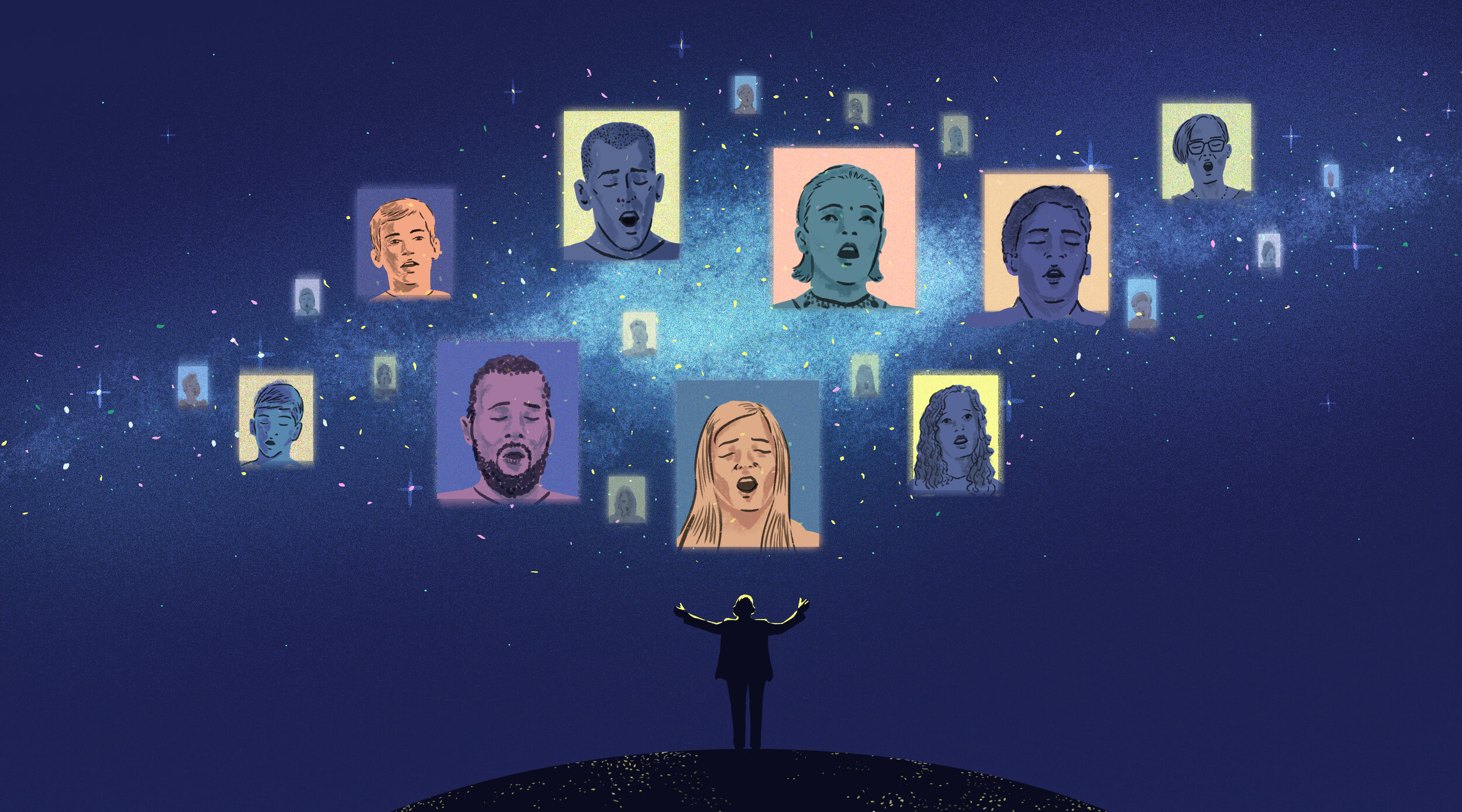
Singing with others is a powerful form of expression. That's why the composer Eric Whitacre started the Virtual Choir; an experiment that connects singers from every corner of the globe. In this episode, we hear how a choir can unite people from different backgrounds to achieve a common goal - creating beautiful music.

MUSIC FEATURED IN THIS EPISODE

Pretty Build by Sound of Picture
In My Head by Sound of Picture
Morels by Sound of Picture
Celadon by Sound of Picture

Twenty Thousand Hertz is produced by Defacto Sound.

Subscribe on ⁠⁠⁠⁠⁠⁠⁠⁠YouTube⁠⁠⁠⁠⁠⁠⁠⁠⁠ to see our video series.

If you know what this week's mystery sound is, tell us at ⁠⁠⁠⁠⁠⁠⁠⁠mystery.20k.org⁠⁠⁠⁠⁠⁠⁠⁠.

Support the show and get ad-free episodes at ⁠⁠⁠⁠⁠⁠20k.org/plus⁠⁠⁠⁠⁠⁠.

Follow Dallas on ⁠⁠⁠⁠⁠⁠Instagram⁠⁠⁠⁠⁠⁠, ⁠⁠⁠⁠⁠⁠TikTok⁠⁠⁠⁠⁠⁠, ⁠Facebook⁠, and ⁠⁠⁠⁠⁠⁠LinkedIn⁠⁠⁠⁠⁠⁠.

Join our community on ⁠⁠⁠⁠⁠⁠Reddit⁠⁠⁠⁠⁠⁠.

Consolidate your credit card debt today and get an additional interest rate discount at lightstream.com/20k.

Go to forhims.com/20k for your $5 complete hair kit.

Check out SONOS at sonos.com.

View Transcript ▶︎

[music in]

You’re listening to Twenty Thousand Hertz. I’m Dallas Taylor.

The music you’re hearing now is not an ordinary choir. It’s a teenager in her bedroom, singing into a laptop microphone. It’s a grandparent performing while their grandchild helps with the camera. And it’s a businessman, reliving his years of choir in school. What you’re hearing are hundreds of individual voices performing both together, and alone. The result is mesmerizing, and powerful, and greater than the sum of its parts.

[music out]

This performance is the first installment of what’s known as the Virtual Choir. It’s a project that connects singers from around the world to create music. The human voice is an instrument we’re born with. It doesn’t cost anything, and we can use it to express all sorts of emotions and stories. And if you sing with others, that expression can be amplified into something more.

But not everyone has the chance to do that.

Eric Whitacre had that in mind when he founded the Virtual Choir in the late 2000’s.

[music in]

Eric: I grew up in northern Nevada, and I really had no musical training. I definitely had an ear. I played piano. My parents tried to get me piano lessons, they just wouldn't stick. I played trumpet in middle school and high school, but I never learned to read music. I would just play by ear.

Eric: Then at 18, I went to The University of Nevada, Las Vegas. And on a whim, I joined choir. ​On the very first day, I was standing with 100 other people in the room and he said, "Lets begin with the Requiem, and the Kyrie. I didn't know what a Requiem was, I certainly didn't know what a Kyrie was. So I looked over the shoulder of the guy standing next to me and turned to page 10, and we launched into the Kyrie from the Requiem by Mozart.

[music out]

[SFX: Mozart’s Requiem in D minor]

Eric: I'll never forget that moment. That first breath, which to this day entrances me. That first breath that a group of people take before they sing. If you know the Kyrie by Mozart, then you know that it begins with the bass's.

[SFX: Kyrie from Mozart’s Requiem in D minor]

Eric: So we start this fugue subject ... the altos join. Then the sopranos, the tenors, and within about 25 or 30 seconds I just found myself standing in the midst of this cosmic Swiss watch. This level of complexity and humanity that I couldn't have imagined existed before that moment. And I remember doing exactly what I still do when I hear music that moves me, which is that I was standing there not singing, and I began trembling, I kind of shake, and then I giggle. It's like I get this feeling in my stomach. Then finally I had tears in my eyes... and I left after that first 50 minute rehearsal, the world's biggest choir geek. I was utterly transformed.

[music out]

Eric is one of the most influential choral composers of our generation. If you’ve been in a choir in the last few decades, there’s a great chance you’ve performed one of his pieces. The list of his accomplishments goes on and on, but the Virtual Choir remains perhaps his biggest creation. The idea though, came from a small gesture.

Eric: So a friend of mine sent me a link to a YouTube video. He said, "You've got to see this." In this video was a young woman, she was only 17 at the time. Her name's Britlin Losee. And Britlin had gone into a room and made a fan video for me. She says, "Hi Mr. Eric Whitacre, I'm a big fan and here's something that I want to do for you. Here's me singing Sleep."

[Music Clip: Britlin singing “Sleep”]

Eric: This was a piece of music that I had written for choir that had been published, and choirs had started performing. I was thunderstruck watching this. I just was moved by the purity of her voice, and also the purity of her intention.

[Music Clip: Britlin singing “Sleep” continued with other voices]

Watching her video, I thought to myself, "You know, if you could get 25 other people to do what Britlin is doing right now. If they were singing their part alone in their dorm room, or in the kitchen, or in the living room. As long as they were singing in the same key and at the same tempo. If they all just uploaded their parts to YouTube, and I literally started them at the same time then this choir would have to unfold, right? This virtual choir.

[Music Clip: Virtual Choir singing “Sleep”]

[music in]

Eric: I go online to my website and Facebook, and just in all caps, "I've got this idea. Let's make a virtual choir." I have no idea how to actually pull this off. The way Britlin did it was she was listening to a recording and she was singing along with it. But we're not going to be using a recording.

Eric: So I got the idea that what I would do is make a video of myself conducting the piece, but in complete silence. The music would only be in my head. I would upload this to YouTube, and then people would download the sheet music and sit in front of their computers, and watch my little conductor video. I genuinely had no idea if this would work or not.

Eric: I also didn't know if anybody would actually do it. But they did. And almost immediately I could tell, oh this is going to work.

[music out]

There were a few challenges early on though. When you’re singing in a group, everyone hears each other so they can stay in tune with each other. But if you’re singing by yourself though, it’s natural for the key to fluctuate over time, since you don’t have a reference to guide you. So to fix this, they added a piano track for the performers to sing to.

Eric: We've refined that so that now there's usually a choir singing underneath them so that they feel like they're singing into the sound of a choir. Instead of just into a vacuum.

In addition to a video of Eric conducting the piece, he also included detailed musical direction for the singers, just like a conductor would do in a normal rehearsal.

[Clip: Eric’s conducting direction]

With the materials in place, submissions began pouring in on YouTube.

Eric: I think it's one of the great selling points of a choir is that you never have to sing alone. Lots of people like to sing, but maybe don't want to be a soloist. When you're in a choir you can sing your heart out, and you never have to have your voice exposed like that.

These submissions were brought together and the first Virtual Choir was released. The only question was if anyone would notice. Here’s more of that performance of the piece Lux Aurumque, composed and conducted by Eric.

[Music clip: Virtual Choir I begins]

Eric: When I uploaded the first Virtual Choir, I really didn't think anybody but me and my tiny circle of choir geek friends would be interested. And the video went viral, I wasn't prepared for that at all. I started getting all of these requests for media appearances. Then suddenly I was being bombarded with requests from all over the world from singers. Saying, "I don't know what this is, but I have to be a part of it, when is the next one?"

[Virtual Choir I continues and fades out]

Eric: The first one had 185 different singers from 12 countries. At the time I thought, "That's as big as this could ever go." But just based on the number of people writing to me, we all thought, "Oh my God, this could be bigger."

Eric: First what we started to do is just build a better infrastructure. Better tools to help people learn the music. I refined the ability to get them to sing all at the same time. So I made a much better and clearer conductor track. The guide track for them to listen to was clearer.

With these improvements in place, the second piece was finished just one year after the first.

[Music clip: Virtual Choir II begins]

Eric: Then we launched Virtual Choir II which this time was that piece “Sleep” that Britlin Losee was singing the very first time she sent me that video.

Eric: We also bumped up our ability to aggregate the videos themselves. First at that time to find them on YouTube. And then to sort them by sound quality. Those that were recorded the best, and those that were recorded not as good. That became very helpful later on in the process.

Eric: This time we had 2052 singers from 58 different countries. It just overnight turned into this earth choir. I was completely unprepared for that. I could never have imagined it.

Putting that into perspective, this performance featured over ten times as many singers as the first Virtual Choir, and they ranged from nine year olds to senior citizens. If Britlin’s first YouTube video was a tiny snowball, it had now turned into an avalanche with no sign of stopping.

[Music clip: Virtual Choir II out]

The Virtual Choir would only continue to grow, which introduced some interesting challenges for Eric and his team.

Eric: With Virtual Choir III, we knew already going in, it's going to get bigger. So more and more singers wanted to be involved so then we started to build our own infrastructure. We had a small army of volunteers that would connect with anybody that was having technical difficulties. They would station themselves around the globe in different time zones so that anyone who wanted to join, but couldn't figure out how to do it, could join.

[Music clip: Virtual Choir III begins]

Eric: The Virtual Choir III, I think ended up with 3700 something singers from 73 countries. In terms of the style of music, we took it to, I think, as far as we can take it musically. We used a piece that I had written called Water Night that splits a lot. By splits it means that there's lots of different voice parts all making a single chord. So the climax of Water Night has the lines if you “open your eyes, night opens.” On the word, "eyes" it's a 14 part chord.

[Music clip: Virtual Choir III 14 part chord]

Eric: Which was a logistical challenge. Not only to line all that up and make it sound good, but literally just to aggregate the parts. So technically it was a huge challenge for us.

Eric: Spiritually it also really changed, I think, the way we were thinking about all of it. Until then, it had just been about amassing numbers in this extraordinary thing that we were making that seemed to resonate with people in a way. But we didn't really understand it at all. But for Virtual Choir III, we set up some places on my Facebook page, and on my website where people could upload their testimonials. They could write about what it was that moved them about the Virtual Choir and why they joined.

Eric: This is when we started to see some of these stories. These extraordinary stories ...

Eric: There was a man from Cuba who desperately wanted to join, but because of government regulations, was unable to send us a video larger than one meg. So we got our tech team together with him, and Cuba became part of the Virtual Choir.

Eric: There was a man who had gone legally blind and because of that, hadn't been able to sing in a choir for over 30 years. Now for the first time, he could get close enough to the computer screen to see my little conductor track, and he was able to join the choir.

Eric: There was a young woman who had sung in choirs with her mother. It's just a thing that the two of them did together. Her mother was dying of cancer and couldn't sing. So this young woman recorded her video looking straight into the camera but just off screen was holding her mother's hand in hospice as a tribute to both of them singing together, and their life together.

Eric: So suddenly for me too, I was seeing the sense of borders and governments starting to dissolve. There really was just this tribe with a common goal, and a common love. Which is to come together to make something larger than themselves. It gave me incredible hope for humanity, and really restored my faith in people.

[Music clip: Virtual Choir III out]

[music in]

Eric brought people from all walks of life together for a common purpose, in a way that had previously never been possible. From the beginning, the Virtual Choir was about so much more than just singing. But, the Virtual Choir was far from over. More after this.

[music out]

[MIDROLL]

[music in]

By the time the Virtual Choir became a viral sensation, Eric Whitacre was already a sensation in the instrumental and choral music worlds. His music was performed everywhere from middle school cafeterias to the most renowned symphony halls. And while he’s written music for lots of different instruments, vocal compositions are always something special.

Eric: I love writing for instruments. I love writing piano music, but there is something about the voice. Especially when I want to express something that I find to be fundamentally human. Sorrow, joy, love, the bond between a parent and a child. There's just no vehicle other than the voice for me.

Eric: I heard Ned Rorem one time, the American composer, somebody asked him, "Are you a singer yourself?" And he said, "No, I'm not, but I think the reason composers compose is because they can't sing." That really resonated with me. Because I have the soul of a singer. I have the heart of a singer, I just don't have the instrument of a singer. It's tragic situation actually.

[music out]

Eric composed for the voice to express things that he otherwise couldn’t. Choral music can communicate nuances in emotion in a way that speech can’t. With the Virtual Choir, Eric opened up that experience to a world of people who didn’t previously have an outlet. Anyone who’s been part of any sort of team knows the joy of working together for a common goal. But there are lots of people who have never had that chance. The Virtual Choir is a team with no boundaries or limitations. It allows people from any background to make a meaningful connection… albeit a digital one.

Following the success of Virtual Choir three, Eric knew the fourth installment would continue to feature more and more singers. But he wasn’t content to just grow in terms of numbers.

[Music clip: Virtual Choir IV begins]

Eric: Going from three to four, I knew that we would continue to grow with singers.

Eric: What I didn't want to do is just keep making the same thing over and over, and over. I wanted to grow. I wanted to grow the idea. So I thought, "Maybe what I'll do is I'll just go back to my pop roots a little bit." I had been working for years on a musical called Paradise Lost that was part musical, part opera, and then part electronica. There's a DJ and all different kinds of electronica beats in it.

Eric: I thought, "Okay, I'll take a piece from that." This piece called “Fly To Paradise,” and then we'll put dubstep in it. Lets just see what happens. And we made Virtual Choir IV, Fly To Paradise, something completely different.

[Music clip: Virtual Choir IV out]

“Fly to Paradise” featured nearly six thousand singers from over one hundred different countries. It was also a departure from the more standard choral music of the first three Virtual Choirs. Eric wanted to do something that stretched the norm. He’s a fan of pop music, so it felt like a natural fit.

Eric: There is great virtue in popular music. I think sometimes in the modern world it's easy to say music used to be so much better, more sophisticated and now it's this. The challenge of course is we never have the perspective of time. In 1965, yes there were the Beatles. Yes, there was Pink Floyd. But there was also 10,000 other groups that we never listened to. So we've really had the luxury of sorting out the wheat from the chafe. We can remember the 60's fondly because all we remember are the huge hits.

Eric: I would say in terms of popular music versus classical music, or lets say concert music. There's two things about it. One, concert music, when really well written is hyper-constructed. The composer spends weeks and months, and sometimes years constructing this whole world of relationships between notes. The architecture of a well written concert piece is something to behold. It's a marvel.

[Music clip: Virtual Choir V begins]

The first three Virtual Choirs were performances of more traditional choral pieces. The fourth was a take on a new genre. The question was, where would it go from here? It ended up taking years to answer to answer that question.

Eric: Mostly I just wanted to make something different and at the time I was in the throws of writing this piece called Deep Field. Deep Field is inspired by the image of the same name that was taken by the Hubble telescope in 1995. To me that image, the Deep Field image is the most important image in human history. It shows us how impossibly large our universe is, and how truly small we are in it.

Eric: I wanted to write a piece of music about that. Originally my concept, which is how the piece was originally performed is that it would be for orchestra. This big orchestral piece, and it would ... the music itself would follow the story of the Hubble.

Eric: And in my mind what would happen is I would turn to the audience, and I would give a little gesture to the audience, and they would know then to push play on their smartphones. And everybody had pre-downloaded an app. What would happen is as they push play, you would have a fly through to deep space, and then this final reveal of the Deep Field image on the phone. But then also from each phone was emitted a small electronica sound. Which on its own isn't that interesting but when you have 1000, or 2000, or 5000 phones in the audience playing a sound all at the same time. Then you surround them with a choir, it really is something special. It feels a bit like you're floating in space. Like you're inside the Deep Field image itself.

Eric: There's the Virtual Choir that comes in at the end.

[Music clip: Virtual Choir V virtual choir section]

Eric: Then we had a film made. So there's the piece itself, then we added the Virtual Choir and then we made an entire film, a 23 minute film to the piece itself.

Eric: And now what can happen is orchestras can perform the piece live with the film being projected.

Eric: The conductor just follows the film hits all the right moments and then at the end when the Virtual Choir is revealed, now the audience has all of the shimmering electronica on their phones, the Virtual Choir is being projected from the screens, and then a real choir is surrounding the audience. So now it adds this other dimension. Not only do we have all of these people in the room creating the sense of floating in space, but now you're joined by over 8000 virtual voices on the screen.

[Music clip: Virtual Choir V continues]

The Virtual Choir began with simple gesture from Britlin Losee. Today, it’s a global phenomenon that connects people across borders, age, experience, and beliefs. It’s a team of humans expressing in a way they otherwise couldn’t. But while the Virtual Choir certainly isn’t done, Eric isn’t really sure what comes next.

[Music clip: Virtual Choir V out]

Eric: I definitely want to keep doing the virtual choirs. It's fun, and it's a great way to get people interested in singing. And for me as a composer, it's just a great way to express things that I'm feeling.

Eric: I don't see how we can get bigger in terms of an ideological thrust. What do you do after you've done the universe? So maybe this time we get more smaller, more intimate, or I'm not sure.

Eric: One thing that will remain the same is ethos we've had since the beginning which is, if you upload a video, you're in, there’s no auditions. Every single person who makes a video gets to be part of the choir. And I'll continue that as long as we do the virtual choirs.

[music in]

The Virtual Choir is based around a belief that singing connects us in a unique and profound way. The voice is our most natural instrument, and it’s important that we use it to express ourselves the best we can.

Eric: I believe that singing is the single most fundamental way we have of communicating with each other, more than even speaking. There's something about a voice, when singing, that it carries terabytes of emotional information. When I listen to an amazing singer, say Ella Fitzgerald...

[Music clip: Dream a Little Dream by Ella Fitzgerald]

Eric: It's not just the music, it's not just the words that she's singing. You hear her entire life. There's something about the magic of the voice that can do that.

[Music clip: Dream a Little Dream by Ella Fitzgerald continues and fades out]

[Music clip: Virtual Choir 2]

Eric: There is something truly transformative that happens when you get a whole bunch of people together, singing at the same time, it's extraordinary. There's now all kinds of scientific studies that show that the physiology of it is transformative in itself. That stress hormones decrease. It's good for breathing, it's good for your musculature. There's even some studies now that suggest that people who sing together, their heartbeats begin to synchronize.

[Music clip: Virtual Choir 2 swells]

Eric: There's nothing like singing together to teach a sense of compassion and empathy.

[Music clip: Virtual Choir 2 continues]

Twenty Thousand Hertz is produced out of the studios of Defacto Sound, a sound design team dedicated to making television, film and games sound incredible. Find out more at defactosound.com.

This episode was written and produced by Colin DeVarney and me, Dallas Taylor, with help from Sam Schneble. It was edited and mixed by Colin DeVarney.

Thanks to Eric Whitacre. You can listen to his extensive catalogue of music on Apple Music or Spotify. You can find him online at eric whitacre dot com. Also, be sure to visit our website 20k dot org there we’ve posted of all 5 virtual choirs.

Finally, if you know a great story in the choir, band, or orchestra world, be sure to tell us about it. You can do that by writing us on twitter, facebook or by email at hi @ 20k dot org.

Thanks for listening.

[Music clip: Virtual Choir 2 out]

Recent Episodes

The Price is Right: The drama behind TV’s catchiest theme song

Artwork provided by Jon McCormack.

Artwork provided by Jon McCormack.

This episode was written and produced by Mike Baireuther.

As a young composer, Edd Kalehoff was looking for his break. In the early 70s he struck gold, writing for the theme song and music cues for The Price Is Right. However, suspect business dealings would cast a dark shadow over this hallmark of daytime game shows for decades.

MUSIC FEATURED IN THIS EPISODE

We Three Kings by Drew Holcomb and The Neighbors
Just Watch Me Now (instrumental) by Lady Bri
Cherry (instrumental) by Chair Model
Grey16 by Tangerine
No Limits (instrumental) by Royal Deluxe
Me and My Friends by Juliet Roberts
Airliner Remix (Instrumental) by Secret American

Twenty Thousand Hertz is produced by Defacto Sound.

Subscribe on ⁠⁠⁠⁠⁠⁠⁠⁠YouTube⁠⁠⁠⁠⁠⁠⁠⁠⁠ to see our video series.

If you know what this week's mystery sound is, tell us at ⁠⁠⁠⁠⁠⁠⁠⁠mystery.20k.org⁠⁠⁠⁠⁠⁠⁠⁠.

Support the show and get ad-free episodes at ⁠⁠⁠⁠⁠⁠20k.org/plus⁠⁠⁠⁠⁠⁠.

Follow Dallas on ⁠⁠⁠⁠⁠⁠Instagram⁠⁠⁠⁠⁠⁠, ⁠⁠⁠⁠⁠⁠TikTok⁠⁠⁠⁠⁠⁠, ⁠Facebook⁠, and ⁠⁠⁠⁠⁠⁠LinkedIn⁠⁠⁠⁠⁠⁠.

Join our community on ⁠⁠⁠⁠⁠⁠Reddit⁠⁠⁠⁠⁠⁠.

Check out The Price is Right Drum Cover on Youtube by RTDUMS2121.

Sign up for The Great Courses Plus and get a free month at thegreatcoursesplus.com/20k.

Check out and subscribe to Just the Beginning wherever you get your podcasts.

View Transcript ▶︎

[music in]

You’re listening to Twenty Thousand Hertz. I’m Dallas Taylor.

If you are from the US, that song means Plinko, spinning the big wheel, and showcase showdowns on The Price Is Right. This game show is a hallmark of American daytime television. If you’re outside of the US and haven’t seen the show, it’s the pure joy of retail therapy distilled into one hour of games. It’s centered around guessing the prices of stuff you probably don’t need, and in my opinion, it’s the most perfect game show ever.

[music out]

[Music clip: Price is Right Modern Intro]

The sound of this show is iconic. It’s like a slot machine on jackpot, fueling frenzied fans in the studio audience eagerly waiting for the chance to “Come on down!” and be contestants.

[SFX clip out]

But even devoted fans of the show might not know that The Price Is Right, used to sound completely different.

[Music clip: Original Price Is Right Intro]

This is from the original Price Is Right, which premiered in 1956 on NBC with host Bill Cullen. That’s right, there was a host BEFORE Bob Barker. Impossible! The original show was way more subdued, to put it lightly. Well-dressed contestants sat behind podiums on stage, and did their best to guess the prices of items.

[SFX clip: Price Reveal]

In the classic version of the show, this is the structure of the qualifying round to get into the actual game.

[SFX clip continued: Price Reveal]

So, that sounds about as fun as wandering the aisles of a department store, but the original Price Is Right lasted for nine years before being canceled.

Then, in the early 70’s, pioneering TV producer Mark Goodson decided to revive the show. Goodson, along with his business partner Bill Todman, created many of the most famous game shows in history, including Family Feud [sfx], Match Game [sfx], and To Tell The Truth [sfx].

At the same time, a young composer named Edd Kalehoff was just getting his start making TV show themes.

[music in]

Edd: I had recently come to New York and I met a guy that turned out to be not such a nice guy but he had a lot of themes going on television. Introduced me to Mark Goodson and Bill Todman, the game show kings of the time. And I started out doing a few of the smaller games ... Password and I've Got a Secret. Those shows that he has bringing back on television.

Edd: And then he was going to bring back The Price is Right, he was going to take it to Los Angeles.

[music out]

Needless to say, American culture and television changed dramatically from the premiere of the original Price Is Right in the late fifties to the it’s early seventies revival. For the show to stick with modern audiences, it needed a contemporary sound.

[music In]

Edd: Mark Goodson had already been hearing the Moog synthesizer, which I had gotten from Dr. Moog. He was intrigued with this new sound and one of the first people to really delve in… and there was actually nobody doing much with melody. Being a kind of a jazz guy and very varied in my styles, I was playing a lot of different kinds of music on the Moog, which does incredible things.

Edd: The great influences on me were the great movie composers. I loved writing accessible music. I loved writing stuff that was intelligent, what I would call intelligent.

[music out]

Edd: Mark Goodson was really a special guy. He was unique in a lot of ways. Certainly a genius of games. And there were no show runners. It was Mark. Mark enjoyed coming to my studio on 45th Street and 5th Avenue in New York. He got out of his tower up on Park Avenue and could come down and hang with the truth and soul network, as I called it.

Edd: He said, "Well, what do you have for me?" Ed: I like to say the name of the show in the melody. So I said, "The Price is Right. Yeah, yeah. The Price is Right." [Music clip: Price is right theme song] "The Price is Right. Yeah, yeah. The Price is Right."

Edd: And he said, "I like that." And of course, if he started to wiggle his foot you knew you had him.

Edd: And so, it was kind of a groovy sound. And that's how I presented the theme to Mark and he said, "Okay, kid. How much to go do it?" So I came up with a price and, "Okay. Go do it."

Edd: So I said to him, I said, "Mark, why don't you ever challenge me with my budget to go and do this music?" And he said, "Look, that's what it costs. If you say that's what it costs, that's what it costs."

Edd: He didn't hear another note until I showed up at CBS in the sound booth and played it when they were loading in the first week of shows.

[music in]

..but, we’re getting a little ahead of ourselves. Let’s rewind to find out how Edd recorded this iconic theme.

Edd: At that time we were doing a lot of London business for other projects and I had great orchestras over there. So I went to London [SFX: jet airplane flyover] And took a synthesizer over there. Customs had a great time trying to figure out what it was. The Cold War was still on. They thought I was a spy.

But once Edd got setup in the studio in London, some real magic began to happen with the session musicians.

Edd: Once you have good guys, the best players in the world that mastered their instruments, you can't go wrong. It's like having the best orchestra in the world to play your stuff.

Edd: They get the music and they go, "What do you want? We know the notes. What do you want it to be?" And I tell them a story about, "Well, this is going to be, tell them what won, Johnny." These guys would play that way.

Edd: I got to give them credit.

[music out]

Edd: So I learned the art of if you have a good pocket ... meaning the good pocket of the rhythm ... the drummer made that happen.

[Music clip: Price is Right drum cover]

Edd: It was almost a swing thing, almost a dotted 8th feel but it wasn't. It was written in 16ths, which are even.

Edd: What a drummer. I said, "How'd we get him?" "Well, you were like you'd been here a couple times before. And so they said yeah. We want to see who this Yank is. Who this Edd Kalehoff guy is."

Edd: He made it swing. And these players over there they got behind it. And they said, "Hey, this isn't TV music. This is something else." They made it come to life.

[music out]

Edd’s contributions to the Price is Right went well beyond the theme song. He’s also responsible for music and sound effects throughout the show. That included the notorious horn that plays when someone loses, named “The Lose.”

[SFX: Losing Horn]

And, for correct answers, Edd went to a hardware store and tested a bunch of different doorbells before recording the perfect option.

[SFX: Winning Ding]

[music in]

Edd’s music was the perfect pairing to each episode of The Price Is Right. The show became a huge wholesome daytime TV hit, but the story behind the royalties for the theme song is anything but wholesome [sfx: sad horn]. More on that, after the break.

[music out]

MIDROLL

[music in]

In the early 1970’s, the re-booted Price Is Right with host Bob Barker was on its way to becoming a mainstay of daytime television. Edd Kalehoff was the young composer of the show’s theme song, he should have been in an amazing position to profit from the show’s success. Writing a long-running theme song is a career-maker, with residuals providing a constant stream of income for years. But if you check the credits for the show’s theme during that time period, you won’t see Edd’s name.

[music out]

You’ll see Sheila Cole.

Edd: A man, I won't mention his name because I don't want to take anything away from his ability to do business.

Edd: Sheila Cole was his wife. And after I had written the Price is Right theme and come back from London, he said, "I have to put her name down as the composer. It's just a technicality." And I was just new at the BMI, ASCAP world. And he said, “You know what? This time it won't make much difference."

BMI and ASCAP are the two main performing rights organizations that represent American music writers and publishers working in TV and film. They set pay rates, work hours, and help determine how residual income is calculated and divied up. Show producers provide a “cut sheet,” which lists all the music cues needed in a given episode, and BMI and ASCAP ensure these composers and publishers get paid for their work accordingly.

Edd: Well, I was originally ASCAP when I first came to New York because that's all I knew. That's what I saw in sheet music that I would play in the night clubs.

[music in]

Edd: ASCAP is American Society of Composers, Authors and Publishers. BMI is Broadcast Music Incorporated. That was founded in Nashville. The government made them do that ‘cause there was only one performing rights society and they in the 40's made them start BMI to anti-monopoly.

Edd: So they came to me and they said, "Look, man, we can make your world much better."

Edd: How it works is there's a theme. Look at it as two 100% pies. One is the publishing earnings. And one is the writing earnings. The composer and the publisher.

Edd: It's based on air time, and it was based on television income. A percentage of their advertising income. It's a small percentage. It would go from maybe 2% to 3.5% of their annual gross income, that would go to the performing rights.

Edd: Well, what happened was this gentleman, to make a relationship with Mark Goodson said, "Okay, I'll make you the publisher. You'll make the money from the publishing." That 100% pie. "But I'll collect the writers."

[music out]

Based on those rules, The Price Is Right doled out a percentage of their ad revenue each year. But since Edd’s name wasn’t listed as the composer, he didn’t receive any of the royalties.

Edd: And I have to say you can carry around the vehemence and the harsh feelings for a guy that would do that to a young kid. Why not split it?

Edd: The income from that one theme, the Price is Right theme that I wrote on the Hammond that Mark shook his foot too, then I went to London, took it to LA and that was done. If you had written something that has earned to date maybe $40 or $50 million to date, that would have made a difference in your life.

Forty to fifty MILLION dollars. That’s what it means to write the theme song to one of the longest running television shows ever. Just think, that small percentage of ad revenue, piling up, year after year, into a fortune… and Edd, missed out on all of it.

Edd: I went to Mark Goodson and said, "Mark Goodson, I can't work for you anymore. You let that happen." He says, "I'll tell you what. I'll put your name down on the credits. On the television." I said, "Well, that would mean a lot for me." "And I'll give you all of the other music credits," which is income. Let's face it.

Edd: That first deal with the Price is Right, let me tell you. I still get it kicked every time that theme plays. That would have made a big difference in my life.

Edd: It would have been nice to recover that. I didn't. BMI and the mentors there said, "Look, man, just look. You're talented, have a great career, you’ll do great.

So, with Edd’s modern, high-energy sound, the revived Price Is Right soared in the ratings. The show, and Edd’s music, defined a generation of game shows, and became a timeless piece of Americana. While the Price Is Right became one of the most successful shows in history, Edd was building his career.

[music in]

Edd: First I was with the king of games, Mark Goodson.

Edd: I play guitar and I played a theme... it was NBA on ABC. And I played the guitar solo [Music clip: Straw Dogs w/ Guitar Solo]. It was good. It made it. It was different.

Edd: And that got ABC opened. That was Jeff Mason, who was then a producer and then he became the president of ABC sports.

[music out]

Edd even put a new spin on a classic Football theme.

Edd: We were doing Monday Night Football, you know that one? [SFX clip: Plays theme on the piano], you know, that thing. I was known for making things hipper, different twist.

Edd became one of the most prolific and prominent TV theme show composers in the industry. In addition to his work on Monday Night Football, his credits include themes Nickelodeon’s Double Dare, PBS News Hour, and ABC’s World News Tonight.

After the relaunch of The Price Is Right in the early 70’s, the format and sound of the show remained mostly unchanged for decades. Then, in the mid-2000s, Edd found himself once again working on the theme that helped start it all.

Edd: When Drew Carey took over when Bob Barker retired, Drew said, "Man, this is in mono. It's a mono recording." And he said, "Can you do it in stereo?" I said, "Well, I... I think I can." We'd already been dealing with surround sound by that time.

Edd had to make the sound of the Price Is Right appeal to a new audience, all while leveraging the nostalgia audiences have for this beloved franchise. Here’s what that mono recording sounded like:

[Music clip: The Price is Right theme, mono recording]

Edd: That was written at a time when I was young and on fire, and already had started making a living. Difficult but making a living. And it was okay. And I brought with me all of the wants and desires, and that theme goes through three key changes in the first 10 seconds.

And here’s what the new, stereo version sounds like:

[Music clip: The Price is Right theme, stereo recording]

Edd: And I said, "Listen. It's got to be real instruments. It's got to be a real Moog... If you don't do that, it's not going to be the same thing."

Edd: Some new musicians. All in New York. A lot of the guys that play Saturday Night Live are on the session. Some great players. And we all studied my old mono recording and what's on the air now is a remake of the original mono recording.

Edd: It's still running and it's a lot of fun to hear it.

[music out]

[music in]

After more than four decades in the industry, Edd hasn’t stopped writing themes or playing music.

Edd: That's what I was born to do. I never did anything else. I love sailboats, I love working with my hands, I love the art world.

Edd: And yet, writing music is something ... it's like I hear something, "Sheesh, that's a great idea that guy just used up." If I'm not out there writing some good stuff, these guys are going to write the themes and I'm going to wish I wrote them.

Edd: Even as late as last night, I heard something, a manipulation of sound. It had a whoosh in it, it had a low frequency, warm chordal harmonic movement. And it went into a melody and it was just that three seconds of sound like, "That was a special moment of something that really spoke to me."

Edd: I said, "I wish I thought of that." I said, "I can't stop."

[music out]

Before we go, here’s the entire :96 second modern-version of The Price is Right Theme song. Written by Ed Kalehoff, but still to this day credited to Sheila Cole (who also still collects the royalties.) Anyway... Enjoy.

[Music clip: The Price is Right Theme song modern version]

[music in]

Twenty Thousand Hertz is produced out of the studios of Defacto Sound. A sound design team that makes commercials, documentaries, and trailers sound incredible. To hear some of this sonic goodness, visit Defacto Sound on Instagram.

This episode was written and produced by Mike Baireuther. And me, Dallas Taylor. With help from Sam Schneble. It was edited and sound designed by Soren Begin. It was mixed by Jai Berger. Thanks to our guest, Edd Kalehoff. To hear more of Edd’s work, visit eddkalehoff dot com.

Thanks also to RTDRUMS2121 from Youtube for their drum cover of The Price is Right theme. You can find a link to that on our website, 20k.org.

The music in this episode is from our friends at Music Bed. Go listen at musicbed dot com.

Finally, are there any other classic TV sound stories that you know of? Well, I’d like to hear all about it. You can chat with me, and the rest of the 20k team through our website, facebook, twitter, or by writing hi at 20k dot org.

Thanks for listening.

[music out]

Recent Episodes

The Loudness War: Can streaming finally end it?

Artwork provided by Michael Zhang.

Artwork provided by Michael Zhang.

This episode was written and produced by Casey Emmerling.

In part 2 of the story of mastering, we explore the consequences of the Loudness War and call out some of the worst offenders. We’ll also hear about the artists and mastering engineers who have been fighting back, and learn how modern listening habits might finally put an end to this sonic arms race. Featuring Greg Milner and Ian Shepherd.

MUSIC FEATURED IN THIS EPISODE

Working Man is Always Poor by Live Footage
The Light Instrumental by SAILR
The Human Flute by Ryan Taubert
Wonderful Life Instrumental by Reagan James
Sparrows Instrumental by Jamie
Money Making Machine Instrumental by Jamie Lono
Airliner Remix Instrumental by Secret American
Waterfalls Instrumental by Reagan James
Do What We Want Instrumental by Spirit City
Smoke by Sound of Picture

Twenty Thousand Hertz is produced by Defacto Sound.

Subscribe on ⁠⁠⁠⁠⁠⁠⁠⁠YouTube⁠⁠⁠⁠⁠⁠⁠⁠⁠ to see our video series.

If you know what this week's mystery sound is, tell us at ⁠⁠⁠⁠⁠⁠⁠⁠mystery.20k.org⁠⁠⁠⁠⁠⁠⁠⁠.

Support the show and get ad-free episodes at ⁠⁠⁠⁠⁠⁠20k.org/plus⁠⁠⁠⁠⁠⁠.

Follow Dallas on ⁠⁠⁠⁠⁠⁠Instagram⁠⁠⁠⁠⁠⁠, ⁠⁠⁠⁠⁠⁠TikTok⁠⁠⁠⁠⁠⁠, ⁠Facebook⁠, and ⁠⁠⁠⁠⁠⁠LinkedIn⁠⁠⁠⁠⁠⁠.

Join our community on ⁠⁠⁠⁠⁠⁠Reddit⁠⁠⁠⁠⁠⁠.
Check out Ian Shepherd’s podcast The Mastering Show.

Check out Greg Milner’s book, Perfecting Sound Forever.

Consolidate your credit card debt today and get an additional interest rate discount at lightstream.com/20k.

Try ZipRecruiter for free at ziprecruiter.com/20k.

View Transcript ▶︎

You’re listening to Twenty Thousand Hertz, I’m Dallas Taylor, and this is part two of the story of mastering.

[music in]

In the last episode, we looked at the history of mastering. Up until the 80s, the constraints of analog equipment meant that music had to be mastered on the quieter side. While this may sound like a bad thing, the upside is that music from this era has really strong dynamics, almost across the board. Pick nearly any song from the 70’s or older, and you’ll find a striking contrast between the quietest parts, and the loudest parts. This gives the music a much more spacious and vibrant quality.

But once digital technology took over, things changed pretty quickly. New audio technology allowed mastering engineers to make songs much louder. Artists also started trying to one-up each other with how loud their songs were, and music overall got louder and louder. But all of this volume came at a price, and music became so compressed that it lost a lot of that impact and depth. The Loudness War had begun.

[music out]

For some people in the industry, even music that was pushed right up to the limit wasn’t quite loud enough. But if you’ve already compressed a song as much as possible, what happens when you try to make it even louder?

Ian: Beyond that, you can actually start to get distortion, where, if you just push the loudness up so that it hits that digital ceiling, where the tops of the waveforms, the musical waveforms, are literally sliced straight off [SFX], you get an effect called clipping. That sounds distorted.

That’s Ian Shepherd, a professional mastering engineer who also hosts a podcast called The Mastering Show.

Greg: When you clip, you literally are inserting a little blip [SFX] of noise.

And that’s Greg Milner. Greg writes about music and technology, and wrote a book called Perfecting Sound Forever: An Aural History of Recorded Music.

Greg: At that moment, the digital system is just saying, "I can't read this." So, if you're careful with it, you just do it every once in a while and the clips last just a fraction of a second, supposedly you're not going to be able to hear those parts, but a lot of recording engineers and musicians will say, "Yes you can.”

[music in]

Just imagine what would happen if you started pushing up every nanosecond of a song until it clipped. Pretty soon, all of that clipping would start to overpower the actual music. [SFX: music gradually clipping more and more] If you kept going and going, eventually, you’d be left with pure white noise. So whenever a song is clipping, it’s like a little bit of the music has been cut out, and replaced with white noise. Human ears aren’t supposed to hear this type of noise all the time.

[music out]

Greg: This is very difficult to prove and I don't know if it ever will be proven, but you ask a lot of engineers and they'll tell you that it causes fatigue. Some people will even say that it's a physical fatigue, that your eardrums are just being bombarded by these compressed parts and you are less likely to listen to music for long periods of time.

If you look at the waveform of a song in an audio program, you can see how the soundwaves swell at the loudest parts, and shrink at the quieter parts. But if you look at a song that’s clipping, you’ll see that the soundwaves no longer have these dramatic peaks and valleys.

Greg: When the sound clips, the soundwaves actually look like mountaintops with the peaks shaved off, which is not the way soundwaves ever behave in nature.

If a song is compressed enough, the waveform will look like a flat block, almost like a floating row of bricks in Mario [SFX]. When a song has had this done to it, engineers will say it’s been “brick walled.” and since the 90s, a ton of albums have been given the brickwall treatment.

Greg: If you look at certain recordings that really are notorious for being really poorly mastered in terms of loudness, the Red Hot Chili Peppers' Californication for a long time was really Exhibit A. There is so much compression and clipping in that, it just assaults the ears [Music clip: Red Hot Chili Peppers': "Parallel Universe"].

As the name implies, brickwalled music often has a kind of wall-of-sound quality to it, where instruments struggle to stand out from each other, the snare drum doesn’t really pop like it normally would… It just sounds kind of… squashed, because it is. It’s almost just like every single sound in a song is exactly the same volume. Take a listen to “Spaceman,” by The Killers and see if you can hear what I mean:

[Music clip: The Killers - "Spaceman"]

Compare that to the 1978 song “Roxanne” by The Police, ” and you can sense a little bit more of a natural difference between the instruments.

[Music clip: The Police - “Roxanne”]

But one album in particular has become the poster child for the Loudness War.

Greg: Death Magnetic by Metallica

Ian: Death Magnetic by Metallica [speaking in unison with Greg]

[Music clip: Metallica - “Cyanide”]

Ian: So the Death Magnetic album by Metallica was one of the first albums that really caught the public attention as far as the issue of the Loudness War was concerned. What happened was that a fan emailed the mastering engineer, complaining about the sound of the CD. And the mastering engineer replied off the record, saying, "Yeah, I'm not super proud of this one, but that's what the band wanted, and it is what it is."

According to that fan, here’s the actual response they received from the mastering engineer: Quote, “I’m certainly sympathetic to your reaction, I get to slam my head against that brick wall every day. In this case, the mixes were already brickwalled before they arrived at my place. Suffice it to say, I would never be pushed to overdrive things as far as they are here. Believe me, I’m not proud to be associated with this one, and we can only hope that some good will come from this in some form of backlash against volume above all else.” Unquote.

[music in]

Ian: The fan then published this on a forum, in public.

Ian: So, suddenly everyone could see what was meant to have been a quiet, private comment by the mastering engineer. And actually, I spotted this and wrote about it on my blog at the time. And Music Radar and Wired magazine and, ultimately, the Wall Street Journal picked up on the story, and it was briefly in the news. And there was actually a petition signed, with 20,000 fans asking for the album to be remixed and remastered.

[music out]

When 20,000 Metallica fans start complaining about an album being too loud, there might be a problem.

Ian: The really fascinating thing about it, though, was that, as well as the CD release, the soundtrack was available as part of the Guitar Hero game on the PlayStation. We think what happened was that the files were sent out to the game manufacturers earlier on in the production process, before the decision was made to go for this extremely loud final result. So the files that were used in the game were much cleaner, less distorted, than what came out on the CD.

Ian: Some of the fans much preferred the sound of the Guitar Hero version to the released CD.

Let’s listen to the two versions, and see if we can hear the difference. We’ve matched the loudness level so you can focus on the quality of the sound. Here’s a clip from the Guitar Hero version:

[Music clip: Metallica Dynamic 1]

And here’s that same clip from the CD release:

[Music clip: Metallica CD version]

The CD version just sounds awful. Here’s another clip from the Guitar Hero version:

[Music clip: Metallica Dynamic 2]

And here’s the CD:

[Music clip: Metallic CD version]

It’s important to note that in order to match the volume levels in these clips, the CD version had to be turned way down. Here’s the actual difference in volume. We’ll start with the Guitar Hero version:

[Music clip: Metallica Dynamic 1]

Now brace yourself, you might even want to pull out your earbuds—here’s the CD version:

[Music clip: Metallica CD version]

Ian: It's very unusual for us, as music fans, to get the opportunity to compare the final sound of an album with how it might've sounded earlier on in the process.

The original CD release of Death Magnetic is an extreme example but the unfortunate truth is that the vast majority of mainstream music from the last few decades has had some version of this hyper compression treatment. This means that for most of the music that’s come out in the last 30 years, there’s a better sounding version that we’ll probably never get to hear.

Greg: I've found you can almost choose stuff at random.

Greg: “Let's Get it Started” by the Black Eyed Peas is a really big offender.

[Music clip: Black Eyed Peas - "Let's Get It Started"]

Greg: “The Fallen” by Franz Ferdinand.

[Music clip: Franz Ferdinand - "The Fallen"]

Greg: Vapor Trails by Rush was another one that was so poorly mastered that the fans actually rebelled.

[Music clip: Rush - The Stars Look Down (original)]

When Rush released Vapor Trails in 2002, a lot of their fans were unhappy with how it sounded, and the band actually agreed.

In 2013, they had the entire album remixed and remastered. Let’s take a listen to those two versions, and see how they compare.

By the way, we are adjusting the volume levels of these examples so we can compare quality, not the loudness.

Here’s a clip from the original version:

[Music clip: Rush - Nocturne (original)]

That guitar sounds kind of crackly, almost like it’s a broken speaker. Here’s the same clip from the remastered version:

[Music clip: Rush - Nocturne (remix)]

Everything sounds so much cleaner. Here’s the original again:

[Music clip: Rush - Freeze (original)]

And here’s the remaster:

[Music clip: Rush - Freeze (remix)]

[music in]

Vapor Trails is a rare example of a band remastering an album specifically to improve it’s dynamics. Plenty of times though, you’ll hear fans complain that the remastered version of a classic album destroys the dynamics of the original.

Ian: Yeah, remastering is a bit of a controversial topic.

Ian: There have been reissues of classic albums where they've been pushed to the kind of extreme Loudness War levels that we've heard recently, which is not always in the best interest of the material.

Albums by bands like Led Zeppelin and The Rolling Stones get remastered and re-released over and over. When a new remaster comes out, services like iTunes and Spotify usually remove the older versions from their library. Unfortunately, these new versions might not be as dynamic as the ones they’re replacing. Our whole perception of what classic music sounds like is shaped by the specific releases that we get to hear. But as newer versions replace old ones, that history is constantly being rewritten.

[music out]

These issues don’t just affect one or two styles of music. No genre has been safe from the Loudness War.

Ian: Unfortunately, we now have the situation where it's not being driven by the genre.

Greg: Some music really benefits from a louder, aggressive sound, but if you want to take hip-hop as a genre you can compare the typical hip-hop song today to a hip-hop song from the so-called Golden Era in the '80s and '90s, and I guarantee you that the ones from the '80s and the '90s are gonna have a bigger dynamic range.

Here’s a clip of Young MC’s “Bust a Move”, from 1989:

[Music clip: Young MC - “Bust a Move”]

And here’s “All of the Lights” by Kanye West, from 2010:

[Music clip: Kanye West - “All of the Lights”]

Ian: Ironically, some of the most dynamic releases recently have actually been metal albums, which is an extreme, loud genre

This is the song “Of Unworldly Origin” by the band Revocation.

[Music clip: Revocation - "Of Unworldly Origin"]

Ian: Whereas you get just other saccharine pop stuff that's pushed to within an inch of its life, I mean the last Miley Cyrus album was a country, folky thing, [Music clip: Miley Cyrus - "Malibu"] and it was as loud as Skrillex, [Music clip: Skrillex - "Purple Lamborghini"] which just feels insane.

[music in]

According to Ian, mastering engineers face a lot of pressure to make music as loud as possible.

Ian: Most mastering engineers, if you ask them, would say that they prefer not to go for the super loud stuff.

Ian: I'm really lucky because I've talked about this issue for a long time. Most people know that I'm a fan of dynamics, and I'm not a fan of super-loud mastering. So, most of the people who come to me are not asking for extreme loudness, but a ton of my colleagues in the industry, all they get is requests for things to be louder. You know, the classic comment when they get back the master is, "It sounds great, but please can you make it louder?"

And even though these issues have gotten more attention recently, Ian says that not much has changed.

Ian: Over the last five years, lots more people are aware of this issue, and the reasons you might not want to go super loud, but they still request it anyway, because there's this idea that maybe they need it in order to compete, or to sell lots of copies, or to get the right sound for the style that they're performing in. None of that, in my experience, is true. There's research to show that loudness has no effect on the sales. There's research to show that users don't really care what the loudness is, it's all about the music.

So it’s not just mastering engineers who are responsible for making music louder. Musicians, mixers, producers, and basically everyone involved in the music production process have a roll in the Loudness Wars. But, there are signs of hope, and they’re hiding in some pretty surprising places. More after this.

[music out]

[MIDROLL]

[music in]

Starting in the 90s, popular music became completely consumed by the Loudness War. Most albums since then have been extremely loud and compressed, and many have been pushed so high that they clip and distort unnaturally. Nirvana’s Nevermind arrived in 1991, just as this trend was catching on. Nevermind became one of the best selling albums of all time, but by today’s standards, it's pretty quiet. On the other hand, Californication, by Red Hot Chili Peppers, came out eight years later, and it was also a huge hit. Californication is a great album, but for better or worse, it's super loud, and super compressed. So I wonder, if it had been a little quieter, with stronger dynamics, would it really have hurt sales?

[music out]

I’m not saying that music should sound exactly the same way that it was in the 1970s. But surely there’s a middle ground between the extremely light touch of the 70s, and the heavy-handed approach that took over in the 90s.

Greg: There are ways to do music that's very compressed that competes in the Loudness Wars and still has enough of a range from the difference between average levels and peak levels, to really sound nice.

Ian: So you’re always looking for the loudness sweet spot: that perfect balance between loudness and dynamics, where it’s loud enough, but it works musically, the sound is right, and it has the right emotional impact.

In recent years, some artists and mastering engineers seem to have found this sweet spot, and have made big hits.

Ian: For example, “Uptown Funk” by Mark Ronson and Bruno Mars was a huge hit

[Music clip: Bruno Mars: Uptown Funk]

Ian: “Get Lucky” by Daft Punk

[Music clip: Daft Punk - Get Lucky]

Greg: “Get Lucky” by Daft Punk I think is a good example. If you look at it on paper, you look at the peaks and the averages it looks like it's just peaking nonstop, but it's very subtly done so that there's enough of a difference between the averages and the peaks to really sound nice.

Ian: “God's Plan” by Drake is a massive worldwide hit and is not ridiculously loud.

[Music clip: Drake - God's Plan]

Greg: In terms of the Grammy winners, the song that Bradley Cooper and Lady Gaga did, if you look at that, that's got a more traditional sort of dynamic range.

[Music clip: Bradly Cooper and Lady Gaga - Shallow]

Greg: One interesting one, if you want to talk about going against the trend is Chinese Democracy by Guns N' Roses. Especially given that they were out of the public eye for so long you might think that they'd want to come back with a huge bang.

[Music clip: Guns N’ Roses - Chinese Democracy]

Greg: The story I heard from Bob Ludwig, the mastering engineer, is that he mastered three versions of that album and played them for Axl, and Axl chose the one that was the least compressed.

Ian: Bob Ludwig, who's a legend, offers his artists the choice. And if they choose the super loud version, that's the version that he goes with. But he personally prefers more dynamics, balanced dynamics.

This “loudness sweet spot” applies to remastering, as well. While some remasters have been overly compressed, others have done a great job preserving the dynamics of the originals, while making them sound even better.

Ian: The reissues of The Beatles' original albums that were done a few years ago are a fantastic example of that. They preserved everything that was great about the originals, and they sound even better than they have before.

Let’s see if we can hear how the sound changed across a few different Beatles releases. Here’s the original version of “Lucy in the Sky With Diamonds”:

[Music clip: The Beatles - “Lucy in the Sky With Diamonds” (original)]

Here’s a remaster from 2009:

[Music clip: The Beatles - "Lucy in the Sky With Diamonds" 2009]

And here’s the remixed and remastered Super Deluxe edition, from 2017:

[Music clip: The Beatles - "Lucy in the Sky with Diamonds" Super Deluxe]

All three versions sound great, but the newest one somehow manages to sound the most punchy, and the most spacious. Let’s do another example, here’s the very first mix of “Back in the U.S.S.R.” from The White Album:

[Music clip: The Beatles - “Back in the USSR” (original)]

And here’s the 2009 remaster:

[Music clip: The Beatles - "Back in the USSR" 2009]

And here’s remixed and remastered version from 2018:

[Music clip: The Beatles - "Back in the USSR" 2018]

These albums were recorded over 50 years, but by using the master tapes, the engineers at Abbey Road made these classic albums sound like they were recorded yesterday.

[music out]

Audio tape was patented all the way back in 1929. In the 9 decades since then, a massive history of music has been recorded on analog tape. For special projects like the Beatles remasters, you can go back to these original tapes and use modern technology to bring the sound quality into the 21st century. But what if we lose these tapes?

[music in]

In 2008 there was a fire at the Universal Studios Vault. The fire started from construction work on the roof. Universal Music Group hasn’t released the exact details on this fire, but it’s estimated that there were over 100,000 tapes with 500,000 songs stored in this vault.

The list of artists is unbelievably long and there’s no way I could go through the entire thing now, but just casually looking over it, here is a tiny fraction of who’s master tapes were probably stored there:

Louis Armstrong, Duke Ellington, Bing Crosby, Ella Fitzgerald, Judy Garland, Billie Holiday, Patsy Cline, Chuck Berry, Aretha Franklin, Elton John, Lynyrd Skynyrd, Eric Clapton, Jimmy Buffett, The Eagles, Aerosmith, Steely Dan, Iggy Pop, Barry White, Patti LaBelle, Tom Petty and the Heartbreakers, The Who, the Police, Sting, George Strait, Dolly Parton, R.E.M., Janet Jackson, Guns N’ Roses, Queen Latifah, Mary J. Blige, Sonic Youth, No Doubt, Nine Inch Nails, Snoop Dogg, Nirvana, Soundgarden, Hole, Beck, Sheryl Crow, Tupac, Eminem, 50 Cent, The Roots.

This is a tiny tiny fraction of what could’ve been in this vault. We don’t know for sure because in the ten years after the fire there still hasn’t been full confirmation. Losing even just one master tape is a huge hit to the music industry.

If these original master tapes were indeed destroyed, and had not been digitized, this is the biggest loss in our modern music history. That would also mean that none of these albums would have the opportunity to be remixed and remastered in the future like what we heard with The Beatles.

[music out]

In recent years, music production has become almost completely digital. But a lot of people still prefer the sound and experience of analog. So, many modern artists have been releasing their music on vinyl, and that’s an encouraging sign for the Loudness Wars.

[music in]

Greg: Vinyl is the only medium in the music industry that's actually growing.

Vinyl technology hasn’t changed a whole lot since the 70s. Due to the sensitivity of the cutting equipment, there’s still a hard limit on how loud you can make a vinyl record. As vinyl sales rebound, mastering engineers are being forced to consider how their mixes will sound on vinyl, just like they used to.

Ian: I wrote a blog post a few years ago, recommending that people master as if it's going to vinyl, but use that same master everywhere, for online, and for CD, and everywhere else, because that master will translate, and will work everywhere.

Ian: If a client was insisting on a super loud master for the CD release, for example, I would always encourage them to send a more dynamic version for the vinyl cut, simply because, as we said, there's a physical limitation. And again, there's no point in pushing that loudness super hard in the mastering for the vinyl if it's going to get turned down at the cutting stage anyway.

Ian: And actually, you do see a fair number of releases these days where the vinyl master actually sounds quite a bit different from the CD master, for that reason.

[music out]

But the biggest change in recent years is the way most of us consume music: by streaming it.

[music in]

When it comes to sound quality, there are pros and cons to streaming services like Spotify, Pandora, and Apple. On the one hand, they compress audio files down to make them smaller. This data compression can definitely result in a lower-quality sound. This is primarily so you can stream it and not eat up your cell phone’s data plan. But there’s another thing these platforms do to songs that’s actually pretty great.

Ian: The interesting thing about streaming is that, because sudden changes in loudness are the number one source of user complaints in TV and radio and also online, streaming services like YouTube and Spotify and Tidal, they want to give people the best user experience, so they have started measuring the loudness of songs they're playing back, and they turn louder songs down to stop people being blasted by sudden increases in loudness.

Greg: They keep it on a constant level because otherwise, especially if you were listening to a mix, if you were listening to Pandora or something, you'd have to be constantly adjusting your volume knob to deal with the fact that some records were louder than others.

Ian: And that's had two interesting effects. One is that it has removed the incentive, really, to make stuff super loud in the first place.

Greg: You’ve gotta figure that if you make music, a lot of it is going to be listened to through some sort of streaming service just because that's the way a lot of people listen to music today.

Ian: 87% of US music industry revenue in 2017 came from non-physical formats. So, only 13% came from CDs and vinyl and cassettes. Everything else was from streaming and downloads. So when that many people are hearing music for the first time online, the temptation to try and use loudness to stand out goes away, because even if you make something super loud, it's going to get turned down afterwards.

Ian: And then you have the situation where maybe some of those compromises that we've talked about, in order to get that super loud sound in the first place, actually become more obvious when they're compared to other songs that were more dynamic to begin with. Because you have this song that was squashed into this small space in order to get the loudness up there, but then you reduce the loudness again and suddenly it sounds kind of held in and constrained in comparison to the music that had more space to breathe in the first place.

Greg: Really, if you're a smart artist you know that and you don't use hypercompression because there's really no point to it.

[music out]

A few artists have actually started making two different versions of their tracks: a more dynamic one that they send to streaming platforms, and a more compressed one that gets put on the CD and on iTunes.

Ian: Some people are optimizing music for streaming services. For example, the YouTube version of Dirty Computer by Janelle Monáe is actually more dynamic than the iTunes version.

Let’s see if we can tell the difference, here’s the iTunes version:

[Music clip: Janelle Monáe - "Make Me Feel" (iTunes)]

And now, Here’s the more dynamic YouTube version:

[Music clip: Janelle Monáe - "Make Me Feel" (YouTube)]

Ian: For me, I think it sounds better as a result. They both sound fantastic, but the YouTube version just sounds incredible. And the iTunes version, to me, when I compare it, just sounds held in. It's a bit more in a box, it's a bit more constrained.

As an artist, is it really fair for artists to give paying fans a worse sounding version of your new album? Doing so isn't just a disservice to them, it's a disservice to the music you worked so hard to make.

Greg: Why would you want to limit the tools that you have at your disposal? And I really think that's what hyper dynamic-range compression does. It just takes a tool out of the toolbox and there's no reason to do it.

If you like to listen to your music loud, the best tool is your volume knob. Making music louder in mastering, just for the sake of being loud, simply degrades the overall quality of sound. This brings us to why dynamic range even matters in the first place.

Greg: Well, you think about it in terms of what music and sound is. It's a sonic palette and there's different ways to use that palette. One of the ways is to vary the music from soft parts to loud parts. It sounds very elementary, but it's very important. You can say music sounds fine today and I'm not gonna argue with that, but it really is undeniable that there is an important part of that sonic palette that just is not being used and I think that a lot of music benefits from that kind of rollercoaster ride of soft to loud to soft. We like our ears to be kind of tickled by these really quick bursts of high energy that go from soft to loud. So that's why I think it's important.

[music in]

Let’s use Photoshop as an analogy. Think about all of the tools you can use to tweak an image. You’ve got brightness, contrast, saturation, temperature. Dynamic range in a song is like contrast in a photo. High contrast means there’s a stark difference between dark and light, loud and soft. But when music has had all of the dynamics drained out of it, it’s like the contrast is stuck at its lowest setting. The image becomes gray, flat, and lifeless. Turning up the brightness on that gray image is like boosting the volume on a hyper-compressed song. Now you’re left with an image that’s almost completely white. Think about if we treated photography like we treat our music and made all of these photos just as bright as possible so that they could stand out from each other. Just think about how much less impactful those photos would be.

Ian: There are various examples of albums where I love the music, and I just find them frustrating to listen to because the sound doesn't do what I want emotionally.

Ian: It just feels like a missed opportunity to me, and especially if it's music where I love it and I want it to have that emotional impact.

But it doesn’t have to be this way.

Since streaming services even-out the volume between tracks, artists don’t really have to worry about standing out with ultra-loud music. So while it was digital technology that started the Loudness War in the first place, ironically, digital technology might be the thing that finally ends it.

Ian: Because we don't have to compete for loudness anymore, we can just choose whatever's perfect for the music itself, and know that it's going to be played back on a level playing field.

Ian: For me, it's an opportunity to go back to what mastering is all about, which is making the music as good as it can possibly be.

[music out]

[music in]

Twenty Thousand Hertz is produced out of the studios of Defacto Sound, a sound design team that makes television, film and games sound incredible. Find out more at defactosound.com.

This episode was written and produced by Casey Emmerling, and me, Dallas Taylor. With help from Sam Schneble. It was sound Edited by Soren Begin. It was sound designed and mixed by Nick Spradlin.

Special thanks to our guests Greg Milner and Ian Shepherd.

If you want to dive deeper into these subjects, be sure to check out Ian’s podcast, it’s called The Mastering Show. His website is called Production Advice. And check out Greg Milner’s book, Perfecting Sound Forever. You’ll find links in the show description.

The background music in this episode came from our friends at Musicbed. Visit musicbed.com to explore their huge library of awesome music.

What album captivates you with its amazing sound? You can tell me on Twitter, Facebook, or through our website at 20k.org. If you enjoyed this episode, be sure to tell your friends and family about us. Also, if there’s anyone in your life who records music seriously be sure to tell them about these two mastering episodes. And finally, support the artists you love by buying their music, and buy it in high quality.

Thanks for listening.

[music out]

Recent Episodes

The [COMPRESSED] history of music mastering

Artwork provided by Michael Zhang.

Artwork provided by Michael Zhang.

This episode was written and produced by Casey Emmerling.

Join us on a musical journey from the Golden Age of analog mastering to the digital methods of today. We’ll find out why the music industry became obsessed with loudness, and learn how the digital era transformed the way that music sounds. Featuring Greg Milner and Ian Shepherd.

MUSIC FEATURED IN THIS EPISODE

Isn't it Strange by Spirit City
Stand Up by Soldier Story
Lonely Light Instrumental by Andrew Judah
Who We Are by Chad Lawson
No Limits Instrumental by Royal Deluxe
Crush by Makeup and Vanity Set
Rocket Instrumental by Royal Deluxe
Light Blue by UTAH
Love is Ours Instrumental by Dansu
Shake This Feeling Instrumental by Kaptan
Wrongthink by Watermark High
Rocket Instrumental by Johnny Stimson
Lola Instrumental by Riley and the Roxies
Quail and Robot Convo by Sound of Picture

Twenty Thousand Hertz is produced by Defacto Sound.

Subscribe on ⁠⁠⁠⁠⁠⁠⁠⁠YouTube⁠⁠⁠⁠⁠⁠⁠⁠⁠ to see our video series.

If you know what this week's mystery sound is, tell us at ⁠⁠⁠⁠⁠⁠⁠⁠mystery.20k.org⁠⁠⁠⁠⁠⁠⁠⁠.

Support the show and get ad-free episodes at ⁠⁠⁠⁠⁠⁠20k.org/plus⁠⁠⁠⁠⁠⁠.

Follow Dallas on ⁠⁠⁠⁠⁠⁠Instagram⁠⁠⁠⁠⁠⁠, ⁠⁠⁠⁠⁠⁠TikTok⁠⁠⁠⁠⁠⁠, ⁠Facebook⁠, and ⁠⁠⁠⁠⁠⁠LinkedIn⁠⁠⁠⁠⁠⁠.

Join our community on ⁠⁠⁠⁠⁠⁠Reddit⁠⁠⁠⁠⁠⁠.

Check out Ian Shepherd’s podcast The Mastering Show.

Check out Greg Milner’s book, Perfecting Sound Forever.

Consolidate your credit card debt today and get an additional interest rate discount at lightstream.com/20k.

Go to forhims.com/20k for your $5 complete hair kit.

Check out SONOS at sonos.com.

View Transcript ▶︎

You’re listening to Twenty Thousand Hertz. I’m Dallas Taylor.

[music in]

Even those of us who know next to nothing about the music industry probably have some idea what mixing is. For instance, we all know mixing involves some sort of leveling— like how loud [SFX], or quiet [SFX] you want something to be. It also involves panning—whether you want an instrument or vocal part to be on the left [SFX], the right [SFX], or somewhere in the middle. And while you might use some effects while recording, a lot of other effects get added during the mixing phase. Maybe you want to add some reverb to the vocals [SFX], double-track to give it a little more oomph [SFX], or autotune those sweet vocals [SFX].

While working on a song, a mixing engineer will make a ton of decisions like these, both big and small. But after being mixed, songs go through a whole other process before they get released. This stage is much harder to explain, and while it’s definitely more subtle than mixing, it still ends up having a huge impact on the final sound. This process is called “mastering,” and even inside the music industry, it’s considered something of a dark art—something that only a small group of elite specialists know how to do.

[music out]

Greg: Mastering is the final step in making a commercial recording.

That’s Greg Milner. He’s written about music and technology for publications like Slate, Wired, Rolling Stone and The New York Times.

Greg: It's taking the fully mixed recording and essentially making it absolutely pristine and correct to actually make it into something that people will listen to or buy. In the old days, before digital technology, the mastering engineer was the person who would literally make the physical master from what the recordings would be stamped from.

Ian: Back in the day that would've been a vinyl master, then cassette, then CD, and these days for digital files.

This is Ian Shepherd.

Ian: I'm a mastering engineer. I have a podcast called The Mastering Show, and I run the Production Advice website.

Ian says mastering isn’t just about preparing music for public consumption.

Ian: It's also an opportunity to get the music to sound the best that it can be.

Ian: If it's a hard rock song [music in] maybe you want to bring even more aggression and density into the sound [music out]. Or, if it's a gentle ballad, [music in] maybe you want a lovely, soft, sweet, open sound… [music fade out]. So it's very much a collaboration between you and the artist.

[music in]

So how is mastering different from mixing?

Greg: Mixing is when you take all the individual tracks, the separate tracks that go into making a recording and you mix them together. I like to visualize it as if you had a lot of jars of different colored sand and you poured them all into one big jar, and you wanted to control how much of each color was there. You might pour a little of one, more of another, into the big jar, but then the sand would be in that jar permanently. You couldn't actually extract the different colors, so that's a finished recording. That's mixing. And then mastering is maybe taking that jar of sand and doing little things to it, maybe moving stuff around here and there, but it's already mixed. You're not doing any mixing when you're mastering. You're working with a fully mixed recording.

Ian: The other analogy is that mastering is like Photoshop for audio. So, we've all taken photographs, you know, on a mobile phone or a camera, and then maybe you have one that you actually want to print out or put on the wall. And you look at it, and actually you suddenly realize it's not quite as good as you thought it was. So, maybe you want to tweak the color balance, or enhance the contrast and the brightness, or maybe take out some red eye from a flash.

Ian: Mastering is the same thing for audio. So, you might adjust the equalization, which is the overall amount of bass [SFX] and treble [SFX] and mid range [SFX] in the sound, to get the tonal balance as good as it can be. You might want to adjust the balance of loudness and dynamics, which is like adjusting the contrast and the brightness in a picture. You might want to take out clicks [SFX] or thumps [SFX] or hiss [SFX] or buzz [SFX], and that's a bit like fixing red eye in a photograph.

[music out]

Ultimately, the mastering engineer is responsible for making an album sound cohesive, rather than just a random collection of songs.

Ian: Often, if you have a collection of recordings maybe from a bunch of different studios, and over quite a long length of time, it's a chance to balance those against each other, optimize the levels, the overall sound, to get the best possible results.

That includes deciding whether songs have gaps of silence between them, or whether they flow naturally into each other.

Ian: The final thing about mastering is to actually choose all of the starts and ends of the songs, and put them in sequence, and choose the gaps between them. And if you widen out the Photoshop analogy a little bit, that's maybe like doing a presentation of your images, maybe laying them out in a photo book or even a little exhibition, you know, and saying... what frame am I going to put this in? How am I going to light this? Should this be large, should it be small? All those kind of things.

Let’s compare the way a song sounds before and after it’s been mastered. Here’s a clip from the song Closer from Nine Inch Nails, before mastering:

[Music clip: Nine Inch Nails Closer Unmastered]

And here’s the mastered version:

[Music clip: Nine Inch Nails Closer Mastered]

Now, they both sound great, but the mastered version sounds fuller, clearer, and noticeably louder. It’s the same song, just...a little better. This shows how simple the effects of mastering can be.

But mastering engineers don’t just work on new music. It’s also common for older albums get remastered using newer technology.

Ian: The advantage is quite often you can go back to the original master tapes, you can make a clean transfer with the best possible equipment.

Ian: And the remastering is also an opportunity to maybe correct come faults.

For instance, Ian was once hired to restore and remaster a 1967 song called “Hush,” by the British songwriter Kris Ife. You may know Deep Purple’s version of the song, from a year later.

[Music clip: “Hush”]

Unfortunately, the original master tape of the track had been lost, so all Ian had to work with was an old vinyl 45. As you’ll hear, the record was in pretty bad shape. But through the magic of mastering, Ian managed to cut out the hiss and crackle. He also tweaked the EQ to make the song sound warmer and punchier. Here’s the original:

[Music clip: Remaster (first section)]

And here’s Ian’s remaster:

[Music clip: Remaster (second section)]

Ian: Sometimes, what was on the vinyl didn't sound as good as what was on the master tapes. And remastering is an opportunity to let people hear that. So that’s the ideal.

But the most controversial part of mastering has to do with loudness.

Ian: Part of the process of mastering is to get a great balance between the dynamics of the music and the loudness. So, the dynamics mean contrast in the music. So, in an orchestral score, you have pianissimo for the quietest moments [music in] and fortissimo for the loudest moments [music up]. And the same thing applies to a rock song [music in], for example. You want the introduction to be quiet and gentle, maybe, and then the verse and the chorus to get louder [music up], and you want the screaming guitar solo to really lift up in level to have the right emotional impact [music up].

[music out]

The natural difference between loud and soft sounds in music is referred to as dynamic range. The word “loudness” has an easier definition. It works just like your volume knob - basically a mastering engineer will change the overall loudness of each song so they all play nicely together as an album, and you don’t have to reach for the volume knob on your sound system.

In the ‘70s and ‘80s, when vinyl was king and recording was all analog, songs could only be as loud as the equipment would allow.

The machines that physically cut music into vinyl records were especially fragile.

Greg: In an analog system... you're really limited.

Greg: So I think their mindset was a little bit different in the '70s and '80s. The mindset was that there is this limit beyond which we really can't go so we have to be very, very careful about the way we master these recordings.

As a result, music from this period tends to have a very high dynamic range. So, there’s a lot of contrast between the quietest parts of a song and the loudest.

Greg: So many things back then had a great dynamic range. You know, you listen to Abbey Road for example, “Here Comes the Sun.” If you really listen closely you can really hear the range.

Here’s the quietest part of “Here Comes the Sun:”

[Music clip: Here Comes the Sun (intro)]

And here’s the loudest part:

[Music clip: Here Comes the Sun (loud)]

Just to be clear, we didn’t adjust the volume at all between the two clips, that’s the exact dynamic range from the album.

Greg: But you know what? If you listen to a Black Sabbath song that came out about a year later, a lot of those actually have an even greater dynamic range.

The song “Black Sabbath,” from Black Sabbath’s first album, Black Sabbath, shows off it’s impressive dynamic range within the first minute. At the start, it’s extremely subdued, with nothing but the sounds of rainfall and church bells.

[Music clip: Black Sabbath (intro)]

Suddenly, the song erupts into a monstrous guitar riff.

[Music clip: Black Sabbath (main riff)]

The energy peaks in the final seconds.

[Music clip: Black Sabbath (end riff)]

If you grew up on.

[Music clip: Black Sabbath (actual end riff)]

...I always forget about that. Anyway, If you grew up on classic rock radio, then you have heard these songs many times but may never have realized how they were affected by mastering.

This also applies to all genres of music, from hip hop to classical. Nearly all music gets mastered before it is released.

If you’re a classic rock fan, you’re probably sick of the song “Stairway to Heaven,” but there’s no denying that the song is a powerful example of dynamic range.

[Music clip: Stairway (intro)]

Greg: There's a reason, I think, that “Stairway to Heaven” was so popular. There's several reasons, but one thing is it just has striking dynamic range…

[Music clip: Stairway (drum verse)]

You can tell by how rich the drums often sound. Drums and vocals are I think the things that benefit most from really strong dynamic range.

[Music clip: Stairway (outro)]

From start to finish, that’s a huge change. We’re not just talking about in increase in energy, but in actual volume. A lot of the most beloved music from this era just is like this.

Ian: Pink Floyd, Wish You Were Here is a classic audiophile album with amazing dynamics.

[Music clip: Wish You Were Here].

Greg: Then of course the Eagles, love 'em or hate 'em, those early Eagles records had really stunning dynamic range, especially when they were mastered on to the Greatest Hits album that became the biggest selling album of all time. There's just a spaciousness to those records.

Like in the Song Witchy Woman.

[Music clip: Witchy Woman]

Greg: It was really kind of an embarrassment of riches in a way, but you could almost pick and choose, and chances are you'd be listening to something with strong dynamic range.

[music in]

But starting in the late ‘80s, the spread of digital technology caused seismic shifts in the music industry. For one thing, songs could made be louder than ever.

Ian: The new digital technology just allowed people to go even further, push the loudness higher and higher.

One of the main ways they did this was through dynamic range compression. Essentially, this type of compression clamps down the loudest parts of a track so they’re closer to the quiet parts, and once everything is evened out, you can boost the whole thing up. That way, the song stays closer to a maximum level the whole time, with less dynamic range from second to second, or minute to minute.

Of course, compressors weren’t invented in the 80s.

[music out]

Greg: Compression has been something that's been around at least since the advent of multitrack recording.

Ian: In fact, the reason that The Beatles got Abbey Road to buy the first Fairchild compressor, was to try and compete in terms of loudness with the music that was coming out of Motown.

[Music clip: You Can't Hurry Love]

Like this song, “You Can’t Hurry Love” by The Supremes.

[Music clip continued: You Can't Hurry Love]

But while analog compression had been around for decades, digital compression was a whole new ballgame.

Greg: With the advent of the compact disc it became easier to employ very, very harsh dynamic range compression to make things sound louder.

Ian: But there's also a limit in digital formats as well. There's this ceiling, basically, above which you can't go any higher because, at the end of the day, there is a number that is the largest number you can store in the digital format, and there are no numbers larger than that.

In other words, in a digital format, we can now make the volume max out riiiight before it’s absolute maximum possible level. With old analog tech, you it was very wishy washy, so mastering engineers had to be much more conservative in their approach.

[music in]

Ian: I have a bit of a crazy analogy to explain this, which is, if you imagine that the music is a person on a trampoline. If they're in a big sports hall with high ceilings, they can bounce as high as they like, and there's no restriction. But if you then think about raising the floor of the room up towards the ceiling, for a while that's no problem, there's plenty of headroom for the person bouncing on the trampoline, or for the music. But as you get closer and closer to the ceiling, the person bouncing is going to have to maybe start ducking their head or curling over, and twisting and turning to avoid crashing into the ceiling. And exactly the same thing happens with music. For a while, you can lift the loudness up with no problems. But as you get towards that digital ceiling, the highest level that can be recorded, you have to start processing the audio, squashing the audio down into a smaller and smaller space to make it fit.

Ian: You can do that quite gently, which can be beneficial and help things sound glued together and dense and powerful. But if you go too far, it can dull things down, and they start to sound lifeless and weak.

And by the time you’re hearing me right now, we’ve slowly compressed Ian’s voice, my voice, and the music. So right now, what you’re hearing is super compressed. Can you tell? [music plays] ...and here it is back with much lighter compression... Ahhhhh [music clip without compression].

So why was the music industry so obsessed with loudness? If hyper compression can degrade the sound quality of a song, why would an artist ever want it?? And how did all of this affect the future of the music industry? That’s coming up, after the break.

[music out]

[MIDROLL]

[music in]

In the analog era of recorded music, songs were mastered to be very dynamic. This meant that there could be a lot of contrast between the quietest parts of a song, and the loudest. But once digital technology hit the scene, mastering engineers could make songs louder than ever before. To do so, they used extreme compression, which boosts the volume but reduces dynamic range. So why were artists so eager to make their songs louder?

[music out]

Ian: If I play you two identical pieces of audio, but one of them is just a fraction louder than the other, they will actually sound different to you, even though they're the same and the only difference is the loudness. So the louder one might sound like it's got a little bit more bass, a little bit more treble, and on the whole, people will tend to say that they think the louder one sounds better.

So let’s try it. Here’s a clip from the song “Juice” by Lizzo. Which one sounds better to you? This:

[Music clip: Juice (quiet)]

Or this?:

[Music clip: Juice (loud)]

You probably picked the second one, and if so, you’re not alone.

Ian: Even though the audio is identical…

Greg: Their initial reaction is often going to be, "Oh, the loud one sounds better. It's just fuller. It's, you know, coming out of the speakers."

Ian: And that means that, if you're producing any kind of audio where you want to catch people's attention, there's a benefit to being loud.

And music isn’t the only place where some people think louder is better. There’s one industry in particular where getting people’s attention matters more than anything else.

[SFX clip: Billy Mays: Hi, Billy Mays here for the Grip and Lift, when you need some extra help for those outdoor chores, it’s a must have!]

That’s right: commercials. And just like music, the volume of commercials used to be limited by analog equipment.

[SFX clip: Bounty Ad (60s): That’s why I switched to Bounty paper towels. They absorb faster than any other leading brand. Bounty is the quicker picker upper.]

But as technology improved, commercials kept getting louder and louder.

[SFX clip: Bounty Ad (00s): The quilted quicker picker upper, Bounty!]

Eventually, things got so bad that Congress had to be the noise police for the entire country. In 2010, Congress passed the CALM Act, which stands for Commercial Advertisement Loudness Mitigation. Under this law, ads are prohibited from being broadcast louder than TV shows.

It basically works by measuring loudness over time. TV shows are longer, so they have time for peaks and valleys in the volume. But TV ads are often just a block of maximum loudness for 30 seconds, so they can still feel a lot louder even though they’re technically the same.

Greg: It's still at the same level, it's just that it's hitting those maximum peaks much more often than the TV show before it.

Ian: We've actually seen a similar thing happen in music, where people have been using loudness to try and get music to stand out as well. On record, originally, and on the radio, and these days, on CD and online... and it's called the Loudness War, because it's basically a sonic arms race. Because people know that if they can be a little bit louder, maybe they'll stand out a little bit more, or sound a little bit better.

Greg: Imagine a jukebox in a crowded bar [SFX] It's set as some kind of master volume. If the song that comes before yours has been mastered to sound louder, naturally that's where the volume is going to be set. [Music clip : Love Is Ours - Instrumental - by Dansu] When your song comes on it's gonna sound kind of weak and wimpy by comparison. Maybe you won't even be able to hear it over the crowd noise, [Music clip: Shake This Feeling - Instrumental - by Kaptan] There was this thought that music really had to just jump out of the speakers and really attack you.

Greg: What's the Story Morning Glory by Oasis: really, really, really aggressively compressed…

[Music clip: Morning Glory - by Oasis]

But on the other hand…

Ian: By modern standards, Nevermind by Nirvana.

Ian: Is quite a quiet record. But nobody ever complained that it didn't sound loud enough, because they just crank it up.

[Music clip: Lithium by Nirvana]

Greg: And that's the thing. We have plenty of volume to go around. All we need to do with records if they're not as loud as we want is just turn up the volume.

Still, Nirvana’s Nevermind ended up being something of an outlier, as more and more artists opted for a loud, ultra-compressed sound.

Greg: While this was all going on, the same thing was happening in radio. Radio stations were facing the same sort of problems. You want your radio station to pop out of the speakers so someone listening to it if they turned to it on the dial and less likely to go to someone else's. So, you had this Loudness War in radio and this Loudness War in recordings and it just combined to be this really crazy morass of loudness and compression.

Ian: Over time, the loudness levels just creep up, and creep up, and creep up.

By the end of the millenium, the Loudness War had spiralled out of control. Music was being hyper-compressed by mastering engineers, and again by radio broadcasters. Just when it seemed like things couldn’t get any worse, mp3s appeared, and music got compressed even more. This time, it was through a process called “data compression.”

Unlike dynamic range compression, which is applied while mixing and mastering, data compression happens when a recording is encoded from one digital format to another, like when you used to rip a CD onto a computer.

[SFX: Vintage CD tray SFX]

So let’s rewind to say 2001, [Show Me the Meaning of Being Lonely - dream sequence-y] and you want to get the music from your new Backstreet Boys CD onto your computer, and then put it on your mp3 player, or most likely you want to share it to Napster. Of course, you shouldn’t be uploading other peoples’ music to the internet, but it’s 2001, and you don’t know that yet.

So you open a program that turns CDs into mp3’s. But you probably didn’t pay attention to the settings. [SFX and Music out] And something most of us don’t realize is that when you turn those CD’s into a bunch of mp3 files, you are throwing away a huge amount of the actual sound of the music through data compression.

Greg: When MP3s came on the scene, they figured out that you could apply algorithms that would take out a huge amount of the music, and I'm talking like a gigantic amount of the music, because at any given moment there are certain frequencies that our ears are not going to hear because they're being overwhelmed by other frequencies.

[music in]

Ian: So I actually find it pretty impressive that lossy data compression works at all. When you think that often as much as 90% of the information is being discarded in order to get the file size down, it’s amazing that they sound as good as they do.

At higher-quality settings, most people probably won’t notice any loss in sound quality. But when you compress the file down enough, the sound really starts to suffer.

Ian: So what you tend to get back has similar tonal balance to the original, you can hear all of the instruments, it still sounds like the same piece of music. But when you do a direct comparison, you’ll often find, if you’re listening in stereo, what used to sound wide and spacious and lush collapses down into the center of the stereo image. You get much less of that sense of space and depth, and everything sounds a bit claustrophobic, a bit constrained… And the other thing that you hear as the data rate goes down is extra mulch, to use a technical term. It’s just this kind of squelchy, scrunchy, slightly distorted quality to the sound.

We’ve actually been gradually compressing the data of this audio over the last minute or so. Here’s how it sounded when we started, [Back to normal, high bitrate] and here’s where we ended up [Back to low bitrate]. It’s one of those things that if you don’t know what’s happening, you can’t really pick it out. But when you compare the two, you can definitely hear the difference.

[music out]

Ian: It probably won’t leap out at you, but once you start to hear it, it’s quite distinctive. For me, it just makes things sound duller, less interesting, less involving. I’m less likely to be sucked into a recording, and lose myself in it. It’s much less likely to give me goosebumps.

[music in]

Data compression in audio is still a big issue today. When you stream music, or listen to a podcast, the audio files gets encoded down pretty heavily to save bandwidth. This does make sense up to a point, since higher-quality files do take longer to buffer. And of course, a lot of us pay by the gigabyte for our mobile data. On the other hand though, internet speeds are faster than ever these days, and unlimited data plans are pretty common. You can stream 4K video from YouTube and Netflix, so why hasn’t audio caught up?

Unfortunately, audio still often gets treated like a second-class citizen compared to video, and the bar for what’s considered acceptable is significantly lower. Between over-compression at the mastering stage, and over-compression at the encoding stage, most of us have to put up with subpar sound all the time, whether we realize it or not.

[music out]

Ian: It’s quite interesting; because it’s such a subtle effect, if you didn’t do the comparison, you might never notice it. But I think it has quite a profound effect on the way that we feel when we listen to the music, and the way that we’re likely to keep on listening, or switch it off and do something else instead.

[music in]

Here at Twenty Thousand Hertz, we care about sound quality, and we think you do too. If you want to make the music you hear sound a little better, go into the settings of your music streaming app, and turn on “High Quality Streaming.” It’s not going to fix all of the issues we’ve talked about, but it does make a difference.

At this point, things seem pretty dire, but there are some signs of hope. While music has been getting pummeled by the Loudness War, some artists and mastering engineers have been fighting to keep dynamics alive. And while streaming services don’t have a great track record when it comes to sound quality, they might end up being the biggest game changers in the Loudness War. How?

We’ll find out next time.

[music out]

[music in]

Twenty Thousand Hertz is presented by Defacto Sound, a sound design team dedicated to making television, film and games sound insanely cool. Go listen at defactosound.com.

This episode was written and produced by Casey Emmerling and me, Dallas Taylor. With help from Sam Schneble. It was sound Edited by Soren Begin. It was sound designed and mixed by Nick Spradlin.

Special thanks to our guests Greg Milner and Ian Shepherd.

If you want to dive deeper into these subjects, be sure to check out Ian’s podcast, it’s called The Mastering Show. His website is called Production Advice. And check out Greg Milner’s book, Perfecting Sound Forever. You’ll find links in the show description.

The background music in this episode came from our friends at Musicbed. Visit musicbed.com to explore their huge library of awesome music.

What album captivates you with its amazing sound? I’d love to know. You can get in touch with me and the rest of the 20K team on Twitter, Facebook, or through our website at 20k.org. And if you enjoyed this episode, tell your friends and family.. And be sure to support the artists you love by buying their music… and preferably in high quality.

Thanks for listening.

[music out]

Recent Episodes

You’ve Got Mail: The voice behind AOL

mail.jpg

This episode was produced by Colin DeVarney.

How a simple soundbite on America Online became one of the most recognizable sounds of the internet age, plus the creation of a whole new musical instrument. This episode features Elwood Edwards, the man behind the famous AOL “You’ve Got Mail” soundbite, and Bosco and Maya Kante, inventors of the ElectroSpit.

MUSIC FEATURED IN THIS EPISODE

Dust in Sunlight by Sound of Picture
Fingernail Grit by Sound of Picture
Fives by Sound of Picture
Massive by Sound of Picture
Jack 12 by Sound of Picture
Tipsy Xylo by Sound of Picture
Twinkle Toes by Sound of Picture

Twenty Thousand Hertz is produced out of the studios of Defacto Sound, and hosted by Dallas Taylor.

Twenty Thousand Hertz is produced by Defacto Sound.

Subscribe on ⁠⁠⁠⁠⁠⁠⁠⁠YouTube⁠⁠⁠⁠⁠⁠⁠⁠⁠ to see our video series.

If you know what this week's mystery sound is, tell us at ⁠⁠⁠⁠⁠⁠⁠⁠mystery.20k.org⁠⁠⁠⁠⁠⁠⁠⁠.

Support the show and get ad-free episodes at ⁠⁠⁠⁠⁠⁠20k.org/plus⁠⁠⁠⁠⁠⁠.

Follow Dallas on ⁠⁠⁠⁠⁠⁠Instagram⁠⁠⁠⁠⁠⁠, ⁠⁠⁠⁠⁠⁠TikTok⁠⁠⁠⁠⁠⁠, ⁠Facebook⁠, and ⁠⁠⁠⁠⁠⁠LinkedIn⁠⁠⁠⁠⁠⁠.

Join our community on ⁠⁠⁠⁠⁠⁠Reddit⁠⁠⁠⁠⁠⁠.

Sign up for The Great Courses Plus and get a free month at thegreatcoursesplus.com/20k.

Get a 14 day free trial of Zapier at zapier.com/20k.

Check out and subscribe to Gastropod wherever you get your podcasts.

Check out and subscribe to Just the Beginning wherever you get your podcasts.

View Transcript ▶︎

You’re listening to Twenty Thousand Hertz. I’m Dallas Taylor.

[music in]

There are so many stories out there that we wanted to share with you, but some of the stories just don’t need an entire episode. So this show is going to be a little different. I want to present two completely separate bite-sized stories. The first is about a small little phrase that’s become one of the most recognizable sounds in recent history. And later in the show, we’ll hear about the creation of a brand new spin on a modern musical instrument. So without further ado, this is Jack Dearlove reporting on our first story.

[music out]

Jack: So, I'm sitting here, on my phone, and currently I have 17 unread emails. Most are spam, there are a couple of newsletters, there's something from a letting agent that I probably should look at more carefully.

Jack: But it got me thinking, it wasn't always like this.

[music in]

Jack: Do you remember when checking your email was a pretty major process? Turn on your computer, dial up, log in, wait for it all to load. I mean, you probably still had 17 unread emails waiting for you, but you were the boss of when they were looked at, rather than your phone.

Jack: And there was something else about that era of email that was pretty special. After you've gone through all the process of getting online, you were probably greeted by something that's gone down in Internet history. The voice of a guy who'd tell you-

Elwood: You've got mail.

[music out]

Elwood: I've been a television broadcaster since I graduated from high school.

Jack: So, this is the man himself. He's called Elwood Edwards, he's now in his mid-sixties, and the story of how he became the voice of AOL starts the same way a lot of stories do. Boy meets girl.

[music in]

Elwood: I had just purchased a Commodore 64 computer, and in a Christian chat room I started talking with a woman who was KarenJ2. I was in Gaithersburg, Maryland and she was in Fairfax, Virginia. After we had talked for several months, I invited myself over for dinner. She fixed tuna salad, I remember that... and we became inseparable.

Elwood: We were married in December 1988.

Jack: What I love about this story is that we still treat relationships that start online like they're a new thing, but this was the eighties. They're definitely not.

Elwood: She was a customer service rep for the company called Quantum Computer Services, which in 1989 became America Online. She overheard Steve Case, one of the principles of America Online. He was discussing with some programmers the idea of adding a voice to the software.

Elwood: Karen volunteered me, and on a cassette deck in my living room, I recorded, Welcome! You've got mail. File's done, goodbye.

Jack: What did you think of it when you heard it for the first time?

Elwood: Well, I've been an announcer, even though you wouldn't know it by my voice today. Gee whiz. I've been an announcer my entire broadcasting career. I started in radio while I was in high school, then I was always a staff announcer at the various TV stations I worked at.

Elwood: So, it was nothing new to me to hear my voice coming out of a little speaker. I didn't really think anything of it at the time.

Jack: “I didn't really think anything of it at the time.”

[music out]

Jack: It was just an average day in a series of average days. It was one recording, three little words that are still in use today.

Elwood: I don't think anyone had any idea what it would become. Certainly, had I realized it at the time, I would now be retired, but I'm not. Even today, I have an AOL account, email account, but if you go on AOL.com and then you either open your mail or you create an email account, when you sign onto that and you have new mail, you still hear me say, you've got mail.

Jack: I will be honest. The first time I heard it, El's voice is still there, I couldn't believe it. I actually went and signed up for an AOL account myself, just to double check, and yup. There he is.

Elwood: You've got mail.

Jack: But he's not the only voice you could have over the years.

[music in]

Elwood: Along with the history of all of this, AOL used to have an occasional, I guess it was an annual for a while, celebrity voice contest where users of the system could change from the default voice, mine, to the voice of various celebrities who had recorded the phrases as well.

Elwood: I know Mick Jagger said...

[SFX clip: Mick Jagger: You've got some letters.]

Elwood: But fewer than 20% of the AOL subscribers, throughout the years, had elected to change from my voice.

Jack: El is really proud of this, you can hear it in his voice.

Elwood: I would like to think they like to hear what I sounded like. I don't know for sure, but that's what I like to think.

Jack: It's almost like you've got a secret identity, you know, a bit like a super hero?

Elwood: Yeah, that's sort of true, yeah.

Elwood: It's not something I go around blowing my horn about, you know. My ex-wife used to be my greatest cheerleader. She would be the one who would open up the conversations, and then people would have me perform, if you would.

Elwood: I was on the Tonight Show with Jimmy Fallon.

[music out]

[Clip: Jimmy Fallon:Elwood!

Elwood: They had me do the "Welcome, you've got mail."

Jimmy Fallon: Elwood!

Elwood: Then they had me say some other things.

Jimmy Fallon: Thank you for coming on the show, Elwood. Now, to prove that it's really you, can you say the classic “You've got mail” line?

Elwood: Welcome! You've got mail.

Jimmy Fallon: That's worth the price of admission, right there. That's enough.

Jimmy Fallon: Now, we've got some other phrases we'd love for you to say, so whenever you're ready, read the cue cards.

Elwood: Uptown funk.

Elwood: Adele Dazim

Elwood: File's done. Goodbye.]

Elwood: That was a great deal of fun, and I really appreciated the recognition. I was slightly taken aback by the audience reaction, it was rather thunderous in the studio, which I had not expected.

Jack: This is a guy who has been famous for decades, but he talks about going on a show watched by millions on TV, and online, all around the world like it was just a nice day out. Maybe that's it.

Jack: He could be milking his fame for everything it's worth, but he's not. He's just happy to have been part of your life.

[music in]

Jack: Do you ever get tired of it, at all?

Elwood: Oh, no. No, not at all.

Elwood: If anything, I enjoy the look on people's faces when they realize who I am. At the TV station where I work, I'm a News Editor, I run the studio cameras. I'm really a behind-the-scenes kind of person, I've never been one to really want to be in the limelight, but it's quite gratifying when somebody does realize who I am, and their reaction to that knowledge.

Elwood: Our world is full of people who were in the right place at the right time, and I'm glad to be one of those.

[music out]

[music in]

The decision to add a voice to America Online probably felt pretty insignificant at the time, but it really became a cultural icon. Elwood was only paid $200 and recorded it on a whim. It was a favor. This phrase has gone on to be synonymous with the early days of the internet, so much so that even younger generations know the phrase. It also made Elwood famous in a unique, hidden way. Almost no one would recognize him if they saw him on the street, case and point - here’s Twitter user Brandee Barker finding out that ther Uber driver was Elwood.

[Clip: Twitter video:

Brandee: This is my Uber Driver and he just told me something very special, that he’s the voice behind

Elwood: Welcome you’ve got mail.

Brandee: No way! Do it again! Do it again! Welcome, you’ve got mail. Yay, ok whats your name?

Elwood: Elwood Edwards.

Brandee: Elwood Edwards, thank you!

Elwood: You bet!]

After the break, we’ll take a look at another story about sound and technology. It’s about an inventor that combined our oldest instrument with modern technology to create something entirely new. After this.

[music out]

MIDROLL

[music in]

The human voice is our oldest instrument. It doesn’t take any sort of gear or technology to use it. It’s sort of the opposite of modern day synthesizers if you think about. But naturally, people have tried to blend these two opposites together to create something different and new. Our second story comes from the podcast Just the Beginning, which is about how independent creators bring their ideas to life. This story is of a husband and wife team that created an instrument called the ElectroSpit. Put simply, it kinda lets you sing like a robot. This story is reported by Michael Garofolo.

[music out]

Maya: A melodic robot. [Laughs]

Bosco: Yeah. That’s a great description. A robot…

Maya: Who has a soul.

Bosco: [laughs]

Maya: A robot with a soul.

[Bosko singing with ElectroSpit]: Oh yeah. Welcome, welcome, EeeElectroSpit…

[Bosco continues to improvise beneath intros]

Maya: My name is Maya Kante. I am in charge of business strategy, marketing, and cracking the daily whip.

Bosco: [Laughs] My name is Bosco Kante.

[SFX: Singing: My name is Bosco…]

Bosco: I am charge of engineering, the vision for the company… which is a shared vision.

Maya: Yeah, I was about to say I don’t know about that. [Laughs]

[Bosco continues on electrospit: "We’re going to give you the backstory — oh."]

Michael: I got to see the ElectroSpit when we sat down for this interview, and it looks a little like a pair of headphones that you wear around your neck… with the parts that you’d normally put over your ears — Bosco calls them soundcups — resting right on your throat.

Bosco: So, the way the ElectroSpit works, the sound comes into the soundcups [SFX]. If I put it on my neck it goes through my neck and out of my mouth. It replaces your vocal chords [SFX]. So if I talk at the same time you can kind of hear it in the background [SFX] but if I open the back of my throat now you can hear it now you can hear it oh… That’s what it sounds like.

[Music: Zapp “More Bounce To The Ounce”]

Michael: The ElectroSpit is actually based on an older instrument, called the talkbox… that was used a lot in the 1970s and early 80s… and that’s when Bosco got hooked…

Bosco: I was in middle school at the time, and I would ride in my neighbor’s ’65 Impala, and he would play Zapp, “More Bounce the Ounce”, and then we would go to the skating rink and they would have breakdancing and popping competitions, and that was the main song for those competitions. Ever since that time, I wanted to know how to make that sound, how do they do that.

[Music: Zapp “More Bounce To The Ounce”]

Michael: Bosco spent years mastering his talkbox technique. And he is a master. Bosco is one of the few go-to guys in the music business and his credits prove it. He’s played talk box on tracks by Bruno Mars and Big Boi.

Michael: So, why is he trying to reinvent it?

Michael: Well, first of all, the talkbox is notoriously difficult to play… there are some… let’s say, basic design flaws… for example… you have to try to sing while holding a plastic tube in your mouth.

Bosco: And if you hold it in the wrong place, it doesn’t sound right. And even if you hold it in the right place, it still sounds like you have a tube in your mouth.

Michael: And then, there’s Kanye.

Bosco: Kanye, okay. So, I had the opportunity to play live on the American Music Awards with Kanye West because I did this song called, “Kanye’s Workout Plan,” that I wrote, and there’s a big talkbox solo. But before the show, they’re talking about what the performance is gonna be like and it’s gonna have all these dancers and you’re gonna be moving around.

Maya:‘Cause they were doing a workout routine, dance routine.

Bosco: Right. And the talkbox is not mobile. So I’m gonna have to lip sync. Which sucks because this is my big moment to like show everybody in the world how great of a talkboxer I am and no, I’m out there doing a Milli Vanilli. That was the inspiration for ElectroSpit.

[SFX: Bosco improvising with ElectroSpit]

Maya: Some of our early prototypes we had like a person with a keyboard tie, and you know how they have those snorkeling things where they have the thing in their nose, we thought maybe we could do that.

[SFX: Bosco improvising with ElectroSpit]

Bosco: I had like an attachment to the tube, like I thought of the talkbox as the tube.

Maya: And the more you thought about it it was like that makes it so you can’t share it because it make it unsanitary. And that means that less people can use it. When you go to a studio, anybody can pick up a guitar, right? But if somebody has a spare talkbox laying around, unless you have a clean tube, nobody wants to touch that thing.

[Bosco improvising with ElectroSpit]

Michael: There was maybe no one more qualified to bring the talkbox into the 21st century than Bosco. He’s not only a musician — he’s also a mechanical engineer. He got his first big break in the music industry while he was still in college when he was commissioned to do the theme song for the TV show In Living Color.

[SFX: In Living Color Theme Song]

Michael:And it seems Bosco’s particular brand of genius that combines music and technology, it runs in his family.

Bosco: My mom plays French horn, my grandmother plays trumpet. My aunt plays trumpet. My other aunt plays guitar and sings. So, you know, Christmas carols are very lively.

Maya: I sit silently. [laughs]

Bosco: So music was a huge part of our family. And then, in addition, everybody in my family did math. My mom is a math … she was a math professor and now she’s a civil engineer. My grandmother was a math professor, but before that she was working as an electrical engineer and she was actually part of the team that invented the microwave. My mom’s first cousin invented the laser.

[Music: ElectroSpit “Now Is So Last Year”]

Michael: Like I said… Bosco seemed destined to build this instrument.

Michael: And with a backstory like this, it makes sense that Bosco and Maya really do consider ElectroSpit a family business… even if what they are doing doesn’t exactly look like a mom and pop type of thing.

Bosco: Everything for us is family, you know?

Maya: Yea, everything.

Bosco: Yea, it’s just everything.

Maya: Some people were like, “How do you work together and live together and you’re married?” And I was like, “Well, we actually really do like each other.”

Bosco: That’s right.

Bosco: But when we first got together, Maya had come from the corporate world.

Maya: There was some learning to be done about what looks like work. Entertainment looked like kick it time to me. He’s like, “No, this is a business meeting.” I was like, “No, you’re having drinks.”

Bosco: And I had never had a quote unquote job, I mean…

Maya: You’ve always been an entrepreneur.

Bosco: I’ve always been-

Maya: And people don’t think of that as a job, but it’s so much more grueling than a job because nobody tells you what to do, there’s no set hours. Like, he had way more of a job than anybody that I’ve ever known.

Bosco: Well, yeah, if I didn’t sell this particular song then I wasn’t gonna be able to pay my mortgage. So initially anytime we would face some adversity in our entrepreneurial ventures, Maya would, she started looking at the job-

Maya: Job boards.

Bosco: Job boards.

Maya: And I’d be applying for jobs and stuff. ” And he was like, “You’re just fooling yourself.”

Bosco: You’re just wasting time. Now, when we face some type of adversity or challenge, it’s “we can do it, we can figure this out, we’re gonna get creative.”

Maya: We’re doing it. It’s always we’re doing it.

Bosco: See? We’re doing it. It’s done. Consider it done.

Maya: Yeah.

[Music: ElectroSpit “Now Is So Last Year”]

Bosco: Initially, she looked at ElectroSpit as “this is Bosco’s thing. He’s the producer, he plays talkbox.”

Maya: This crucial turning point where our son was trying to give me a compliment, and he goes, “Mommy, maybe when I grow up I wanna be a music helper like you.” And I was like, “What?” I was like, “I’m a boss.”

[Music: ElectroSpit “Now Is So Last Year”]

Michael: And how about their son? Even though he’s still in elementary school, he’s already angling to take over the family business.

Maya: At his school, they had a project called The Living History of Hip Hop. His dad came in as a part of that whole project and did a demonstration of the ElectroSpit. And all the kids got up and tried it. And then after school that day, our son said, “Okay, so I need to be the salesman.” Because he said, “Everybody in class says that they each have $100, so I think that’s a good price point, around $100.” I was like, okay, you’re in the fourth grade and you’re nine years old and you’re trying to basically pimp out your classmates to buy the ElectroSpit [laughing].

[Music: ElectroSpit “No Chute”]

Michael: When I spoke to Bosco and Maya, the ElectroSpit was just about to go into production. And I couldn’t help but notice that as they talked about the upcoming release, they sounded a bit like parents watching their kid grow up.

Bosco: You know, the talkbox is gonna be out there and people are gonna do all kinds of stuff. And I know that there’s gonna be some kid that’s gonna pick it up and be 10 times better than me and play it upside down or behind his back and that’s the exciting part.

Maya: We don’t wanna put any limitations on it. We’re just excited to see what other people do.

[Music: ElectroSpit “No Chute”]

That story came from our friends at the Just the Beginning podcast. The hosts Zakiya Gibbons and Nick Yulman and they present some fantastic stories on creatives making their dreams become a reality. So take a moment to go find it and hit that subscribe button... You can also find out more about the Electrospit at electrospit dot com.

[music out]

[music in]

Twenty Thousand Hertz is produced out of the studios of Defacto Sound, a sound design team dedicated to making television, film and games sound incredible. Find out more at defactosound.com

This episode was produced by Colin DeVarney and me, Dallas Taylor, with help from Sam Schneble. It was sound edited by Soren Begin, and mixed by Jai Berger.

Thanks to reporter Jack Dearlove and the Just the Beginning podcast for letting us share their stories. And if you happen live in London, Jack actually made an awesome app that tells you the status of the London Tube through emojis. So check that out at tubemoji dot com.

Also, if you’ve heard any other great stories about sound or read in another article about sound, be sure to send it to us. You can do that by writing us on Twitter, Facebook or by email at hi@20k dot org. Seriously, my favorite part of doing this show is hearing from our amazing listeners, so don’t be shy.

Thanks for listening.

[music out]

Recent Episodes

From Spinal Tap to The Simpsons: Voice acting w/ Harry Shearer

Artwork provided by Mike Andrews.

Artwork provided by Mike Andrews.

This episode was written and produced by Fil Corbitt.

We rarely think about the way we speak. For most of us, it just happens. In this episode, we catch up with two professional voice artists and chat about their rituals and techniques that help them communicate. Featuring voice actor Harry Shearer and NPR vocal coach Jessica Hansen.

MUSIC FEATURED IN THIS EPISODE

Fantasy (Instrumental) by De Joie
Trembling Care (Instrumental) by How Great Were the Robins
Wishing Well Wheel by Sound of Picture
Do Better by Sound of Picture
Por Supuesto by Sound of Picture
Peas Corps by Sound of Picture
Bright White by Sound of Picture
Platformer by Sound of Picture

Twenty Thousand Hertz is produced by Defacto Sound.

Subscribe on ⁠⁠⁠⁠⁠⁠⁠⁠YouTube⁠⁠⁠⁠⁠⁠⁠⁠⁠ to see our video series.

If you know what this week's mystery sound is, tell us at ⁠⁠⁠⁠⁠⁠⁠⁠mystery.20k.org⁠⁠⁠⁠⁠⁠⁠⁠.

Support the show and get ad-free episodes at ⁠⁠⁠⁠⁠⁠20k.org/plus⁠⁠⁠⁠⁠⁠.

Follow Dallas on ⁠⁠⁠⁠⁠⁠Instagram⁠⁠⁠⁠⁠⁠, ⁠⁠⁠⁠⁠⁠TikTok⁠⁠⁠⁠⁠⁠, ⁠Facebook⁠, and ⁠⁠⁠⁠⁠⁠LinkedIn⁠⁠⁠⁠⁠⁠.

Join our community on ⁠⁠⁠⁠⁠⁠Reddit⁠⁠⁠⁠⁠⁠.

Subscribe to Harry's podcast Le Show.

Consolidate your credit card debt today and get an additional interest rate discount at lightstream.com/20k.

Try ZipRecruiter for free at ziprecruiter.com/20k.

Check out SONOS at sonos.com.

View Transcript ▶︎

[SFX: voice clearing/Dallas’ Vocal prep]

You’re listening to Twenty Thousand Hertz. I’m Dallas Taylor… uh, hold on. Let’s do that one more time. You’re listening to Twenty Thousand Hertz. I’m Dallas Taylor. There we go.

[music in]

Since I’ve been making this very podcast, I’ve had to start thinking about something I never thought about in my entire life: my OWN voice.

Every episode tells stories of people who study and design the way our world sounds. But - getting meta here - It’s MY voice communicating these stories, and it’s super weird and I hate my voice just as much as you do. And it’s not like I ever considered myself a vocalis, of any sort.

But there was this one time last Winter where I completely lost my voice but I had to record an episode, I had no idea what to do. So, as you do, I posed the question to twitter asking for advice and was completely blown away when one of my childhood heroes responded.

[music out]

Harry Shearer: And we’re recording.

This is Harry Shearer. You might not know his name, but you’ve definitely heard him.

He was a cast member on Saturday Night Live, he was Derek Smalls in the movie Spinal Tap....And of course, he’s the voice of many characters on The Simpsons.

[SFX: montage of Ned Flanders Clip, Seymour Skinner Clip and Burns & Smithers].

[music in]

In addition to acting and voice acting, he also has been on the radio for decades.

Harry: Well, that's where I started. That's where I've had a foothold for coming on 35 years now as a so called grown up. So I probably have been more of a regular presence or more of a presence on radio than in any other medium.

So this is someone who knows how to use his voice. And after he responded to my tweet, with a recipe for a throat-soothing drink, I figured why not take this moment and set up an interview and see what else I could learn from a voice master.

Harry: There's a world of effects you can create with the voice and with these tools that we have, and that can both spellbind a listener and take a listener into a world of imagination that visual kind of overwhelms and wipes out, and you can spend literally millions of dollars of CGI work trying to create an effect that the listener's imagination can create very easily just with a sound and a few words.

All we need is our voice to tell a story and sound can elevate that to another level. But there are so many nuances that make our voice engaging. This can take years to master. And our voice is very fragile. So it’s incredibly important to find ways to protect it.

[music out]

Harry: My wife is a singer and her dad was an opera singer, and she taught me his warm ups. The most tired my voice gets is doing what we're doing right now, talking in some version of my actual voice. So, I always warm up before that and certainly if I'm going to do Simpsons or stuff for my radio show, she just taught me that's the essential thing is to warm up and it's about a 10 minute routine and then she also taught me, I think what I suggested to you, which is apple cider vinegar, honey and hot water and then someone else added and I sometimes will do this as well, some garlic and lemon juice to the preceding ingredients.

Are there certain voices that are more difficult or strenuous?

Harry: Oh yeah. Oh yeah. The decision as to how a character sounded, they call it a decision is to dignify it unsuitably because it was basically just a sort of a stab, an intuitive leap I'll call it if I want to dignify it at all, in the beginning of the show, I don't know about anybody else in the cast but I know I didn't see any drawings.

Oh really?

Harry: Yeah, yeah, yeah. I only saw was script and like a one sentence description of the character, so it's really just I think it sounds like this and if you had told me then you're going to be doing this voice for 30 years, there are several voices I would have changed how they were done, Otto [SFX: Otto] and even more particularly a character that they mercifully finally killed off, Dr. Marvin Monroe, who sometimes reappears magically from the dead on a Halloween show.

[SFX: Dr. Marvin Monroe]

Harry: Marvin Monroe was designed to be as grating as humanly possible. He was a family counselor who was supposed to, you know, have a benevolent kind of reassuring bedside manner but I think it was written into the description that he had just this horrible voice that was grading and totally went against the grain of the effect he was supposed to have on people, so that's what I did but I mean it was not good on the cords and Otto, I will say this, we do that at the end of every session.

[SFX: OTTO]

[music in]

Establishing a warm-up routine and having a concoction to clean out your pipes are great first steps to Vocal Health. But wading into this world of using my voice professionally, I’ve realized there is so much more than just voice health. There’s breathing, there’s phrasing and of course there’s the pronunciation of words, or what’s better known as, diction.

Harry: I haven't heard the word diction used in public in so many years, ‘cause people seem to have forgotten about it. Yeah, I mean, listen to the way people talk.

Harry: I never thought of myself as a dialectician, and if you listen to some of my accents on The Simpsons, you'd agree with me… but it's just my observation of what I've seen, tend to emphasize pronunciation as a key to an accent or a dialect.

When doing an accent, Harry says it’s actually inflection that can make it believable, instead of the diction.

Harry: You've learned the inflection of the way your parents talk before you knew what they meant. You don't make a mistake with that, and so a musical ear will clue you into the music that each accent encodes and you can make dozens of mistakes with pronunciation and still sound like you're doing the accent.

[music out]

I’m going to be totally honest -- it’s hard to use your voice to its full potential. And it’s something we’re all born with, but it’s also something we rarely think about. And zooming out a little, that’s true about sound in general.

[music in]

Sound often takes a backseat to the other senses, even though it can really shape our experiences.

Harry: If you're doing a film, sound is the guy at the bottom of the food chain. The actors have been called to the set, lights have been set and you hear this all the time, oh waiting on sound. It's the last guy who has to sort of finally get his two cents in and it’s “oh this isn't right, I got to fix something”, sigh, waiting on sound…

Harry says he made a low-budget film about 20 years ago, and his understanding of sound is what made it possible.

Harry: When you're working low budget, you really have to be inventive with everything but I learned you can almost trick people into thinking they saw something if you use sound correctly and combine it with a couple other things, so effects that you just can't afford to do, you can almost be sure that people will think they've seen that effect in your film if you use sound properly with as I say a couple other treatments.

[music out]

Through sound, you can trick the mind into thinking it saw something, and Harry says that makes sound a subversive effect.

Harry: It's so powerful in all sorts of ways. In mood, coloring how you perceive something and this is a golden age as far as I'm concerned in terms of what is now being made available in terms of tools to play with sound.

[music in]

Sound is powerful, and were all born with this little built in sound box. This whole podcasting experience got me thinking that I need to learn how to use this tool better. So I went searching for somebody who could help.

That -- and some pretty embarrassing sounds coming from my voice -- after the break.

[music out]

MIDROLL

[music in]

One really fast way to learn how to use your voice professionally is to start a podcast and figure it out as you go. That’s what I did, but last year I started thinking, maybe I should ask a professional to teach me some tricks. So I emailed Jessica Hansen.

[music out]

Jessica: I am the in house voice coach at NPR. I'm also the voice of NPR funding credits.

In case you’re not familiar with NPR funding credits, here’s some of Jessica’s work.

[SFX: Jessica Hansen reading funding credits]

Jessica works specifically with NPR Journalists to help them find a voice for radio.

Jessica: The primary reason for NPR needing a voice coach is because we are an audio product and most people don't have training in using their voices as storytellers. They have training in how to write, how to find sources, how to cultivate the sources, how to put together the story, how to ask the right questions, how to be in the right place at the right time, but they just don't get voice training.

And all of that hard work to write a story, can fall flat if your voice can’t engage the audience.

If you don’t sound excited, people will pick up on that. And if you sound too authoritative, people might not identify with you.

Jessica: Most people say, you know, "Oh, well sound more conversational", but then the person doesn't know how to sound more conversational, because you are reading and it is hard to lift words up off a page. It is the trick in this business.

[music in]

So how do you start?

Jessica: Breathe. Uh, gosh, breathing solves almost every problem. Breathing solves nerves, breathing solves phrasing, breathing solves decisiveness, and breathing helps you to open your voice.

It’s so easy to run out of breath without even realizing it’s happening. Just learning to think about your breathing is huge.

Jessica: I'm also often being asked to solve the problem of a voice being placed wrong. You know? She sounds too nasal, he's talking out of his throat, he has vocal fry, she sounds like she's whispering. And so I solve a lot of resonance problems. Helping people to put their voices forward in their faces so that they're resonating and they're not speaking out of the backs of their throats, and that they feel like they're using their whole voices and sounding like a whole person that's present and not just part of a voice.

[music out]

We often think of our voice as a natural part of our self, but like any muscle, we have to train it to unlock its full potential. Without thinking about it, we limit our ability to communicate.

For instance, you can work to expand vocal range. That’s the variation between high notes and low notes.

Jessica: I think increasing vocal range is one of my favorite things to work on. A lot of people use only a few notes in their range. We speak on maybe two or three or four notes because, you know, we're grownups and we're trying to sound like we're adults.

This sort of adult tone can get really monotonous.

Jessica: I love to work with people on increasing the range of their voices, and helping people to find that higher notes don't necessarily sound shrill, and lower notes aren't the only thing that you can do to sound authoritative. And so really playing with vocal range, and giving people a broader spectrum to choose from is not only fun, but I think it's really important.

Remember, training and vocal work is not about changing the voice, but expanding it.

Jessica: People are scared they're going to be talking way up here like Minnie Mouse, but that's not the result either. If you work on talking like Minnie Mouse, and like the Wicked Witch of the West, and like some Dark Lord villain character, and then you marry all three of those together we get various places in the voice that blend and merge, and all three of those qualities together create the whole voice.

I actually took vocal lessons with Jessica for about 3 months. And they were totally different from what I had expected. Instead of singing scales, or trying to hit certain notes, She had me do all kinds of weird stuff.

Like lay totally flat on my back at NPR making cat noises and weird grunts. I would also do things like singing twists where I spin my whole body and just sing… Just go (uuhuuuhuuuh). Things like lip trills (brrrrrr). Barrel shimmies, these are things where I’m shaking my whole body and just gonna (ugh ugh ugh ugh). Lazy tongue where I just let my tongue sit in my mouth and not use it. Toddler (ME! ME! ME!) I can’t do it, it’s just so ridiculous. Anyway there's a ton of laughing and just ridiculousness. But its all to just stretch your entire comfort level, to find out where your voice can go, really.

Anyway, we tend to think of our voices as pretty fixed. But they really aren’t -- even without training, they can change quite a bit over time. If you go back and listen to the earliest episodes of your favorite podcasts, you’ll probably be surprised a how different the host sounds. I’m not gonna play anyone else’s show, but I can play mine.

The first episodes of this show really weren’t that long ago -- it was late 2016 -- and still, I can hear a clear difference in my voice. It is horribly cringey for me.

Anyway, very reluctantly, here’s me from the first episode of Twenty Thousand Hertz:

[SFX: #1 Siri]

It’s always weird to hear your own voice recorded, but hearing an old version is even weirder. I sound weird and unhappy. And it really sounds like I got pulled out of bed at four o’clock in the morning and someone put a microphone in front of my face.

[music in]

It’s weird that you have to work so hard just to sound natural. And this goes beyond podcasting and voice acting. If you give a speech or just want to communicate with your boss, a lot of the times the feelings in your head just doesn’t really translate much to the voice. I think everyone could benefit in some way by just practicing their voice.

Jessica: I think that the voice is a really good expression of who we are. You know the expression, 'the eyes are the window to the soul'? I think it's true of the voice as well. Every voice is unique. Every person has his or her own unique sound. And no matter how much training you give it, it's still an expression of that person's inner self.

Jessica says, when you train your voice, you gain a wider range of expression.

Jessica: So people who work on expanding their vocal range, they have more options for expressing themselves or what they're trying to communicate, whether it's storytelling or a presentation in a boardroom, or giving an inspirational speech. Whatever it is, even if it's just your Thanksgiving toast around the family dinner table. Just having more options for color, and tone, and lyric and being able to express yourself more fully.

And being able to express yourself more fully, and more accurately, is a pretty cool skill to learn.

Jessica: I think it's important for professional voice users to remember that the most important thing is to make a connection with your listener.

Jessica: The more free and open, and the more possibilities for expression, the better we feel. The better we individually feel physically, emotionally and mentally. And just know that everything that you have to offer is exactly enough, and just to open that up and give yourself the range and the freedom to express what you have to say, because everyone has a different perspective, everyone has a different story, everyone has a different point of view, and everyone has a different voice, so we want to hear them.

[music out]

[music in]

Twenty Thousand Hertz is produced out of the studios of Defacto Sound a sound design team dedicated to making television, film and games sound incredible. Find out more at defactosound.com.

This episode was produced by Fil Corbitt and me, Dallas Taylor, with help from Sam Schneble. It was sound edited by Soren Begin, it was mixed by Jai Berger. The writer of this episode Fil Corbitt is the host of Van Sounds, a podcast about movement. It’s a unique blend of music journalism, travel writing and experimental radio. You can find Van Sounds on apple podcasts or wherever you listen.

A huge thanks to Harry Shearer and Jessica Hansen. You can find more of his work, links and news at Harry Shearer Dot Com and Jessica’s work at jessicahansen DOT net.

Thanks to Stephen Indrisano for naming this episode.

Finally, if you have a friend or loved one thats an actor or somebody who has a podcast or anyone who uses their voice professionally where it be in a meeting or just in work. Be sure to take a moment to share this episode. We are 100% independent so the only way people will know about us is if you tell them. So whether its this episode or any of your other favorite episodes be sure to tell your friends. And remember this is a totally clean podcast, its politics free and it will always be those two things.

You can find us in any podcast player and you can connect with us on Twitter, Facebook, or by writing hi at 20k dot org.

Thanks for listening. One more time. Thanks for listening, thanks for listening…

[music out]

No lets do this again, thanks for listening. No, thanks for listening, thanks for listening, thanks for listening.

Recent Episodes

Hear Here: The messy history of architectural acoustics

Artwork provided by Jon McCormack.

Artwork provided by Jon McCormack.

This episode was written and produced by Fran Board.

Humans have been fascinated with acoustics since our earliest ancestors. From Roman amphitheaters to modern symphony halls, we’ve designed our spaces with sound in mind. But the relationship between acousticians and architects isn’t always smooth sailing. In this episode, we explore the way acoustics has shaped our history and what we might do to make our spaces sound better today. Featuring Emily Thompson, author of The Soundscape of Modernity and Professor of History at Princeton University, and Trevor Cox, author of Sonic Wonderland and Professor of Acoustic Engineering at the University of Salford.

MUSIC FEATURED IN THIS EPISODE

Oh My My (Instrumental) by Summer Kennedy
Going Forward Looking Back by Sound of Picture
Bambi by Sound of Picture
Gears Spinning by Sound of Picture
Tweedlebugs by Sound of Picture
Algorithms by Sound of Picture
Trundle by Sound of Picture
Delta by Sound of Picture
Massive Attack by Sound of Picture
Lone Road by Sound of Picture
Flutterbee by Sound of Picture

Twenty Thousand Hertz is produced by Defacto Sound.

Subscribe on ⁠⁠⁠⁠⁠⁠⁠⁠YouTube⁠⁠⁠⁠⁠⁠⁠⁠⁠ to see our video series.

If you know what this week's mystery sound is, tell us at ⁠⁠⁠⁠⁠⁠⁠⁠mystery.20k.org⁠⁠⁠⁠⁠⁠⁠⁠.

Support the show and get ad-free episodes at ⁠⁠⁠⁠⁠⁠20k.org/plus⁠⁠⁠⁠⁠⁠.

Follow Dallas on ⁠⁠⁠⁠⁠⁠Instagram⁠⁠⁠⁠⁠⁠, ⁠⁠⁠⁠⁠⁠TikTok⁠⁠⁠⁠⁠⁠, ⁠Facebook⁠, and ⁠⁠⁠⁠⁠⁠LinkedIn⁠⁠⁠⁠⁠⁠.

Join our community on ⁠⁠⁠⁠⁠⁠Reddit⁠⁠⁠⁠⁠⁠.

Consolidate your credit card debt today and get an additional interest rate discount at lightstream.com/20k.

Go to forhims.com/20k for your $5 complete hair kit.

View Transcript ▶︎

[SFX: Inchindown sax]

You're listening to Twenty Thousand Hertz. I'm Dallas Taylor.

[SFX: Inchindown sax up]

Believe it or not, this is the sound of one, single, saxophone. The angelic sound is created by the space around the saxophone. This recording was done in an old oil depot called Inchindown. It’s an underground complex of huge oil tanks in Scotland. Some of these tanks are forty feet high and double the length of a football field. But the coolest thing about them is they hold the record for the longest reverberation time of any man-made structure.

[SFX: Inchindown sax crossfades with the music track]

[music in]

Acoustics is the study that deals with how sound works in a space. It’s something we don’t usually think about, but it actually plays a huge role in our lives.

Here’s the good news... You’re already an acoustics pro! Humans are great at listening for clues about our surroundings. That’s how you already know that I’m speaking to you from a recording studio. You’d notice right away if I were somewhere else, like in a bathroom [SFX reverb] or a cathedral [SFX reverb]. See? You already inherently know all about acoustics.

And while we don’t usually come across acoustics quite as spectacular as this oil depot, they play a big part in our lives wherever we are.

[music out]

We’ve only just begun to really understand acoustics in the last hundred years. But our fascination with it goes back thousands of years.

[music in]

Trevor: If you go into a cave or you go into a stone circle, the acoustics would have been unusual to our prehistoric ancestors. It would be really surprising if you didn't go in there and enjoy the acoustics. After all, if a toddler goes into a railway tunnel, they all start yelping because it sounds exciting.

That’s Trevor Cox. Trevor’s a Professor of Acoustic Engineering at the University of Salford. He’s also the saxophonist you heard at the start of the episode.

Trevor: There's this theory around that where cave paintings are found is where the acoustics are good.

Researchers found that cave paintings of animals like horses and bison are usually found in more reverberant spaces. If the most interesting acoustics were in a narrow tunnel that was difficult to paint in, our ancestors would sometimes just draw red marks on the wall instead. It’s as if they were highlighting the interesting sounds.

[music out]

The theory is that these places were used for ceremonies and storytelling. We all know how much more interesting voices sound when they’re echoing off the walls. These reverberations could even turn the sound of hoofed feet [SFX] into a herd of galloping horses [SFX]. Our ancestors might not have understood the science of acoustics, but it sure seems like they were fascinated by them.

[music in]

Man-made structures have been built with acoustics in mind since the earliest human civilizations.

Emily: People have been considering how sound behaves in space really for as long as we have records, at least within Western civilization. You can go back to Ancient Greece and Rome, and writings indicate that people were considering these problems.

That’s Emily Thompson. She’s a professor of history at Princeton University. Her studies focus on sound technologies in American culture.

Emily: It's important to understand that, back in the time of Ancient Greece and Rome, architecture, science, music, were all considered a kind of part of the same holistic intellectual entity. They weren't considered distinct or separate in the way we perceive them today.

Many of these ancient civilizations believed that everything was tied together by harmonic ratios.

Emily: This connected the movement of the planets to principles of design for architecture, as well as the harmonies of music, and all of nature was really understood to be tied together by perfect ratios.

Emily: And so, that was one way to connect sound and space: To design spaces that embodied the kinds of harmonic ratios that were seen as the foundation of music.

[music out]

One of the best examples of man-made acoustics from this era is the amphitheater. These spaces hosted gruesome gladiator battles and chariot races [SFX], as well as theater and music. The largest amphitheaters could hold about fifteen thousand spectators. Architects designed these spaces to filter out background noise so everyone could hear what was going on. And considering there was no electricity for amplification, it’s a pretty remarkable feat for an ancient civilization if you think about it.

And just like today, a lot of old spaces were designed with music in mind. But other times, composers crafted their music around the space instead. It’s actually had a significant impact on our music history.

Trevor: If you look at Western music, going back to, sort of, 16th, 17th century, it's all about what was happening in churches really, in terms of Western classical music.

Trevor: There's no point, for example, going to a grand cathedral and writing something with lots of very fast moving music and words that are rapidly delivered, ‘cause everything would have been a mush and unintelligible

Trevor: That's the reason you have things like plainsong. It's a kind of way of getting words across which is more intelligible in a very reverberant environment.

[SFX: Plainsong]

In the 16th Century, churches started being built with balconies inside of them. That sounds like a small detail… but even small changes can alter acoustics drastically.

Trevor: The acoustics tend to get a bit drier, less reverberant. That then influences music. Because you can write more intricate music. There's people who argue that Bach's music, some of his very fast moving pieces would never have been written if church acoustics had never changed.

[SFX: Bach’s B Minor Mass]

Some people think that this seemingly tiny detail is actually one of the most important factors in the history of music. And it was all thanks to acoustics.

[music in]

Our understanding of acoustics evolved dramatically in the late 1800’s. Harvard University had just constructed a new museum. But they soon discovered one of its lecture halls was completely unusable due to the acoustics. The room was huge, with semi-circular walls and a domed ceiling. Because of this, students couldn’t tell at all what the professor was saying... So, the university’s president turned to a young physics lecturer, Wallace Sabine, to try and fix the room’s sound problem.

Emily: The president probably thought that he would just do a little bit of research, figure out why the music hall at Harvard sounded pretty good, and then apply that knowledge to this new room which didn't sound good.

But it wasn’t quite that easy.

Emily: Sabine was a kind of consummate, perhaps even obsessive, experimenter, and he took this small query and actually spent three years working late at night, when the campus was quiet, painstakingly taking measurements of the sound of spaces all over campus.

One time, Sabine threw out thousands of measurements after he realised that his clothes were having a tiny effect on his results. To most of us it might not have mattered. But for Sabine, this was a big deal. He started all over again, and from that point on he always wore the same outfit.

[music out]

Sabine would move huge amounts of soft surfaces into a room, like cushions and rugs. Then, he’d measure how it changed the sound of the room. He didn’t have any fancy technology to do this - just an organ pipe and a stopwatch.

[music in]

Emily: Sabine pored over his data, the data that he had been collecting painstakingly in notebooks for years and years, and he finally discovered a mathematical relationship between all these data points, that would ultimately provide a kind of a key to connecting the different materials that make up an architectural space with the reverberant or echoey quality of that space.

He figured out that the time it takes for sound to fade away is based on the size of the room and the amount of absorbent material in it. It may sound obvious to us now, but this breakthrough is the cornerstone of all of modern-day acoustics.

[music out]

Right away, Sabine’s formula was changing the way buildings sounded.

Emily: This became a very powerful design tool that offered the authority of scientific understanding, but at the same time it didn't force the architect's hand. It allowed you to choose what kind of materials you wanted to use, and by doing so proportionally, you could create any kind of reverberant quality you wanted.

Around that time, the Boston Symphony Hall was being built and an acoustics expert was needed.

Emily: The idea was to create a temple for this musical sound.

So they hired Sabine to advise them on how to make the hall sound just the way they wanted.

Trevor: It actually made a great concert hall, which is still revered as one of the great concert halls in the world today.

There’s even a plaque dedicated to Sabine in the lobby of Symphony Hall. It commemorates the building as the first auditorium in the world to be built according to his specifications and formula.

Here’s what Symphony Hall sounds like. This is the Boston Symphony Orchestra performing Shostakovich’s Presto from Symphony number 6.

[SFX: Symphony Hall, Boston]

[music in]

Trevor: If you look at a modern concert hall and look at what Sabine was working with, it's like comparing a Model T Ford with a modern car. A lot of the basics are very similar but there's a lot and lot of development.

Modern day materials can help spread the sound more evenly across an entire symphony hall. This gives the audience a more equally enjoyable listening experience no matter where they are seated.

Emily: They developed a way to create a tile that had a porous surface, and those pores would absorb sound energy.

These tiles let architects design spaces that sounded completely different from how they looked. You could make a big Gothic cathedral sound more like a small, intimate space.

Emily: It was clear that the way a room looked was no longer inherently connected to the way it would sound, in the sense that had always characterized the sound of architecture, for centuries really.

Acoustic materials, like special plaster and flooring, are used in all types of modern buildings to control acoustics.

[music out]

Nowadays, modern concert halls can even change their sound on demand. This is great for music fans, since it means one space can be used for all sorts of different performaces.

Trevor: Often, if it's a venue where there's a very famous orchestra, the primary purpose will be designed to make it to work for the classical orchestra. [SFX: Classical music] But, then if you go and bring along a rock band [SFX: Rock music], you'll find it sounds awful, a soupy sound, doesn't work with electronic reinforcement with loud speakers. What you typically do is you bring in an absorbents, you bring in material, fluffy stuff that deadens the acoustic.

While we understand acoustics pretty well, there still isn’t one mathematical formula for creating the perfect concert hall. Sometimes, it’s just down to personal preference.

Trevor: There isn't a definitive ideal design for a concert hall.

Trevor: There are people who like to listen to lots of reverberation, so they like to have a swimming sound, a little bit like being in a cathedral. But, there's the other people who prefer a clear sound, a bit more like listening to a CD.

[music in]

Concert halls today look and sound amazing. Thanks to Wallace Sabine, we can enjoy Beethoven symphonies, Chopin nocturnes, or even modern rock music in a space tailored perfectly for it. But even though we’ve come a long way, good acoustic design is still slipping through the cracks. And this oversight might just be jeopardising our future. We’ll find out how, after the break.

[music out]

[MIDROLL]

[music in]

A lot of thought goes into the acoustics of modern concert halls and theaters. So you’d think that other important buildings would sound good too, right? Well… not exactly.

Let’s think about some buildings where sound really matters. For me, schools and hospitals are near the top of the list… Maybe offices and transit stations too.

[SFX: train station]

Unfortunately, these places are well known for having lousy acoustics.

[music out]

Trevor: The design of everyday spaces tends to get overlooked, but it's incredibly important.

If a concert hall sounds terrible, people will notice. Designers know that it’s important that they sound just right. But acoustics in schools and offices have been a massive problem for decades and few people have spoken up.

Trevor: I think the problem with architecture is it's taught very much as a visual art. So, if you go to an architect school, you'll see lots of pictures up, you submit your folder of visual images about the building you're making, or you might get a walk through, nowadays, in a VR suite, but it probably won't have any sound on it.

Trevor: So, they're taught to think about circulation, light and visual, but they're not really taught so much to deal with the acoustic. It's obviously a bit harder to get your head around, because it's not something you can print on a page.

As a result, the architecture-acoustics relationship is pretty murky.

Trevor: Bexley Business Academy is a really good example of what happens if architects and acousticians don't work together to make it a success.

[music in]

Bexley Business Academy was built in London in the early 2000’s. It was designed by award-winning architects. The British Prime Minister opened the building and it was even short-listed for a prestigious architectural award. But amazingly, the architects had designed the classrooms with no back walls.

Trevor: So you can imagine a sort of a big office block, where you have a central atrium, and off to the sides, you have what would normally be the offices, but in this case were the classrooms.

This was an open-plan school?

Trevor: And the added stupidity was they put design and technology at the ground floor. So there were people using machines down on the ground floor, the noise would come up through the atrium and leak into the classrooms. [SFX: machinery noise] You can imagine how amazingly distracting and how difficult it is to teach in such an environment.

They had to spend tons of money sorting out the acoustics.

Trevor: To give you a sense, I think it was nearly a million dollars worth of remedial work to put walls back in.

Trevor: It shows you how much money you can waste if you don't get the acoustics right the first time.

[music Out]

Thankfully, there aren’t too many classrooms without back walls. But bad acoustics are a big problem in traditional classrooms as well. Modern design trends are a big part of the problem. Hard shiny surfaces like glass and polished wood may look nice, but they bounce sound around the room like crazy. Even older school buildings can be a problem, with high ceilings and hard floors.

The most obvious problem with this sort of design is that it’s hard to hear the teacher. But that’s just the tip of the iceberg.

[SFX: classroom babble]

Trevor played the sound of this classroom chatter to a group of teenagers while they were taking a test. He wanted to find out how it affects their performance, it lowered their cognitive ability by three years. Study after study shows that noise is terrible for learning.

It can cause stress, hearing loss, bad behavior, high blood pressure, and more… and these aren’t just abstract theories. They’re happening right now.

The good news is you don’t have to be an engineer or a physicist to improve the acoustics around you. Things like carpets and cushions can make a real difference. And it’s certainly worth giving it a try. Scientists have tested whether better acoustics would improve classrooms. In one case, kids’ grades improved, and in another, teacher illness plummeted by thirteen percent.

The key is creating a more thoughtful relationship between architecture and acoustics.

Trevor: One of the problems we have in architectural acoustics is the people like me, the acousticians, the experts, are engineers. We work with charts and graphs and we really understand it. The architect comes from a completely different background and probably has very little or no acoustic training.

[music in]

Fortunately, there’s a modern breakthrough that could solve this problem. It’s called Auralization. It lets architects actually hear what a building will sound like before it’s built. Imagine how that might have helped that open-plan school...

Trevor: We're all listeners. That can be the start of a conversation to say okay, if you design it this way, it's not going to sound good and rather than say this number is wrong, we can say, listen to it. Can you hear that effect?

Listening gives architects and acousticians a common language, which is something we clearly need.

Emily: Architectural acoustics matters because the ways we experience and engage with our sonic environment really tie us very physically and materially to that place where we are, as human bodies.

We’ve been fascinated with acoustics since our earliest ancestors made paintings in caves. Today, we have the knowledge to design beautiful sounding spaces that make our lives better. It’s a testament to the amazing things human ingenuity is capable of. And we can use that ingenuity everywhere, not just in concert halls and theaters. We’re all experts in acoustics, so it’s important we get them right.

[music out]

[music in]

Twenty-Thousand Hertz is produced out of the studios of Defacto Sound, a sound design team dedicated to making television, film, and games sound incredible. Find out more at defactosound.com.

This episode was written and produced by Fran Board, and me, Dallas Taylor, with help from Sam Schneble. It was sound edited by Soren Begin. It was sound designed and mixed by Jai Berger.

Thanks to Trevor Cox of Salford University and Emily Thompson for speaking with us. If you’d like to find out more about acoustic technology and its effect on culture, check out Emily’s book, “The Soundscape of Modernity.”

Thanks also to Danielle Marcum York for naming this episode. If you’d like to help name future episodes, or want to tell us what you think is the best sounding concert hall, write us on facebook or twitter, you can also email us at hi@20k.org.

Thanks for listening.

[music out]

Recent Episodes

What makes Stradivarius violins so special?

Artwork provided by George Butler.

Artwork provided by George Butler.

This episode was written and produced by Elizabeth Nakano.

Stradivarius violins are reputed to have an exquisite sound that cannot be replicated or explained. Why is that? And what, exactly, is a Stradivarius violin anyway? This episode features interviews with The Strad magazine’s managing editor, Christian Lloyd, and violin maker Joseph Curtin.

MUSIC FEATURED IN THIS EPISODE

African by Kingpinguin 
Whiskey Boomed by Aj Hochhalter 
Champion by Dexter Britain 
Spring by Cathedral 
The Races by David A Molina 
Horizon Rainfall (Piano and Strings) - Instrumental by Future of Forestry 
Journey Towards Home by Shawn Williams

CLASSICAL MUSIC FEATURED IN THIS EPISODE

Violin Concerto in D Major, OP. 61 - III. Rondo: Allegro by US Marine Chamber Orchestra
String Quartet no. 2, Op. 68 - I. Andantino; allegretto by Steve's Bedroom Band
3 Fantasy Pieces for String Quartet - No.1 by Steve's Bedroom Band
I. Allemanda by Steve's Bedroom Band
Phantasie by Steve's Bedroom Band

(*all tracks have been edited for this episode)

Twenty Thousand Hertz is produced by Defacto Sound.

Subscribe on ⁠⁠⁠⁠⁠⁠⁠⁠YouTube⁠⁠⁠⁠⁠⁠⁠⁠⁠ to see our video series.

If you know what this week's mystery sound is, tell us at ⁠⁠⁠⁠⁠⁠⁠⁠mystery.20k.org⁠⁠⁠⁠⁠⁠⁠⁠.

Support the show and get ad-free episodes at ⁠⁠⁠⁠⁠⁠20k.org/plus⁠⁠⁠⁠⁠⁠.

Follow Dallas on ⁠⁠⁠⁠⁠⁠Instagram⁠⁠⁠⁠⁠⁠, ⁠⁠⁠⁠⁠⁠TikTok⁠⁠⁠⁠⁠⁠, ⁠Facebook⁠, and ⁠⁠⁠⁠⁠⁠LinkedIn⁠⁠⁠⁠⁠⁠.

Join our community on ⁠⁠⁠⁠⁠⁠Reddit⁠⁠⁠⁠⁠⁠.

Can you tell the difference between a Stradivarius violin and a modern violin? Take the informal test here!

Our classical tracks came from Musopen. Check them out at musopen.org.

Try ZipRecruiter for free at ziprecruiter.com/20k.

Check out SONOS at sonos.com.

View Transcript ▶︎

You're listening to Twenty Thousand Hertz...I'm Dallas Taylor.

[music clip: Antonious from the MET]

The music you are hearing right now isn’t coming from just any violin. This is a Stradivarius violin, a family of instruments so distinguished and mysterious that it has become legendary. This one in particular is named Anotnius and it’s being played at The Met, however these instruments are spread all over the world. Stradivarius violins are renowned for their supposedly unique sound. They’re also among the most expensive, most respected, and most studied instruments in the world.

A single Stradivarius violin is valued in the millions of dollars. This is because only a handful of these instruments still exist and it is impossible to make more. Eventually, one by one, they will become too fragile to be played. With enough time, all of them will fall silent.

[music out]

The sounds of Stradivarius violins are considered so precious that they are preserved in a digital archive. To do this, a group of musicians and sound engineers took over a concert hall. There, they recorded every possible note and note transition a Stradivarius violin can make (or at least every possible sound they could think of). The entire process took 5 weeks.

During that time, the surrounding city of Cremona, Italy had to keep noise to a minimum. This was so other sounds wouldn’t leak into the recordings. It was so important that the city’s mayor diverted traffic [SFX] around the concert hall, some women were asked not to wear stilettos on the cobblestone streets [SFX], even kissing teenagers were shooed away from the vicinity.

But… why such fuss over this kind of violin?

[music in]

Christian: I think for the Stradivarius violins matter hugely on the grand scheme of things. The whole industry of violin making today is built on the legacy of Antonio Stradivari.

That’s Christian Lloyd. He’s the managing editor of The Strad. It’s a magazine that covers news and research about stringed instruments.

Christian: I also take care of the violin making sections of the magazine, which involves the historical, technical and anything to do with the sound of the violin.

[music Out]

Let’s start with the basics.

[music in]

Stradivarius violins are the work of Italian craftsman Antonio Stradivari.

Christian: Antonio Stradivari is generally considered to be the greatest violin maker ever. He was born in the 1630s and he died in 1737, which means that he had a very, very long life and he was working all the way through that life as a violin maker and he finished, probably about 1,100 instruments in his lifetime. That's not only violins but also violas, cellos, harps, mandolins and guitars.

Christian: Of those instruments, probably about 650 have survived until the present day. We have fragments of many others. About 550 of those are violins.

All of Stradivari’s instruments are called “Stradivarius.” So, there are Stradivarius violas, Stradivarius guitars, and so on. Stradivari himself came up with that word. It’s how he labeled his finished instruments.

Christian: People say Stradivarius because if they actually look at a label, then it says Antonio Stradivarius inside. But that's because Stradivari was very respectful of the Roman civilization being Italian himself. And he liked to sign his name in the Roman style, putting a U-S on the end, but his name was actually Stradivari and that's how he was known in his day.

[music out]

Picture the body of a modern-day violin. You’re probably imagining a hollow, kind of pear shaped piece of wood with a crescent cut into either side. Maybe you’re also seeing those thin, squiggly holes on the front. Those are called f-holes.

Well, that shape was pretty much defined by the time Stradivari was born, but he was confident he could make it better.

Christian: He was changing the sizes, the proportions, the width of the top plates and back plates and the thicknesses, just to see whether they would make a difference in the sound quality and in the ability of the musician to create a large range or pallet of tone colors with the instruments.

Christian: Most instrument makers even today, will only use one mold to make their instruments on. Stradivari used at least 12 molds. And probably even more than that.

Stradivari’s interest in acoustics wasn’t unusual for that period. He was living in a time and place of musical innovation.

Christian: There's a romantic myth about Stradivari, there were a few portraits in the Victorian era just based on what they thought Stradivari might look like in his workshop by himself, studying an instrument, deep in thought.

[music in]

Christian: He lived in Cremona, which is a small town now, on the banks of the River Po in northern Italy. It's between Milan and Mantua.

Christian: Cremona had a reputation as a musical hub. In fact, Cremonese musicians, have been known to be performing at the court of Henry VIII in the 1500s, and also in the French court at that time. In fact, Cremona was the birthplace of Claudio Monteverdi, who was known as the father of the opera. And for that reason, we can assume that Cremona had the ability to attract very, very ambitious people who wanted to extend the borders of what music can be and what music can do.

[music out]

[music in]

Stradivari’s experimentation yielded mixed results. His early violins are generally considered to be of lesser quality than the instruments he made later in life. But his craftsmanship was recognized and appreciated.

Christian: The phrase in Cremonese society was, as rich as Stradivari, because he was getting commissions from the courts of James II in England. He was getting commissions from the Pope, which meant that he could not only bring his expertise to bear, but also some of the finest materials and equipments that 18th century Cremona had to bear as well.

Christian: He was a very rich man. What people don't realize is that Stradivari was not just a lone craftsman. He had the biggest workshop in Cremona, and we think that not only was he working, but he was also employing his sons and apprentices in his workshop at the same time.

The violins Stradivari produced later in his career were incredibly influential in the violin world. His design was widely copied. In fact, it’s basically the one we use today.

But this legacy isn’t what Stradivarius violins are best known for.

Christian: So many people have tried to find the secrets of the Stradivari sound.

Christian: You talk about a pallet of tone colors and a Stradivari violin can give you a bright sound, a dark sound, a noble sound and mellifluous sound, anything that you want to express in your playing, you can get out of a Stradivari, which is an ability that you can't get from all violins.

[music out]

Over the years, scientists and academics have put forth a lot of theories as to why Stradivarius violins sound the way that they do. Thousands of dollars and hours have been spent in a quest for answers.

[music in]

Two popular theories center around the instruments’ wood.

Christian: It's believed that he got all his wood from the Val di Fiemme, which is a large forest in the Dolomite mountains of Italy. Recently, it suffered a terrible storm and almost a million trees were felled. And so the wood makers are desperately trying to salvage some of the wood from that, because obviously people are still searching for Stradivari's wood.

Researchers have speculated that the wood was also treated with minerals from local alchemists that somehow led to a superior sound.

Christian: But there's also a theory that Stradivari's wood from the 17th century was particularly dense, and the reason for that was because of what they call the Little Ice Age.

Christian: There were long hot summers and very cold winters, during that certain point of history. And because of that, they say the wood grew to be much more dense because there was so little growth per year, and that was particularly useful for making resonant wood that Stradivari would be able to employ.

Another popular theory points to the varnish Stradivari used.

Christian: He gave it a kind of rich, red golden luster, especially in the later part of his career when he was very successful. So for that reason, his instruments have always stood out among the others. In fact, one of them has the nickname The Red Diamond.

Some researchers have gone as far as to say that it was Stradivari’s chemistry over woodworking that defines the sound and longevity of his violins.

Christian: He was able to use the best materials for his varnish. For instance, the best dye that is red is from the Cochineal Beetle of Mexico. And this was so expensive that people would put thousands upon thousands, in order to get a ship load of Cochineal back to Europe from South America. Stradivari was one of those people and he was able to push the boat out and make the instruments as red as he could.

Christian: For that reason also they've had this mystique attached to them, there must be something in the varnish that makes them extra special.

[music out]

There are plenty of other hypotheses, too. Researchers have studied the glue Stradivari used.

Christian: The quality of the strings.

Solar activity around Stradivari’s lifetime.

Christian: The length of the neck and the fingerboard.

The design of the f-holes. Stradivari’s instruments are routinely studied all the way to the millimeter and beyond.

[music in]

These violins have undergone countless CT scans, X-rays, and chemical analyses. While some theories have become less popular or been disproven entirely, there is still no consensus as to why the sound of Stradivarius violins is so treasured.

Is there actually something special about the sound of Stradivarius violins? Can people even hear the difference between a Stradivarius and another kind of violin? To find out, researchers assembled a group of elite violinists, and they put Stradivari’s instruments to the test. We’ll find out how much truth there is to the lore… after the break.

[music out]

[MIDROLL]

[Music in]

Stradivarius violins are reputed to sound superior to other violins. But what happens to that reputation under scientific scrutiny? Researchers decided to find out.

[music out]

Joseph Curtin: It used to be thought, "Well, if it's an old Italian, it's good. If it's new, it's probably less good. If it's factory violin, it's probably terrible." But those aren't scientifically based.

That’s Joseph Curtin. He’s a violin maker.

Joseph: Like most makers, I grew up with a set of beliefs about violins. That old violins were better than new violins, that violins got better with playing, that Stradivari was the greatest maker of all time, that a lot of old Italian violin makers sounded mellow under the ear and yet still projected in a hall in comparison with new violins, which supposedly sound loud under the ear, but fail to project. There was all these sort of interesting things that were taken for granted.

Joseph also conducts –acoustical research.

Joseph: Most of the research in the violin world has traditionally been historical research. Who made what instrument when. Who influenced who. I became interested in how the violin works and how that might be understood through scientific research.

Joseph: I remember my physicist friend, in response to some theory I was coming up with about why old Italians might be better than new ones. He said, "Before you start inventing theories to explain a phenomenon, you should probably make sure the phenomenon actually exists."

Joseph: That struck me as common sense, but then you think “how could we test that?"

[music in]

Every four years, the city of Indianapolis hosts an international violin competition. Some of the most gifted violinists in the world attend. During one competition year, Joseph teamed up with another researcher named Claudia Fritz. She was also interested in comparing Stradivarius violins to modern violins. Joseph and Claudia rented a hotel room in the city, and they got 21 highly-talented violinists to participate.

Joseph: They would walk into a hotel room, they would be asked to wash their hands, they'd be asked to pick their bow that they're gonna use and stick with it.

Joseph: The protocol would be explained. We're gonna lay out six violins on a bed, and you are going to try each one for a minute or whatever the protocol was. Or you'll be handed violin A and violin B, and asked to compare them.

Three of the violins were new. The other three were made by Stradivari. But the violinists didn’t know which one they were playing… and neither did the researchers, for that matter. This type of test is called a double-blind.

[music out]

Joseph: Blind testing invites you to respect the primacy of your own perceptions, rather than your expectations.

Joseph: The idea of double-blind testing is that the subject is not at all in contact with the researcher or anyone who knows anything about the particular thing being passed back and forth.

Joseph: What blind testing allows us to do is tease out which part of the value has to do with, in this case, the violin's performance as a musical tool versus the part of the violin that's part of cultural history.

Joseph and Claudia were worried blindfolds would make people feel too disoriented. So, they turned to a particular piece of eyewear: welding goggles. Anyone who handled or saw a violin needed to wear a pair.

Joseph: I found at a welding store some relatively inexpensive goggles that kind of wrapped around your eyes like sunglasses, but were darker. And then we put some black tape along the bottom edges, because you could look straight down and as we tend to hold instruments under our chin, that was a little crack in the system.

Joseph: And we also keep the lights in the room low. Violins all look similar enough that even if you can see a darkened silhouette, you're not gonna be able to recognize the violin.

In addition to the violinists’ sight, there was another sense that Claudia and Joseph had to address.

Joseph: We also tried to neutralize the smells. A lot of new violins might smell of varnish solvents and polish, whereas an old violin might smell of eau de cologne of the last player, or stale cigarette smoke. You never know. There's just all these scents, and even unconsciously I think we can tell the difference between things by scent.

Joseph: So we put a dab of an essential oil underneath the chin rest of each violin in hopes that that would neutralize that.

[music in]

Here’s how the test worked: A researcher wearing welding goggles presented violins to the players. Meanwhile, Joseph and Claudia sat behind a partition.

Joseph: In that way, we could truly isolate the researchers from the player, or to the extent that was humanly possible there.

The violinist would be given time to play the instruments. And then Joseph and Claudia would ask him or her a series of questions.

Joseph: Which do you think is better? Which do you think is worse? Which do you think has more tone colors?

Joseph: Which do you think would project better in a hall? Which is easier to play?

It took 3 days to conduct the test, and the results were not what Joseph expected.

[music out]

Joseph: The results were pretty clear. The most favorite violin easily was a new violin. The least favorite was a Stradivari, and no one could tell old from new at better than coin toss statistics.

The results of the blind test immediately made waves–and not just in the music community. Mainstream publications around the world wrote about the test.

Joseph: Stradivari is right up there with Coca Cola and Ferrari in terms of recognition by people who don't know anything about the violin. He's really crossed over into the culture in a way that other violin makers never have.

[music in]

Many people were understandably upset. Joseph and Claudia had called into question a long-standing and deeply-held belief.

Joseph: There was a lot of pushback. One of the main criticisms, and a fair one, was it was in a hotel room not a concert hall. As one famous violist said, "You can't test a Stradivari in a parking lot."

Joseph: We didn't feel this invalidated our results. It meant that we couldn't extend the results to concert halls. More cynically, people said, "Oh, you just got the three worst Strads you could find, and the three best new instruments. I remember reading out one of these criticisms to Claudia, and she laughed and said, "If we wanted to cheat, we don't need to touch the violins. We can just fiddle the numbers."

Joseph and Claudia didn’t stop after that first study. They ran two more double-blind tests in two different cities. But these tests were even more complicated. There were more violins to evaluate. Players were given more time to play them. And instead of being held in hotel rooms, they were conducted in concert halls. Joseph and Claudia also invited more people to listen and give their opinions.

Joseph: We had an audience of some 50 people. Violin makers, musicians, experienced listeners, and we had them judging.

Joseph: As in Indianapolis, the most preferred instrument by a good margin was new. The least preferred happened to be a Strad, but there was also a new instrument which was almost as badly judged.

[music out]

Joseph: Why would we assume that old violins could necessarily do better than new violins? I think what these studies have shown is that on a level playing field, new instruments can do very well.

Joseph: One can't assume because you have a very valuable old Italian instrument, that it will out-perform a new instrument that's valued at a fraction of that in terms of money, at least.

The sound of Stradivarius violins continues to spark debate and scientific questions. Many Stradivarius enthusiasts outright dismiss all of Joseph and Claudia’s studies.

Joseph makes it clear that their work was not a criticism of Antonio Stradivari the man. Instead, they were questioning the mystique attached to the instruments.

Joseph: I think the evolution of old Italian sound is ongoing. It's kind of one of the great constructions of the Western musical imagination.

Joseph: What one needs to remember is first of all, virtually all the Stradivaris used today have been re-engineered over the centuries in incredibly important ways acoustically. If you took a Stradivari straight from his workbench and a bow that was available at the time, most of the standard repertoire would be unplayable.

Joseph: It's as simple as that. It is not the same instrument.

You heard that right: that famous Stradivarius sound might be a more recent development.

[music in]

Of course, there are other reasons to value these instruments–such as Stradivari’s place in violin-making history.

Joseph: Stradivari is, I believe, the greatest violin maker who ever lived. No one of comparable originality and influence has come along since then.

We value objects for all kinds of intangible reasons, and our knowledge of how expensive, or rare, or famous something is can color our perceptions of an item’s true qualities. However, while a famous piece of art, an item owned by a historical figure, or indeed a Stradivarius violin may just be the sum of its parts, these items are infused with something else…

Christian: When you buy a Stradivari, you're also buying into the history and heritage of that particular Stradivari. Every instrument has a provenance to it and you can get to see who's owned it and which famous players have played it in the past. And that's going back a hundred years or 200 years. And when you pick up an instrument, then many violinists tell you that you can feel the soul of Jasha Heifetz or Bronislaw Huberman or any of the great violinists of years gone by and you can feel that you're standing in their footsteps and you're also buying into their heritage and the heritage of the composers who composed great concertos for the great soloists of yesteryear, all inspired by the same colors and tones that they could hear in the instrument that you have in your hand.

Joseph: There's many many layers of narrative, there's a sense of richness, there's all the things about objects or works of art that we value that come into play and these are very important, and it's not as though it's a kind of snobism in that "I only like expensive wines or expensive violins."

Joseph: There's no shame in valuing things because of their history at all.

Joseph: It's something human. I think it's inevitable, part of being human.

[music out]

[music in]

Twenty-Thousand Hertz is produced out of the studios of Defacto Sound, a sound design team dedicated to making television, film, and games sound incredible. Find out more at defactosound.com

This episode was written and produced by Elizabeth Nakano, and me, Dallas Taylor, with help from Sam Schneble. It was sound designed and edited by Soren Begin. And mixed by Jai Berger.

Thanks to Christian Lloyd and Joseph Curtin for speaking with us.

The first piece of music in today’s episode is from a Stradivarius violin owned by The Metropolitan Museum of Art. Many of the Classical music tracks in this episode were from musopen.com. That's m-u-s open.com, check out our website for the full track list. The rest of today’s music is from Musicbed. Which you can find at musicbed.com

If you want to test whether you can hear a difference between a Stradivarius violin and a modern violin go to our website, 20k.org. We have a link to an informal test.

And let us know how you did. You can tweet at us, find us on Facebook, or find us online at 20k.org.

Thanks for listening.

[music out]

Recent Episodes