Art by Jon McCormack.
This episode was written and produced by the listeners of Twenty Thousand Hertz.
We’re proud to present the top selections from our 2026 Listener Story competition. In these extraordinary pieces, you’ll hear about the forgotten world of free online record labels, the controversial sounds that shape public spaces, the hidden history of a global pop hit, and finally, this year’s winning story.
MUSIC FEATURED IN THIS EPISODE
Still Sleeping by Wesley Slover
Just Facts 06 by Wesley Slover
Sandra Robot by Wesley Slover
Twenty Thousand Hertz is produced by Defacto Sound.
Subscribe on YouTube to see our video series.
Follow Dallas on Instagram, TikTok, Facebook, and LinkedIn.
If you know what this week's mystery sound is, tell us at mystery.20k.org.
Support the show and get ad-free episodes at 20k.org/plus.
Listener Links:
Explore Wesley Slover’s custom music at sanctus.audio.
Learn about the Sound Co-Op audio collective.
Learn about defensive urbanism and subscribe to Darknet Diaries.
Explore Ricardo Ramirez’s work at rezsounds.com.
Build your Sonos home sound system today at sonos.com.
Get NetSuite's free business guide, "Aligning for the Agentic Era: How AI Is Changing Everyday Work," at netsuite.com/20k.
View Transcript ▶︎
[20K sonic logo]
[music in: Wesley Slover - Morning Arrival]
This year marks our second annual Listener Story competition, where I invited you to submit fully produced, short stories about sound. Basically, it’s an opportunity for you to craft your own mini Twenty Thousand Hertz episode, and share it with your fellow listeners.
This time, we received thirty four submissions, and hearing all of these insightful, thoughtfully crafted stories means so much to me. Earlier this summer, we aired the bronze and silver collections. And now, we've arrived at the gold. So here are the top choices from this year’s competition, culminating in this year’s winner.
Enjoy.
[music out]
Story 1, by Wesley
Wesley: It's the early 2000s. Napster has just proven that people really like free music. The iPod made that free music portable, and now record labels are freaking out, wondering, "How are we going to survive the internet?" Meanwhile, a small community saw the internet differently, not as a threat to music, but as an opportunity.
Wesley: This community was called the Netlabel scene. Netlabels were record labels that existed only online, and everything they released was free to download. These were small, scrappy operations. Each one had a personality and a point of view.
Wesley: A great example was 8 Bit Peoples, a label focused on music made with retro video game hardware. They built a community, hosted festivals around the world, all while releasing music with beautiful album artwork.
Wesley: Another Netlabel particularly special to me was called Test Tube, run by a man named Pedro Litau. I was an avid listener, and Pedro even released some of my albums when I was a young artist. And so in a real sense, we had a relationship, but we'd never spoken until now.
Wesley: Hi, Pedro.
Pedro: Hey, how are you? N- nice to put a face on someone.
Wesley: Yeah. Nice. Yeah, you know, 20, 20 years later.
Pedro: Yeah, 20 years later.
Wesley: I was curious about why Pedro started Test Tube in the first place, since he clearly put a lot of work in that he wasn't being paid for. He told me that he actually used to run a traditional physical record label. He kept receiving submissions he loved, but there were just too many to release.
Pedro: It was kinda frustrating when you, you see so, so much good material. Thought, "This really deserves something more. People need to hear this because it's really new and refreshing."
Pedro: There were already a few Netlabels at the time, and I thought, "Why, why not? Why not starting a Netlabel?" It was really refreshing for, for me to don't think about money at all.
Wesley: Something I loved about Test Tube is that every album came with a sort of mini review. Pedro would share something about the artist and describe how the music made him feel and what he found interesting about it.
Pedro: It was personal to me. This has to be a, a, a very personal approach. So that's why I signed also the descriptions because it's, it's my personal view, and I didn't want people to think, "Oh, this is just a marketing talk."
Wesley: Test Tube released music almost every week, so I'd periodically check in. The first thing I'd do was read Pedro's description. If an album's description sounded interesting, I'd wait for it to download.
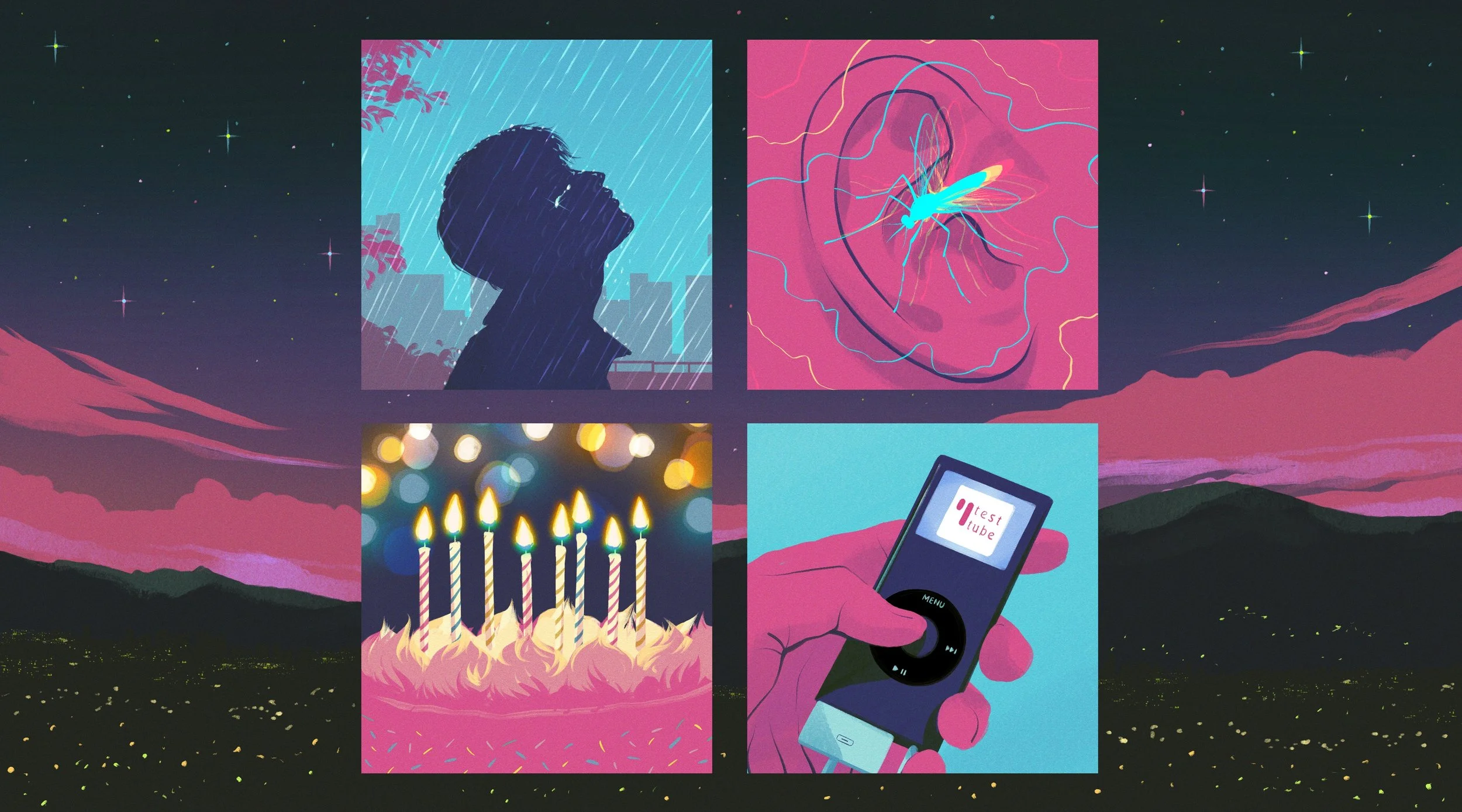
Wesley: The, uh, internet was slower back then. Unzip it, drag it into iTunes, plug in my iPod, and wait for it to sync. Today, I can pull up basically any music instantly on my phone. It's pretty great, but I see that the friction of the Netlabel music created attachment. It cost something. With Netlabels, the cost wasn't money, it was time and care.
Wesley: I wouldn't have bought experimental drone music or noisy lo-fi rave music, or even known that it existed to buy. But when someone like Pedro presented it with care and context, it made me want to give it a chance.
Pedro: The thing about Netlabel music was that it welcomed you to try. At the time I thought I want something for people to explore new territories and, and to give musicians a, a chance.
Wesley: The Netlabel scene only really existed during that short transition from iTunes to modern streamers. In 2008, a platform called Bandcamp launched, which created a really great way for independent artists to release their music online. Spotify gained traction. The Netlabel era, it didn't end dramatically. It just became unnecessary.
Wesley: Nowadays, I usually listen to Apple Music. I love it. The platform has led me to music I genuinely care a lot about, but I find myself sitting with an ambivalence I can't quite resolve.
Wesley: The difference between finding music and music finding me. When tech companies and their algorithms are what decide what we should hear next, something personal is lost.
Wesley: This is why I think Netlabels were special. They were just people who found music they believed in, treated it with care, and passed it along.
Wesley: I’m Wesley Slover. The piece was mixed by Trevor Richardson. Music is from Test Tube Releases by A Sankip Hummad, Lee Rosevere, Tidy Kid, Multi-Panel, Morgan Jenks, and Craque. They’re all still making music, and when I reached out, every one of them responded almost immediately. It was wonderful to see the Netlabel spirit is still alive and well.
Story 2, by Benjamin
Benjamin: Music has long been used as a form of protest. “Yankee Doodle” was an American Revolutionary War protest song. Woody Guthrie and Bob Dylan's careers were largely built on protest songs. The entire blues genre arose as a form of protest.
Benjamin: But there's one song in particular that stands alone in my mind. The song, and the story of how it came to be, is truly fascinating. So let's get into it. This is Kyu Sakamoto's “Sukiyaki.”
Benjamin: Kyu Sakamoto was a crooner in post-war Japan. In 1961, when he was just 19 years old, he released a song called "Ue o Muite Arukō." Hold on, I, I don't think I have that pronunciation just right. Give me a second.
Translation Voice: Ue o Muite Arukō.
Benjamin: Okay, yeah. In 1963, Capitol Records released it as a single in the US, but they changed the original title to “Sukiyaki,” which is the name of a Japanese beef soup. It's an odd name for a song, and it was only chosen because it's a vaguely recognizable Japanese word to the American public. And more importantly, it's easy to pronounce, so it could be requested at radio stations and record shops. And I kinda get it.
Benjamin: Just to be clear, this song has nothing to do with soup. But understand that it has a real title, and it's not “Sukiyaki.”
Benjamin: Anyway, it's June 1963. Sukiyaki is released in the US, and it becomes an immediate hit. It reaches number one on Billboard's Hot 100 chart, and it stays at number one for three weeks. It remains in the Top 10 for the rest of the summer, and by the end of 1963, it was number 10 overall, beating out some other classic songs like “Ring of Fire” by Johnny Cash.
Benjamin: To this day, it is one of the best-selling singles of all time, just a few places behind Whitney Houston's “I Will Always Love You.”
Benjamin: Okay, you get it. It was a popular song. But let's put that into context. This is a Japanese song that is fully 100% in Japanese, and it became the most popular song in the United States? But just 17 years earlier, every person of Japanese descent in the US was imprisoned in internment camps following the Empire of Japan's attack on Pearl Harbor.
Benjamin: Sakamoto himself was born December 10th, 1941, three days after Pearl Harbor. His entire childhood was completely defined by the war, and the atomic bombs, and the fall of the Japanese Empire. And yet somehow he puts out this song that seems to transcend all of that, and GIs returning from the Pacific Theater and their kids are just rocking out to this song for an entire summer.
Benjamin: On one hand, I, I get it. The song is incredibly catchy. It has this upbeat melody countered with this strange melancholic lilt that hints at something deeper hiding in Sakamoto's singing. And then there's the whistling. Oh, man, that whistling is top tier.
Benjamin: Even without speaking any Japanese, it's pretty clear that there's some heavy-duty emotion going on in this song. Here, let, let me translate the first couple lines.
Benjamin: "I look up when I walk, so the tears won't fall. Remembering those happy spring days, but tonight I'm all alone." Oh, man. Kinda sounds like a breakup song, right?
Benjamin: On the surface, it seems like the story of a man maybe shattered by unrequited love. The real inspiration for the song was not the loss of love, but the loss of country. This song was actually written in 1960 by a guy named Rokusuke Ei. He was a friend of Sakamoto, and he wrote the lyrics shortly after walking home from a protest, eh, over something called the Treaty of Mutual Cooperation and Security that was between the United States and Japan.
Benjamin: The treaty, among other things, allowed for a permanent US military presence in Japan. Hundreds of thousands of Japanese citizens were very unhappy with this arrangement, and they assembled in massive protests at the Capitol Building in Tokyo in order to dissuade the government from signing the treaty.
Benjamin: This would later be called the Anpo Struggle. It was in May of 1960 when things got really bad. These protests were very intense. A university student was killed in a clash with the police. President Eisenhower canceled his trip to Japan because of the protests. The Prime Minister of Japan would eventually resign in disgrace as a result of these protests.
Benjamin: Nevertheless, by mid-June, it was clear that things weren't going to change. Rokusuke Ei walked home from the final protest devastated by the outcome, looking up so his tears wouldn't fall. Japan would eventually commit to the treaty, and it remains in place to this very day.
Benjamin: This is some kind of wild high level irony: A protest song with strong anti-US sentiment becoming a smash hit in the US. Moreover, it, it's been used in dozens of films and television shows as a sort of shorthand to indicate either Asian exoticism or American post-war expansion and exceptionalism. The song was famously used in the second season of the show Mad Men to do both, and it is dripping with symbolism.
Benjamin: “Sukiyaki” remains the only Japanese song to ever reach number one in the US charts. It just shows you that heartache is a universal language, and a good song is a good song. Kyu Sakamoto was the only Asian artist to reach the top 100 until just recently with the rise in popularity of K-Pop. Sakamoto's life was incredible. Even his death is very noteworthy, but I don't have time to get into that now.
Benjamin: But I will leave you with this one final note. In 1965, during the 13 days of the Gemini VII mission, NASA transmitted music for the astronauts to enjoy while they worked in a very tiny space capsule, including an instrumental version of “Sukiyaki,” making it one of the first songs heard in space.
Benjamin: And I found a recording of the transmission
Astronauts: Roger Hawaii.
Benjamin: And it's kind of my favorite thing.
Astronauts: Number three solid in Hawaii. Roger Hawaii.
Benjamin: I'm not certain, but I think that's the voice of mission pilot Jim Lovell, who would later command Apollo 13.
Astronauts: Gemini VII Hawaii, CAPCOM.
Benjamin: Dude, every aspect of this song just blows my mind.
Astronauts: Okay, we're a go here on the ground. We're ready for your fuel cell purge. Roger, stand by just one. We're taking an S6 picture now. All righty. We've had a long shot on C-band beacon here. Roger Hawaii.
Benjamin: Well, that's it. I hope you enjoyed. Over and out.
Astronauts: All right, Gemini, I set up for exit plate. Okay, we've got all that. Do you need anything else? No, thank you Okay. This is final controller, just standing by. We need not acknowledge. Thank you.
Benjamin: All right, here are the credits. This is Ben Nimkin. I'm a proud member of the Sound Co-op. Keep your head up. Don't let those tears fall.
[music in: Wesley Slover - Just Facts 06]
After the break, what happens when public sound is weaponized. And, a listener rediscovers a song from his childhood.
[music out]
MIDROLL
Story 3, by Emi
Emi: I'd like to give you a quick hearing test. Ready? I'm going to play a sine wave at five hundred hertz. Depending on your hearing health, you should be able to hear this. Now I'm going to increase the frequency and let you know what is playing as it increases.
Okay, let me chime in for a quick note here… Depending on what you're listening with, your headphones or even your bluetooth signal might not play these super high frequencies. So if you can’t hear all of them, it might be that, and not your ears.
Now, back to the demonstration.
Emi: One thousand hertz, two thousand hertz, four thousand hertz, eight thousand hertz, twelve thousand hertz, fifteen thousand hertz, eighteen thousand hertz, and finally twenty thousand hertz. Hey, that's the name of the show!
Emi: Were you able to hear all the way up to the highest tone? At what point did you stop being able to perceive it? Depending on your answer, I could probably guess your age. The full range of human hearing is twenty to twenty thousand hertz, hence the name of the show. But that's what a person with full hearing is born with.
Emi: Over time, the most sensitive parts of our inner ear required to hear those highest frequencies die off, and the limit to what you can hear is reduced. This is perfectly normal. For example, I'm forty years old, and I can hear to about seventeen thousand hertz, which is actually pretty good for my age. But what if I told you that there's a device that weaponized this phenomenon?
Emi: In order to understand how and why this device exists, I spoke to an expert on the subject.
Cara: So my name is Cara Chellew, and I'm a PhD candidate in Urban Planning, Policy, and Design at McGill University in Montreal.
Emi: Cara just so happens to be my sister-in-law. She's dedicated her life to understanding how public spaces are used and the deterrents put in these places, often known as “defensive urbanism.”
Cara: So “defensive urbanism,” also known as “hostile design” or “unpleasant design,” is an urban design and governance strategy that uses the built environment to guide or restrict people's behavior in urban spaces. So common examples of defensive urbanism are benches that are segmented with a center bar that keeps people from lying down.
Cara: And then another common, uh, example would be actually the removal of public amenities that make public spaces comfortable, like public washrooms, water fountains, and places of shelter and shades.
Emi: Not all forms of defensive urbanism come in the form of physical barriers. Designers in this space have been looking into other means to deter people from using public spaces.
Cara: Sometimes there are interventions that are done, like light to, to make a space uncomfortable, maybe really bright lights, or maybe different colored lights. Also, I remember seeing a story out of the UK where they were installing pink lights to amplify the acne of, of teenagers to keep people from congregating.
Emi: And yes, sound can be used as a deterrent as well. This is where The Mosquito comes into play.
Cara: It was originally developed to, uh, move along teenagers, uh, young people So this device emits a really high-pitched sound that was meant for young ears to hear.
Emi: The Mosquito takes advantage of the fact that as you age, you lose perception of higher frequencies. It does this by emitting a high-pitched whining noise above 16,000 hertz, which will be noticeable by most people under the age of 30. The manufacturer of the Mosquito also provides the option for these devices to emit annoying noises starting at 8,000 hertz, which would affect people in a much larger age range.
Emi: The idea is that by pumping out these targeted annoying sounds, crowds will not want to hang around the area where they are installed.
Cara: And they've been increasingly using it to move out, uh, folks that are homeless from seeking refuge in places like parking garages and in alcoves as well.
Emi: While the device is legal in most areas as it technically doesn't break any noise pollution laws, it has brought forward some questions over where it should be allowed to operate. In 2017, a Mosquito was discovered near McGill Parkette in Toronto, Ontario. Managers of a nearby building installed it, claiming it was used to deter criminal activity.
Cara: News about this device made media headlines at the time, and so it was removed shortly after. It shows that these kind of devices might not actually be totally accepted, and there might actually be some controversial aspects with their use.
Emi: Similar sonic devices are marketed as pest control, a method of keeping away insects and rodents. So should we use the same technology to keep people away from public spaces?
Cara: This is where we learn about others, and other cultures, and how to be with other people in society. And public space is really important because it is a space where we should be all able to access that is free and just how important it is for not only, uh, physical activity, for emotional and mental health, but also for being able to move through the city as well.
Emi: Thanks to Cara for sharing her expertise on this subject. You can find her ongoing document of defensive urbanism in Toronto at defensiveto.org. This short audio story was produced by myself, Proximity Sound. If you enjoyed the story, you might like another podcast I work on called Darknet Diaries: True Stories from the Dark Side of the Internet, hosted by Jack Rhysider.
Emi: The music featured here was also created by my brother, SMBRZ.
And now, the winner of our 2026 Listener Story competition... Story 6, by Ricardo.
Ricardo: Last week, we celebrated my son's first birthday up in Charlotte, North Carolina. My family lives there, so it was the perfect middle point for everyone to meet up. Honestly, it was beautiful. My son got to meet some of his aunts and uncles for the first time. He had a blast playing in his bouncy castle, and I finally got to reconnect with my brother for the first time in over a year.
Ricardo: Around 5:00 PM, everyone gathered around to sing Happy Birthday, and somewhere in the middle of it, I had this weird feeling in my stomach. At first, I thought it was the cheese from the pizza I had earlier, but no, this was different.
Ricardo: My wife's family is Brazilian. The second the singing started, they went fully into their tradition, a loud, chaotic, joyful rendition that separates Brazilians from other Latinos.
Ricardo: My family, we just sang the standard American “Happy Birthday” song. Well, the Spanish version of it. At the time, I didn't think much of it, but during the drive back home to Atlanta the following morning, it finally hit me: Venezuelans have a birthday song too, and it's not some quick little jingle either. It's long, dramatic, emotional, and every Venezuelan knows it by heart. It's called “Ay Que Noche Tan Preciosa,” or “What a Beautiful Night.”
Ricardo: Back in Venezuela, we sang that song at every birthday party, no matter if it was for an uncle who wasn't really an uncle, but earned that title somehow, or for a grandma who had heard it enough times to absolutely hate it.
Ricardo: And trust, there are many Venezuelans who probably cringe at that song, but you had to get through it. No way out. But for the first time in my life, I realized a huge part of my culture didn't happen automatically. And by the way, nobody in my family openly rejected it. Nobody was embarrassed by it. It just didn't happen.
Ricardo: And honestly, it scared me a little, realizing how easy it is for things like this to slowly disappear, not through some dramatic moment, but through the small cracks that are too hard to notice until it's too late. Little habits changing over time until one day, you realize something that used to feel instinctive now requires intention.
Ricardo: When I got home, I grabbed my guitar and played the song too many times until my wife told me to please stop. So I decided to do some research about this Venezuelan cultural phenomenon that was so ingrained in my memory, but that I didn't really know much about. So I got on WhatsApp and messaged my family members, asking questions, sharing memories, and trying to piece together the history of the song.
Ricardo’s Mom: Para los Venezolanos, yo creo que es algo como icónico, es como un himno nacional, y no sabes de dónde viene ni sabes por qué, pero siempre lo tienes que cantar cuando tienes un cumpleaños, y quizás ahora, como-
Ricardo: My mom was basically saying that for Venezuelans, the song feels almost like a national anthem. Nobody really questions where it came from. You just grow up knowing that when there's a birthday, you sing it.
Ricardo’s Aunt: Yo formé parte del grupo de Luis Cruz, y allí me enteré que él era el autor de esa canción. Y además después con ellos, con Los Naipe, la canté muchísimo.
Ricardo: That was my aunt, Mirta Pérez, who's honestly a legend in Venezuelan music. She completely blew my mind when she told me she had actually worked and recorded music alongside Luis Cruz, the original composer of “Ay Que Noche Tan Preciosa.” At that point, the song stopped feeling like just a childhood memory. A barrage of emotions hit me like a truck, because suddenly I wasn't just hearing a birthday song anymore.
Ricardo: I was back at my grandma's apartment in Caracas, leaning out of the window, trying to find the ice cream truck through echolocation. I was thinking about my dad surprising me at school for Father's Day and sitting there drawing pictures of trucks with me. I was reminded of the handmade decorations my mom would spend hours making for my ridiculous birthday party themes. My mom was, and still is, a construction paper savant.
Ricardo: I think Latinos, especially those in the US, usually think about culture through the big things: food, language, soccer teams. But lately, I've been thinking about the smaller things, fragile things, the traditions that only survive if somebody consciously keeps repeating them. Becoming a father has made that feel very real to me.
Ricardo: The memory of “Ay Que Noche Tan Preciosa” made me realize that my son is not automatically going to inherit the emotional connection I have to these traditions just because he's half-Venezuelan. That only happens if I pass them down. One day, when his cultural ambiguity phase inevitably shows up, I hope those memories help him understand that he doesn't have to choose between parts of himself, that it's okay to love grits, arepas, and coxinhas equally. And maybe years from now, he'll hear that song from another room and immediately feel home.
Ricardo: This story was written, produced, and sound designed by me, Ricardo Ramirez. Special thanks to my family and to my wife Gabby and my son Felipe. Find more of my work at rezsounds.com.
[music in: Wesley Slover - Sandra Robot]
Twenty Thousand Hertz is produced out of my sound agency, Defecto Sound. Hear more by following Defacto Sound on Instagram, or by visiting Defacto Sound dot com.
Ricardo: This episode was written and produced by the incredible listeners of Twenty Thousand Hertz.
Other Voices: It was story edited by Casey Emmerling, with help from Grace East. It was sound designed and mixed by Jade Dickey, with original music by Wesley Slover.
Thanks to everyone who submitted a story this year. It’s clear how much thought and care you all put into these pieces, and I am so honored that you’d share them.
Finally, subscribe to my Youtube channel Dallas Taylor dot mp3. Over there, audio professionals take inside their creative spaces to show me what they do and how they do it. You can also find the bite sized versions on Instagram and TikTok under that same name, Dallas Taylor dot mp3.
Thanks for listening.
[music out]